

More news on this day
Hundreds of flights across the Middle East were canceled on March 2 as airspace closures over the Gulf forced airports in the United Arab Emirates and Qatar to halt commercial operations, severing critical links between Europe, Asia and Africa and unleashing the worst bout of global travel chaos since the pandemic.
Gulf Hubs Go Dark as Airspace Remains Closed
By Monday, March 2, Dubai, Abu Dhabi and Doha had effectively fallen off the global aviation map, with authorities confirming that commercial services at the region’s main hubs remained suspended amid escalating military tensions involving the United States, Israel and Iran. Notices to airmen covering Iran, Iraq, Israel, Syria, Kuwait, Qatar, Bahrain and the UAE have created a broad no-fly belt across the heart of the Middle East, leaving airlines with few safe corridors.
Dubai International, normally the world’s busiest international airport, closed along with Dubai World Central, Sharjah and Ras Al Khaimah airports, as the UAE’s civil aviation regulator ordered a nationwide airspace shutdown. In Qatar, Hamad International Airport halted all commercial traffic after Qatari airspace was closed, leaving Qatar Airways unable to operate even short regional hops.
Data from flight tracking services showed thousands of flights delayed or canceled globally over the weekend and into Monday as carriers scrambled to reroute away from the Gulf and surrounding conflict zones. Aviation analysts said the pattern resembled the early days of the Covid-19 crisis, but this time driven by security concerns rather than public health restrictions.
Officials and airline executives warned there was still no clear timeline for a full reopening of the skies, with aviation authorities expected to reassess only once the intensity and direction of regional strikes became clearer in the coming days.
Flag Carriers Emirates, Etihad and Qatar Airways Ground Fleets
The shutdown has hit the Gulf’s flagship airlines at the core of their business models, which depend on funneling long haul passengers through Dubai, Abu Dhabi and Doha. Emirates said it had suspended all flights to and from Dubai until at least mid afternoon on March 2, citing multiple regional airspace closures and ongoing coordination with authorities.
Etihad Airways halted all departures from Abu Dhabi and announced the suspension of flights to and from Zayed International Airport into the early hours of Monday, warning that aircraft and crews were now badly out of position. Sharjah based low cost carrier Air Arabia also stopped operations to and from the UAE, while flydubai confirmed a blanket halt on its Dubai flights through at least Monday afternoon.
In Qatar, Qatar Airways confirmed that its operations remain temporarily suspended because of the closure of national airspace and said flights will resume only once the aviation regulator declares it safe to do so. The carrier promised a further update on March 2, but industry observers said restarting such a complex operation would take time even after restrictions are lifted.
The cancellations have rippled far beyond the Gulf. European, Asian and Australian airlines that rely on overflight permissions through the region have axed or diverted services, adding hours to itineraries and forcing last minute crew and fuel planning changes. Aviation consultants said the concentration of high capacity long haul fleets in the UAE and Qatar meant the impact on global seat supply was immediate and severe.
Passengers Stranded From Delhi to London
The closures have left tens of thousands of travelers stranded on multiple continents, as aircraft and crews are trapped on the wrong side of the Middle East. At major origin and transit airports from Delhi and Mumbai to Frankfurt, London and Sydney, departure boards on Monday were dominated by cancellations for Dubai, Abu Dhabi and Doha, along with a growing number of long haul flights that would have used Gulf airspace.
Indian carriers were among the first to formally extend suspensions. Air India canceled services to and from the UAE, Saudi Arabia, Israel and Qatar through late on March 2 and warned of additional disruptions on selected European routes whose flight plans depended on Middle East corridors. IndiGo introduced broad curbs on flights touching West Asia and on other international routes that would typically overfly the Gulf, directing passengers to check dedicated cancellation lists.
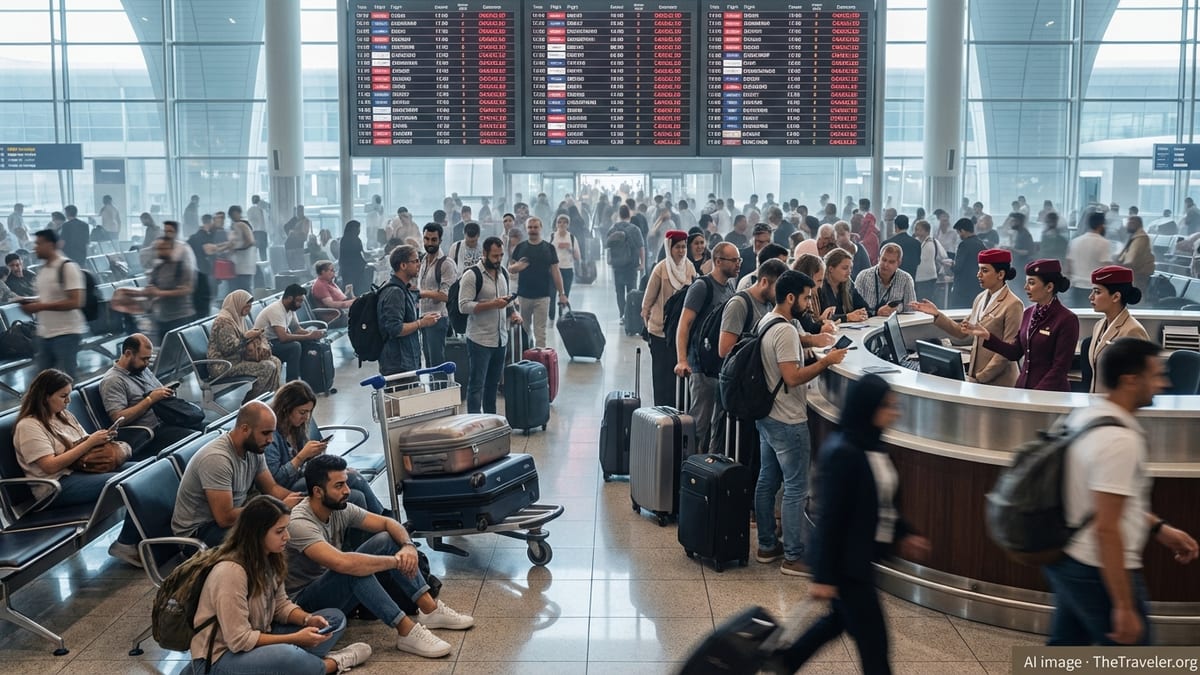
On the ground, scenes at terminals recalled the worst travel days of recent years: long lines at rebooking counters, families sleeping on the floor near closed gates, and queues forming at information desks where staff struggled to offer definitive answers. While some travelers have managed to secure seats on alternative routings via Central Asia or southern Mediterranean corridors, many more have been told to expect multi day delays as airlines work through backlogs.
Tour operators reported a wave of last minute holiday cancellations into the UAE and Qatar, while corporate travel managers scrambled to shift meetings online or find circuitous itineraries for critical staff. With uncertainty over when normal services will resume, some businesses have imposed temporary bans on non essential travel anywhere near the affected region.
Economic Shock for Global Aviation and the Gulf
The aviation shutdown comes as a sharp economic shock for Gulf states that have built their diversification strategies around becoming global aviation and tourism hubs. Dubai and Doha in particular rely heavily on transfer traffic and high yielding premium passengers connecting between Europe, Asia, Africa and Australasia. Every day of closures means lost revenue for airlines, airports, hotels, retailers and service providers that cluster around the hubs.
Analysts noted that the disruption is hitting just as global air travel had largely recovered from the pandemic downturn. With aircraft once again flying at near full capacity on many long haul routes, there is less slack in the system to absorb a sudden closure of a key region. Some airlines may be forced to cut frequencies elsewhere to free up aircraft and crews for longer detours that avoid the Middle East.
Freight operators are also feeling the strain. The Gulf has become a central artery for high value cargo moving between Asia and Europe, from electronics and pharmaceuticals to fashion and automotive components. Rerouting freighters around the closed airspace adds hours of flight time and thousands of dollars in extra fuel costs per rotation, costs that are likely to be passed on through higher shipping rates and ultimately consumer prices.
In the Gulf itself, authorities have moved to reassure residents and visitors that basic supplies are secure and that contingency plans are in place for essential imports. Officials in the UAE reiterated that strategic reserves of food and fuel are sufficient and urged the public not to stockpile, even as some residents reported queues at supermarkets and petrol stations over the weekend.
Uncertain Timeline and Shifting Travel Advice
For now, the only certainty for travelers is uncertainty. Airlines across the world are updating schedules in rolling batches as they await clarity from military and aviation authorities on which portions of the region’s skies might reopen and under what conditions. Carriers have introduced temporary waivers allowing passengers booked on affected flights to rebook without fees or request refunds, but the volume of change requests is overwhelming call centers and online support channels.
Travel advisers are urging passengers with itineraries routed through the UAE or Qatar in the coming days to monitor airline channels closely, avoid heading to the airport without confirmed rebookings, and consider alternative routings that bypass the Gulf entirely, even if they involve longer flying times. Some governments have updated travel advisories to warn against non essential trips to affected countries or through their airspace.
With the regional conflict still evolving and military activity continuing, aviation regulators have signaled that safety will dictate the pace of any reopening. Even once airspace restrictions are eased, airlines will need to reposition aircraft and crews, clear backlogs of stranded passengers and restore complex wave based schedules at their hubs.
Industry executives privately acknowledge that the shock of a near total shutdown of Gulf airspace is likely to reshape network planning long after the immediate crisis passes, as carriers weigh the efficiency of traditional Middle East routings against the geopolitical risks that have abruptly come into focus.