

More news on this day
Thousands of passengers across the Middle East are facing extensive disruption as airlines including Gulf Air, Qatar Airways, Malaysia Airlines, EgyptAir and flydubai suspend or delay hundreds of flights following renewed airspace closures and security concerns over parts of the Gulf region.
Get the latest news straight to your inbox!
Airspace Closures Trigger Wave of Cancellations
Published coverage across regional and international outlets indicates that recent military escalations and associated airspace restrictions have sharply reduced normal flight operations over key Gulf corridors. Authorities in several states have closed or tightly limited access to upper airspace used for long-haul routes between Europe, Asia and Africa, forcing airlines to ground aircraft or adopt lengthy detours.
Aviation data referenced in regional newspapers shows that, over a span of several days, at least 272 flights involving major carriers serving the Gulf were cancelled, with more than 200 additional services delayed. The figure spans both point to point routes within the Middle East and long haul connections that typically transit hubs such as Doha, Dubai and Abu Dhabi.
Network carriers such as Qatar Airways and Gulf Air, along with EgyptAir, Malaysia Airlines, flydubai and other operators, have announced wide ranging schedule cuts or temporary suspensions on select routes as they reassess risk profiles and await clearer guidance on airspace availability. Publicly available timetable updates suggest that many services remain either cancelled or operating on significantly revised timings.
Flight tracking platforms show unusually sparse traffic over parts of the Gulf, with numerous aircraft diverted south over Saudi Arabia and Oman or rerouted via alternative corridors that avoid restricted zones. These workarounds add substantial flying time, contribute to congestion in open airspace and have knock-on effects for subsequent rotations.
Major Hubs From Manama to Doha and Dubai Hit Hard
The knock on impact has been most visible at major regional hubs. In Bahrain, operations at Manama’s primary airport have been repeatedly disrupted, with Gulf Air and other carriers consolidating departures and arrivals or shifting aircraft positioning flights to alternative gateways when feasible.
In Qatar, publicly available information shows that Doha’s Hamad International Airport has seen a sharp reduction in departures and arrivals as Qatar Airways pares back its schedule in response to temporary airspace closures. Many passengers connecting between Europe, Africa and Asia through Doha have been left waiting for rebooking options, with some itineraries pushed back by several days.
Dubai International and Dubai World Central have also experienced a dramatic fall in movements. Reports from regional outlets describe a period in which the overwhelming majority of flights were cancelled, followed by a gradual and partial resumption of services by Emirates, flydubai and a limited number of foreign carriers operating on modified routings. Even as some flights return, extended ground times and crew scheduling challenges continue to generate delays.
Abu Dhabi’s main airport, another critical transfer point for travel between continents, remains affected by the same constraints. While some services have restarted on restricted paths that route south of the most sensitive areas, capacity remains well below normal levels, and passengers are advised through public notices to expect irregular operations for the foreseeable future.
Ripple Effects Reach Fujairah and Secondary Gateways
The turbulence is not limited to flagship airports. Smaller but strategically important gateways around the Gulf, including Fujairah, Sharjah and regional airports in Saudi Arabia and Oman, have become integral to revised operating plans. Some airlines are repositioning aircraft and running limited services through these secondary hubs to circumvent closures affecting their traditional routes.
Fujairah, located on the Gulf of Oman coast, has been cited in regional coverage as a potential relief point for cargo and select passenger operations seeking to avoid congested or closed airspace nearer the Strait of Hormuz. While overall passenger volumes there remain far lower than in Dubai or Abu Dhabi, any uptick in operations places added pressure on local infrastructure and ground handling capacity.
Airlines that normally rely on seamless overflight permissions across multiple Gulf states are now engaged in complex daily replanning. Schedules for carriers like Malaysia Airlines and EgyptAir, which depend on transiting the region for long haul links between Asia, the Middle East and Europe or Africa, show repeated timing adjustments as they weave around the evolving pattern of airspace restrictions.
These changes are also affecting airports outside the immediate conflict zone, including hubs in South Asia and Europe where aircraft and crews arrive off schedule, causing missed connections and forcing terminal operators to manage irregular passenger flows well beyond the Middle East.
Stranded Passengers Face Long Waits and Limited Options
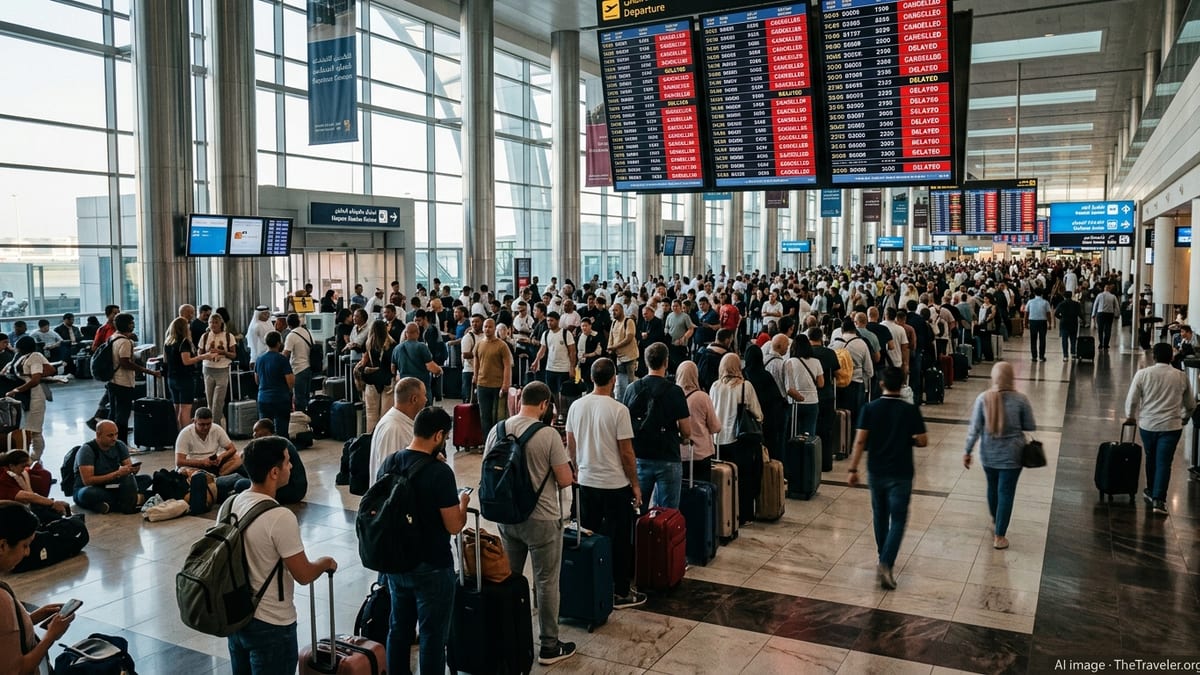
For travelers caught in the disruption, the most immediate impact is uncertainty. Social media posts, airline app notifications and accounts compiled in consumer travel forums describe passengers sleeping in terminals in Manama, Doha, Dubai and Abu Dhabi as rolling cancellations and delays accumulate. Some report being rebooked multiple times as operating plans shift day by day.
Publicly available guidance from airlines across the region advises passengers not to proceed to the airport without a confirmed, operating flight, and to rely on official apps and status pages for real time updates. Yet high call volumes and website traffic have made it difficult for many to secure clear information or alternative arrangements, particularly during peak disruption periods.
Travelers with complex itineraries involving multiple carriers are experiencing some of the longest delays, as re-ticketing across alliance or codeshare partners depends on seat availability on rerouted services. With capacity constrained and safety considerations driving conservative scheduling, spare seats on outbound flights from Gulf hubs remain limited.
Passenger rights and compensation frameworks also vary by departure and arrival country, leaving many travelers unsure of their entitlements regarding hotel accommodation, meal vouchers or refunds. Consumer advocates in the region are urging passengers to retain documentation of cancellations and delays to support later claims once immediate disruptions ease.
Uncertain Timelines for Full Recovery
Industry observers note that even if airspace restrictions are eased in the near term, full normalization of schedules will take time. Aircraft and crews are currently out of position across multiple continents, and airlines will need several days, if not weeks, to rebuild stable rotations once primary routes reopen.
Recent experience from previous regional airspace closures suggests that carriers will initially focus on restoring trunk routes linking major hubs, followed by secondary destinations as resources allow. Travelers connecting via Manama, Doha, Dubai, Abu Dhabi and Fujairah can therefore expect a phased restoration of frequency rather than an immediate return to pre disruption timetables.
Aviation analysts quoted in open media have emphasized that safety considerations will remain paramount. Even as some carriers test revised routings that skirt restricted zones, a cautious approach is likely to persist, with additional flight time and fuel burn accepted as the cost of maintaining safe separation from any active conflict areas.
For now, publicly available information from airlines, airports and aviation data providers points to a prolonged period of irregular operations across the Gulf and adjacent regions. Travelers planning to transit the Middle East in the coming days are being advised through official channels to build in generous connection buffers, remain flexible on dates and routings, and monitor status updates closely as the situation evolves.