

More news on this day
Thousands of passengers across the Middle East and beyond are facing major disruption as regional airspace restrictions trigger the cancellation of at least 328 flights and delays to more than 1,100 services, affecting operations at key hubs including Dubai, Abu Dhabi, Doha, Istanbul, Cairo and Muscat.
Get the latest news straight to your inbox!
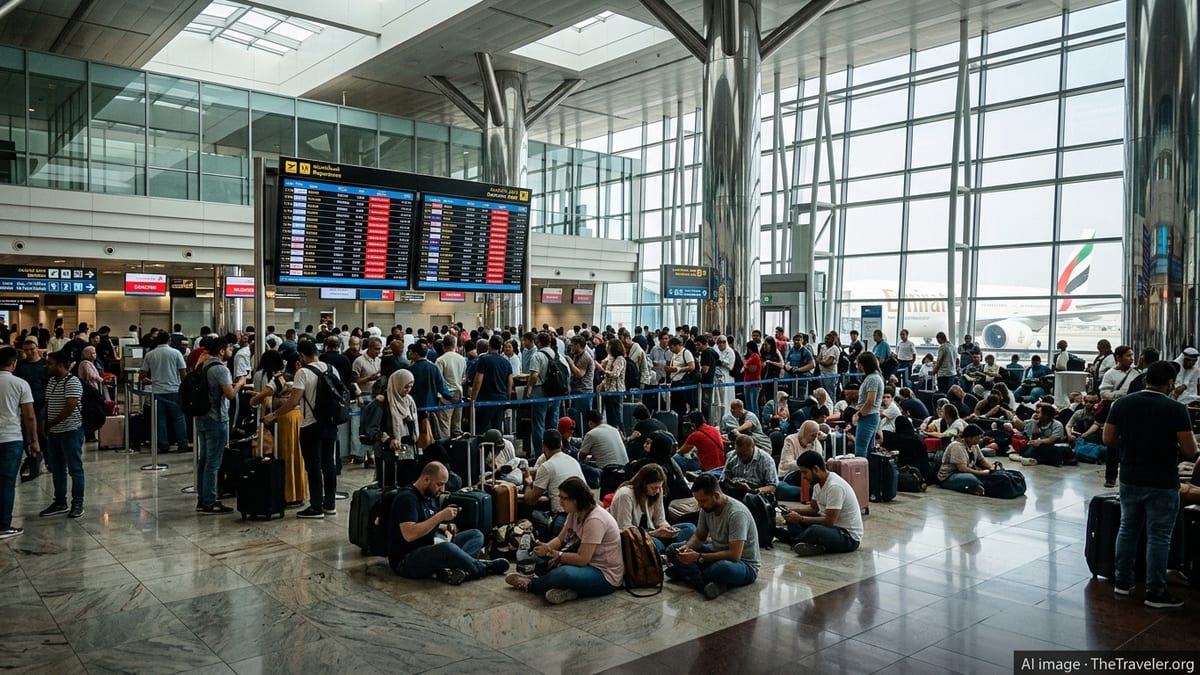
Regional Airspace Closures Ripple Across Major Hubs
Publicly available operational data and airline advisories indicate that parts of the airspace over the United Arab Emirates, Qatar, Bahrain and sections of neighboring countries remain restricted or intermittently closed, forcing carriers to ground or reroute services. The knock-on impact is being felt across the wider Middle East and Eastern Mediterranean, with schedules into Saudi Arabia, Turkey and Egypt also affected.
Airline and airport status boards show that a combined 328 flights have been cancelled and 1,155 delayed over a 24 to 36 hour period, as carriers adjust to constrained corridors and shifting overflight permissions. The figures cover a wide mix of long-haul and regional routes, including high-density connections linking Europe and Asia via Gulf hubs.
In Dubai and Abu Dhabi, where normal operations depend heavily on overflight access to neighboring states, traffic patterns have become irregular, with clusters of cancellations followed by limited waves of departures as windows briefly open. Similar disruption is reported in Doha, Muscat and Bahrain, while Istanbul and Cairo are absorbing diverted and rescheduled services that would typically track more direct routes through Gulf airspace.
Observers note that the current wave of cancellations and delays builds on weeks of intermittent restrictions in the region, leaving airlines to repeatedly redraw their networks and timetables in response to evolving operational and security assessments.
Emirates, Saudia, EgyptAir and Gulf Carriers Slash and Reroute Flights
The disruption has hit major Middle Eastern and international airlines that rely on the region’s hub-and-spoke model. Emirates and flydubai have curtailed parts of their schedules, with reduced frequencies and last-minute timetable changes on key trunk routes. Public updates from regional aviation bulletins indicate that Etihad in Abu Dhabi is also operating with a slimmed-down schedule as it works around restricted corridors.
EgyptAir services through Cairo and Saudia flights via Riyadh and Jeddah have likewise reported cancellations and extended delays on routes threading through affected airspace. Some departures are operating on significantly longer routings, increasing flying time and complicating crew and aircraft rotations.
Gulf Air has been particularly constrained by the closure of Bahrain’s airspace, with regular operations at Bahrain International Airport largely suspended and select services temporarily transferred to Saudi Arabia’s Dammam airport. According to published travel advisories, the carrier has been mounting limited commercial flights from Dammam to major destinations while awaiting a full reopening of its home hub.
Qatar Airways and other carriers based in Doha are operating a patchwork of limited flights and relief services where corridors are available, but many regular commercial rotations remain grounded. Across the region, airlines are cycling between cancellation, delay and rebooking as they attempt to align schedules with rapidly shifting regulatory and airspace conditions.
Dubai, Istanbul, Cairo and Muscat Struggle With Stranded Passengers
At the passenger level, the most visible impact has been in crowded terminals and extended waits in Dubai, Abu Dhabi, Istanbul, Cairo and Muscat. Social media posts and traveller forums describe long queues at transfer desks, boarding gates repeatedly updating from “on time” to “delayed,” and, in many cases, same-day cancellations following hours of uncertainty.
Reports from Dubai and Abu Dhabi suggest that many travellers have been advised not to proceed to the airport unless their flights are explicitly confirmed, as limited departures are often reserved for passengers already in transit or those previously offloaded from earlier cancelled services. This pattern has created a backlog of travellers across regional hotels and short-term accommodation as people wait for confirmation of alternative routing.
In Istanbul and Cairo, which sit on the fringe of the main Gulf airspace closures, airport operations remain more stable but are still feeling the strain of diversions and rerouted long-haul services. Additional feeder flights are competing for constrained departure slots, and some aircraft are arriving heavily delayed after flying extended detours around restricted zones.
Further east and south, airports in Muscat and Dammam have taken on an outsized role as staging points for ad hoc services operating around the disruption. Travellers report complex itineraries involving overland transfers between cities, overnight layovers and multi-stop routings through secondary hubs that would normally not feature on standard Middle East itineraries.
Knock-On Effects for Global Connections and Cargo
The flight disruption is not limited to point-to-point travel in the Middle East. Because Gulf hubs serve as critical connectors between Europe, Africa, Asia and Oceania, cancellations and delays in the region are rippling through global networks. Passengers travelling between cities such as London and Bangkok, Paris and Johannesburg, or New York and Delhi are experiencing missed connections, forced rerouting and, in some cases, multi-day delays.
Published analyses from logistics providers indicate that air cargo flows are also under pressure. Many freighter and belly-hold flights normally transiting the Gulf are being rerouted through longer southern or northern corridors, increasing flight times and constraining available capacity. Time-sensitive shipments in sectors such as pharmaceuticals, automotive parts and electronics are facing extended transit times and higher costs.
Airlines are attempting to prioritize certain long-haul and high-yield sectors when allocating scarce operational slots, which can leave secondary regional routes more exposed to cancellation. This triage approach, while rational from an operational standpoint, further complicates recovery for travellers based in or flying to smaller markets that depend on Gulf hubs for connectivity.
Industry observers note that if airspace restrictions persist or tighten further, knock-on effects could deepen, with crew availability, aircraft maintenance cycles and airport congestion becoming increasingly difficult to manage across multiple continents.
What Travellers Are Being Advised to Do
Across official airline channels and widely shared travel advisories, passengers are being urged to closely monitor their booking status and not rely solely on original itineraries. Many carriers in the region are allowing free date changes, waiving some change fees, and offering refunds where flights have been cancelled, although implementation can vary by route and ticket type.
Travel forums and consumer travel sites emphasize the importance of checking flight status directly through airline apps or websites before leaving for the airport. Because schedules are changing at short notice, a flight that appears as “scheduled” several hours ahead can still be delayed, rerouted or cancelled as airspace conditions evolve.
Passengers already stranded in transit hubs are being encouraged, through publicly available guidance, to work through official airline channels to secure rebooking or alternative routings, even if that involves circuitous journeys through less affected hubs. Travel insurance providers are also reminding policyholders to review coverage terms for disruption related to airspace closures and security incidents.
While there are tentative signs of partial reopening in some corridors, analysts caution that a full return to normal operations across the UAE, Qatar, Bahrain, Saudi Arabia, Turkey and neighboring states is likely to be gradual. For now, travellers with imminent plans to transit the region are being advised to build in additional time, remain flexible and prepare for the possibility of short-notice changes to their journey.