

More news on this day
Hundreds of travellers moving to and from Saudi Arabia have had their plans disrupted this week, as at least 33 flight cancellations and 18 significant delays were recorded across Riyadh, Jeddah, Dammam and Medina, with Gulf Air, Qatar Airways, KLM and several other international carriers adjusting schedules in response to wider Middle East airspace restrictions.
Get the latest news straight to your inbox!
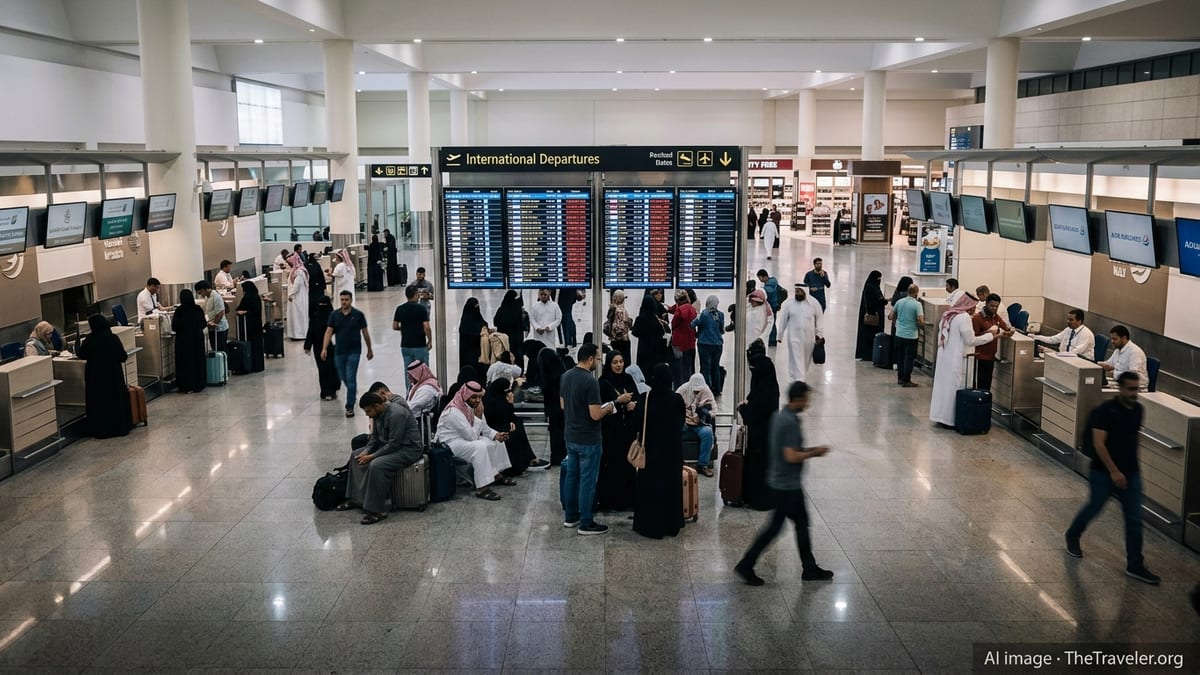
Regional Tensions Ripple Across Saudi Arabia’s Key Gateways
Publicly available operational updates and industry summaries indicate that the latest wave of disruption is closely tied to the evolving security situation in the Gulf region, which has led to partial airspace closures, rerouting of long-haul services and a reduction in frequencies on some trunk routes. While Saudi airspace and airports remain generally open, adjustment of regional flight paths has introduced knock-on impacts for departures and arrivals serving the kingdom’s main hubs.
Specialist logistics briefs summarising the Middle East situation describe Saudi Arabia’s major airports as operational but subject to “open or limited” status, with Riyadh, Jeddah and Dammam highlighted as experiencing schedule pressures due to regional airspace restrictions and rerouted traffic. In practice, this has translated into a pattern of day-to-day cancellations, rolling delays and aircraft being repositioned through alternative hubs.
Travellers using these Saudi gateways over the past several days have reported late-notice schedule changes, especially on itineraries that normally transit other Gulf states. The impact has been felt across both business and leisure segments, as well as among religious travellers using Jeddah and Medina as primary entry points for Umrah.
Gulf Air, Qatar Airways, KLM and Others Trim and Reroute Services
According to recent airline communications, multiple carriers serving Saudi Arabia have been forced to trim their schedules or reroute services around the region’s most affected air corridors. Gulf Air and Qatar Airways, which typically rely on dense networks across the Gulf, have adjusted frequencies and in some cases shifted passengers onto alternative routings or partner airlines to maintain connectivity.
Posts from affected passengers and travel trade notices indicate that Qatar Airways, in particular, has been operating with a reduced schedule while also setting up limited special flights and emergency corridors. Some traffic that would usually connect via Doha has temporarily been moved to or from Saudi airports such as Riyadh and Dammam, adding extra strain on ground operations and available slots.
KLM and other European and Asian carriers have also been impacted where their normal routings intersect with constrained airspace. Flight-tracking data and passenger accounts show that several long-haul flights have been cancelled outright on certain days, while others have operated with extended detours that increase flight time and contribute to arriving and departing aircraft missing their scheduled slots in Saudi Arabia.
Riyadh, Jeddah, Dammam and Medina See Uneven but Persistent Disruption
Operational information reviewed by TheTraveler.org suggests that disruption has not been evenly distributed across the kingdom’s airports. Riyadh and Jeddah, as the country’s busiest international hubs, have seen the highest absolute number of cancellations and delays, particularly on services connecting to Doha, Dubai, Abu Dhabi and major European capitals.
Riyadh’s King Khalid International Airport has remained open with regular domestic and international operations, yet a subset of flights has been withdrawn from the schedule or retimed at short notice. Travellers on regional routes report that some sectors that previously offered multiple daily frequencies are temporarily reduced, making rebooking more complex when a flight is cancelled.
In Jeddah and Dammam, passengers have described a mix of normal operations and sudden cancellations, with some journeys between Saudi cities themselves also affected when aircraft or crews fail to arrive on time from earlier disrupted legs. Medina, which handles a heavy share of religious travel, has reported fewer cancellations overall but has still experienced notable delays on specific days when regional traffic has been rerouted or when connecting flights through Gulf hubs have failed to materialise.
Travellers Face Rebookings, Long Delays and Shifting Guidance
The pattern of 33 cancellations and 18 delays recorded across recent days has resulted in a wave of rebookings as airlines work within tightened operational windows. Public comments from passengers and travel intermediaries describe long hours spent in call queues, repeated itinerary changes and, in some cases, last-minute moves to alternative airlines at higher fares in order to maintain critical travel plans.
Qatar Airways has circulated updated passenger guidelines for journeys originally scheduled during the core disruption period, outlining options for refunds, date changes and rerouting via different carriers or gateways where space is available. Travellers report that these policies, while offering additional flexibility, still require persistence as availability fluctuates rapidly whenever new cancellations are loaded into reservation systems.
Similar patterns are visible for other Gulf-based airlines, with some passengers indicating that they were transferred to services operated by partner carriers or rerouted via less congested hubs such as Riyadh, instead of their usual Doha or Dubai connections. The resulting itineraries can involve longer total travel times, overnight layovers or additional visa and entry considerations, especially for those transiting via third countries.
Advice for Passengers Planning Imminent Travel via Saudi Hubs
Given the fluid nature of the regional airspace situation, publicly available advisories from airlines and specialist logistics providers consistently recommend that passengers remain prepared for potential last-minute changes. For those scheduled to fly to or from Riyadh, Jeddah, Dammam or Medina over the coming days, careful monitoring of airline apps and email notifications is essential, as many cancellations have reportedly been communicated only 24 to 72 hours before departure.
Travel experts commenting in public forums suggest building additional buffer time into itineraries, especially when connecting onward to long-haul flights, and considering alternative entry or exit points in the region where feasible. Some travellers with short-haul domestic sectors within Saudi Arabia have opted for rail or road options between cities such as Riyadh and Dammam to avoid the risk of further flight disruption.
With airspace conditions and airline schedules still in flux, most observers expect an extended period of irregular operations before full normality returns. For now, Saudi Arabia’s major airports continue to function as critical gateways for travellers navigating an increasingly complex Gulf aviation landscape, but with a higher-than-usual likelihood of cancellations, delays and last-minute route changes.