

More news on this day
Escalating conflict across parts of the Middle East has triggered sweeping airspace closures and flight disruptions in Qatar, Saudi Arabia, the United Arab Emirates and Iraq, pushing South Africa into the same turbulent travel landscape now confronting India, Germany, the United Kingdom, Singapore, Nigeria, Thailand and other major markets that rely on Gulf hubs for medical travel and long-haul connectivity.
Get the latest news straight to your inbox!
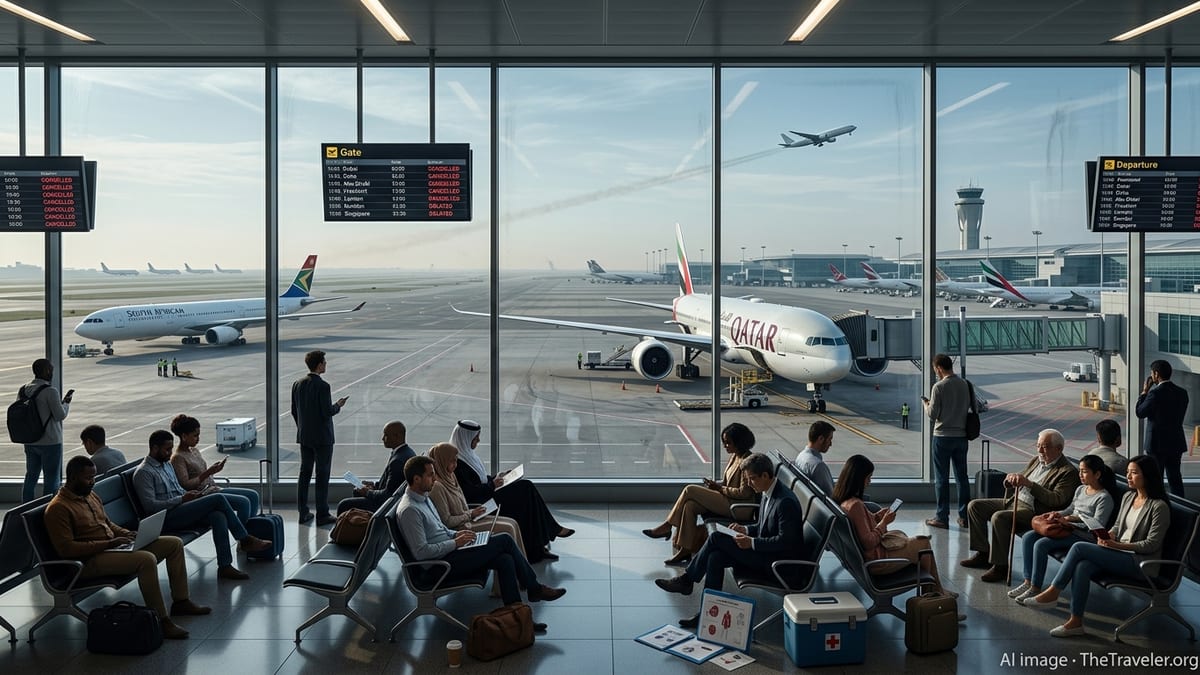
Middle East Conflict Closes Skies And Chokes Key Transit Hubs
Publicly available aviation data and security assessments show that, since late February 2026, airspace over Iran, Iraq, Qatar, Bahrain, Kuwait, Israel and much of the wider Gulf has been closed or heavily restricted following a sharp escalation in the conflict involving Iran, the United States and regional states. Airlines have responded with mass cancellations, emergency diversions and wide detours around the affected zone, effectively emptying what was one of the world’s busiest east–west aviation corridors.
Reports from flight-tracking platforms highlight that the traditional high-altitude route over Iraq, long described as an air “superhighway” between Europe and Asia, has thinned to a fraction of normal volumes as carriers shift north through the Caucasus, or far south via the Red Sea and East Africa. This redirected traffic is lengthening many intercontinental journeys by two to five hours, burning more fuel and slashing the effective capacity on already busy long-haul networks.
Gulf hubs such as Doha, Dubai and Abu Dhabi, normally prized by African, European and Asian travellers for their frequency and global reach, have been operating under severe constraints. Industry updates indicate that leading Gulf carriers have cut large portions of their schedules on short notice and warned of further changes as missile and drone incidents periodically disrupt airport operations and trigger fresh safety reviews.
South Africa Feels The Shock As Gulf Links Falter
South Africa’s reliance on Gulf carriers as a bridge to Europe, North America and large parts of Asia has left its tourism and business travel sectors highly exposed. Coverage in regional travel media records that flights between South African cities and major Middle East hubs were among those disrupted in the final days of February, with passengers urged to verify bookings before travelling to the airport and to anticipate rolling schedule changes.
Travel advisories circulated in early March by South African tourism bodies and industry associations emphasised that the interruption of Emirates and Qatar Airways services is particularly acute. These airlines collectively carry a significant share of South Africa’s long-haul passenger and cargo traffic, and they underpin the country’s connections to secondary European and Asian destinations that are not always served directly from Johannesburg or Cape Town.
Logistics briefings targeting South African shippers describe a similar pattern on the cargo side, noting that constraints on Emirates, Qatar Airways and Etihad have complicated airfreight routes to Europe and Asia. Freight planners are being encouraged to consider alternative routings via African and European hubs, although these options often involve higher costs, reduced capacity and longer transit times, adding pressure to supply chains already dealing with global shipping volatility.
India, Germany, UK, Singapore And Others Grapple With Rerouting
South Africa’s predicament is mirrored in other key outbound and transit markets that traditionally lean on Middle East hubs. In India, national media report that hundreds of flights have been cancelled or rerouted as carriers avoid restricted airspace, affecting not only Gulf sectors but also onward services to Europe and North America. The closures come on top of existing challenges related to other regional airspace restrictions, compounding delays and raising operating costs for Indian airlines.
European states including Germany and the United Kingdom are contending with the loss of a central east–west corridor at the same time as they continue to bypass Russian airspace on most routes. Industry analysis highlights that this double constraint is forcing airlines to crowd into a handful of remaining corridors, such as paths over Turkey, the Caucasus and parts of North Africa, intensifying congestion and stretching crew and fleet resources.
In Asia, Singapore and Thailand stand out as both affected markets and relative beneficiaries. While travellers from these countries face longer journeys and schedule uncertainty on services that once used Gulf hubs or overflew Iraq and Iran, some regional carriers have been able to market themselves as more stable alternatives by offering northern or intra-Asian routings that bypass the conflict zone. Tourism commentators suggest that this may temporarily boost Southeast Asia’s role as a staging point for Europe–Asia itineraries.
Nigeria and other African markets that rely on connections through Doha, Dubai and Abu Dhabi are also experiencing disruption, particularly for passengers heading to secondary European cities or to Asia-Pacific destinations. In many cases, travellers are being rebooked via Addis Ababa, Nairobi, Cairo or European hubs, increasing journey times and constraining seat availability during peak travel periods.
Medical Travel And Health Tourism Caught In The Crossfire
Beyond leisure and corporate trips, the turmoil is rippling through global medical travel. West Asia and the Gulf region function as critical transit points for patients from Africa and South Asia seeking specialised treatment in India, Europe or Southeast Asia. Reports from Indian business media indicate that hospitals and facilitators are already seeing delays and cancellations from international patients who cannot secure timely flights, particularly from conflict-adjacent countries where air links have been sharply curtailed.
India’s position as a major supplier of pharmaceuticals to Iran and other Middle Eastern markets is adding another layer of complexity. Shipping and aviation detours around conflict-affected areas are lengthening delivery times and increasing insurance and logistics costs, creating concern among exporters and importers that critical medicines could face bottlenecks if the situation persists.
South Africa, which has been steadily developing its own regional medical tourism offering in areas such as oncology, elective surgery and specialised diagnostics, depends on stable long-haul links to attract high-value patients from other African states and beyond. As flights through Qatar, Saudi Arabia, the UAE and Iraq remain disrupted or uncertain, some of these patients are postponing travel or opting for providers in Europe or Asia that can be reached via less affected corridors, weakening a small but growing segment of South Africa’s tourism economy.
For Nigeria, Thailand and other emerging medical travel hubs, the current crisis is prompting a reassessment of marketing strategies and patient pathways. Commentators in regional tourism publications suggest that providers may need to pivot toward short-haul or intra-regional markets, at least in the near term, while also exploring partnerships with airlines that can guarantee routings circumventing the most volatile airspace.
Rerouting Through Africa And Europe Brings New Costs And Opportunities
With much of the Gulf airspace either closed or constrained, airlines and travellers are turning to alternative corridors through Africa and Europe. Travel advisories and aviation briefings describe Saudi Arabia as one of the few relatively stable east–west options at certain points in the crisis, although even that route faces intermittent restrictions and heavy traffic. Carriers have also been threading through North African and Eastern Mediterranean skies, further crowding these regions’ flight information regions.
For South Africa, the reshaping of global routes is a mixed development. On one hand, African hubs such as Addis Ababa, Nairobi and Kigali are positioned to capture passengers who might otherwise have flown via Doha or Dubai, potentially strengthening intra-African connectivity. On the other, detours through these hubs typically lengthen travel times and may involve multiple connections, which can be challenging for older travellers or those with medical needs.
European hubs including Frankfurt, London, Paris and Amsterdam are also absorbing some of the displaced traffic from the Gulf, as airlines reorient their networks and passengers seek routings that avoid conflict-adjacent airspace. This shift allows some South African travellers to reconnect with traditional European transfer points, but capacity constraints and elevated fuel prices are contributing to higher fares and limited award-seat availability.
Industry analysts caution that, even if active hostilities ease, the restoration of confidence in airspace over Qatar, Saudi Arabia, the UAE and Iraq may lag, especially for risk-averse corporate and medical travellers. As a result, South Africa and peer markets such as India, Germany, the UK, Singapore, Nigeria and Thailand may face a protracted period of recalibration in how they connect with the rest of the world, compelling governments, airports and airlines to rethink routing strategies, diversify partnerships and build greater resilience into their long-haul networks.