

More news on this day
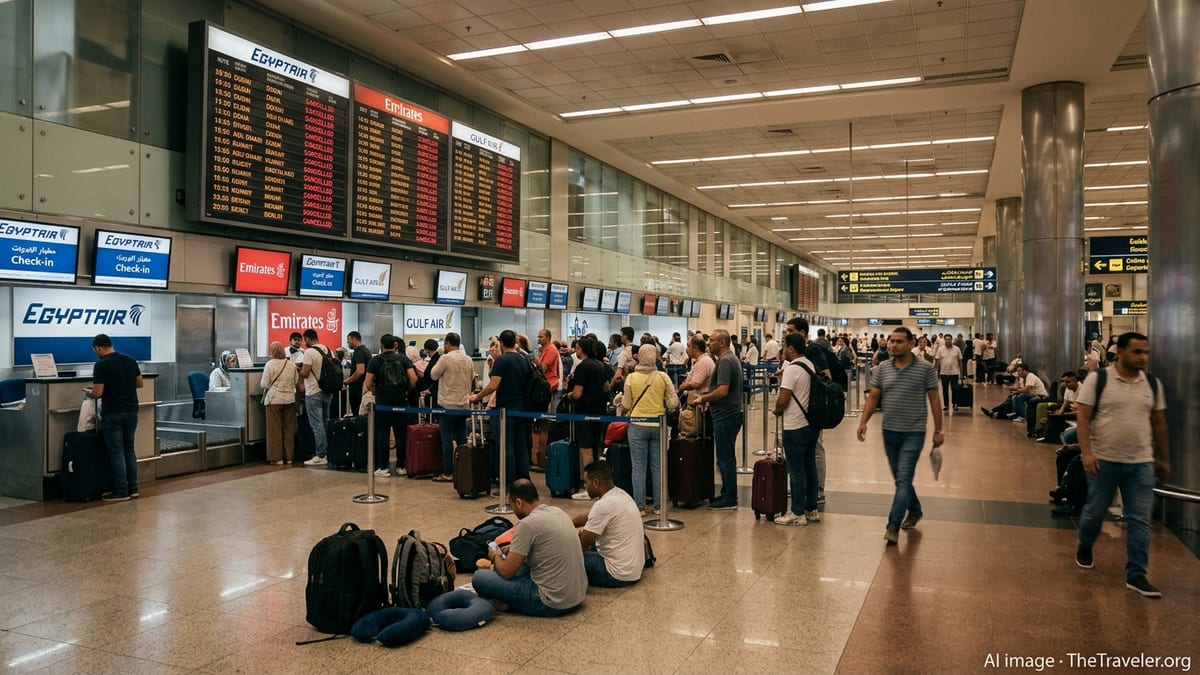
Regional airspace instability is again rippling through Egypt’s major airports, with more than 25 flights reportedly cancelled on Monday across Cairo, Hurghada and Luxor, forcing passengers bound for Gulf hubs and European cities to scramble for alternative routes.
Get the latest news straight to your inbox!
Fresh Cancellations Across Key Egyptian Gateways
Published coverage and live flight-tracking data indicate that a new wave of disruptions hit Egypt’s aviation network early on March 23, with EgyptAir, Emirates, Gulf Air and other regional carriers cancelling a cluster of departures and arrivals. The latest disruptions center on Cairo International Airport but also extend to popular Red Sea and Upper Egypt gateways, including Hurghada and Luxor.
Flight boards monitored on Monday showed multiple services scrubbed on short notice, affecting morning and afternoon departures in particular. While some cancellations were displayed as "operational reasons," the pattern follows weeks of irregular schedules linked to wider Middle East airspace constraints and intermittent restrictions on routes to and from the Gulf.
Local aviation observers note that the number of cancelled services across Egypt’s main tourist and transit airports has now climbed into the dozens over recent days. Many of the latest affected flights were high-demand services in the busy spring travel period, when visitor numbers to Egypt’s resorts and cultural sites typically rise.
The overall volume of cancellations remains fluid, with some services removed from schedules only hours before departure while others are replaced by ad hoc or consolidated rotations. Travelers in Egypt are being urged in public advisories and airline updates to verify their flight status repeatedly rather than relying on earlier confirmations.
Routes to Gulf Hubs and Berlin Hit Hardest
The impact is most visible on routes linking Egypt with major Gulf hubs such as Dubai, Doha, Riyadh, Abu Dhabi and Kuwait City, alongside at least one disrupted service to Berlin. According to publicly available timetables and airport departure boards, flights between Cairo and Dubai on Emirates and EgyptAir have seen repeated cancellations and retimings in recent weeks, with another round recorded on Monday.
Services from Hurghada and Luxor to Gulf capitals have also been curtailed, affecting travelers using these secondary airports as convenient gateways for resort stays and Nile cruise extensions. Gulf Air rotations connecting Cairo and Gulf hubs have appeared irregular, with cancellations and schedule changes prompting passengers to be rebooked through alternative connection points or on different travel days.
In addition to Gulf-bound services, at least one Berlin flight from Egypt has been reported cancelled in the latest batch, illustrating how the knock-on effects are rippling beyond the immediate region. European connections that depend on stable Gulf and Levant airspace have been particularly exposed whenever rerouting adds excessive time or cost to a given rotation.
The pattern is not uniform across all carriers and destinations. Some flights to the same cities are still operating, sometimes at heavily adjusted times or via circuitous routings that skirt restricted airspace. This uneven picture has made it harder for travelers to assess risk based on destination alone, as two departures to the same city on the same day may face entirely different operational realities.
Passengers Face Long Queues, Ad Hoc Rebookings
Reports from travelers transiting Cairo, Hurghada and Luxor describe long queues at check-in and transfer desks as passengers react to last-minute cancellations and rolling delays. Many have found themselves moved onto later departures or different routings via still-operating hubs in Saudi Arabia and other parts of the region.
Publicly available information from airlines shows a growing reliance on flexible rebooking and cancellation policies introduced earlier in March to handle the prolonged disruption. Gulf-based carriers and EgyptAir have expanded fee waivers and date-change options on certain tickets, allowing affected passengers to postpone travel or shift to alternative flights where seats are available.
Despite these measures, the surge in demand for limited operating flights has created bottlenecks. Seats on remaining services to Dubai and Doha are in some cases booked out days in advance, leaving stranded travelers to consider lengthy overland journeys within Egypt or multi-stop itineraries through secondary hubs.
In airport terminals, ground handling capacity and customer service counters have come under visible strain, with some passengers reporting extended waits for rebooking assistance and baggage retrieval. Travel agents and online booking platforms are playing a larger role in managing changes remotely, but their ability to help is ultimately constrained by the reduced number of flights actually operating.
Ongoing Regional Tensions Keep Schedules Volatile
The latest cancellations in Egypt come against the backdrop of a prolonged period of regional volatility that has led to successive rounds of airspace closures and route suspensions across parts of the Middle East. Aviation reference sources for 2026 note that thousands of flights have been cancelled since late February as airlines respond to shifting risk assessments and changing regulatory directives.
Operations at major Gulf hubs such as Dubai and Abu Dhabi have gradually resumed from earlier near-total shutdowns, but the recovery remains uneven. Airlines including Emirates and Gulf Air are operating a mix of regular, reduced and exceptional flights, with some rotations focused on repositioning aircraft or facilitating repatriation-style travel rather than restoring full commercial schedules.
For Egyptian airports, this environment has translated into a stop-start pattern, where flights appear in schedules only to be pulled when connecting airspace becomes constrained again. Carriers are also juggling aircraft availability and crew positioning, further complicating efforts to stabilize daily timetables from Cairo, Hurghada and Luxor.
Aviation analysts following the situation caution that while some corridors are reopening, the overall picture across the region remains fragile. Any renewed escalation or additional restrictions on overflight routes could trigger another round of cancellations affecting Egypt’s role as both a destination and a convenient transit point for journeys between Europe, Africa and Asia.
What Travelers Through Egypt Should Expect Now
With flight schedules still in flux, travelers using Egyptian airports in the coming days should be prepared for late-notice changes and cancellations on services to Dubai, Doha, Riyadh, Abu Dhabi, Kuwait and selected European destinations such as Berlin. Industry advisories recommend building extra time into itineraries, avoiding tight connections and monitoring both airline and airport communications closely.
Passengers already in Egypt are being encouraged by travel agents and tour operators to keep electronic contact details updated with their airline, as many schedule changes and rebookings are being processed via email, app notifications and text messages rather than at the airport alone. Those with flexible tickets or travel insurance policies that cover disruption have more options to postpone or reroute their trips without incurring substantial additional costs.
For new bookings, some aviation commentators suggest prioritizing routes with multiple daily frequencies or alternative carriers on the same city pair, as this can increase the chances of same-day reaccommodation if one flight is cancelled. Direct services that avoid the most affected hubs may also offer a more reliable, if sometimes more expensive, option.
As EgyptAir, Emirates, Gulf Air and other airlines continue to adjust their schedules, the situation for travelers through Cairo, Hurghada, Luxor and other Egyptian airports is likely to remain uncertain in the short term. Spring holidaymakers and business travelers alike are being advised to treat departure times as subject to change up until the last hours before travel, and to plan accordingly.