

More news on this day
Dozens of travellers in Thailand are facing last-minute plan changes after a fresh wave of cancellations by Middle Eastern carriers, with around 20 flights to and from Bangkok and Phuket scrapped as regional tensions ripple across key routes to Tel Aviv, Bahrain, Kuwait, Kuala Lumpur and other hubs.
Get the latest news straight to your inbox!
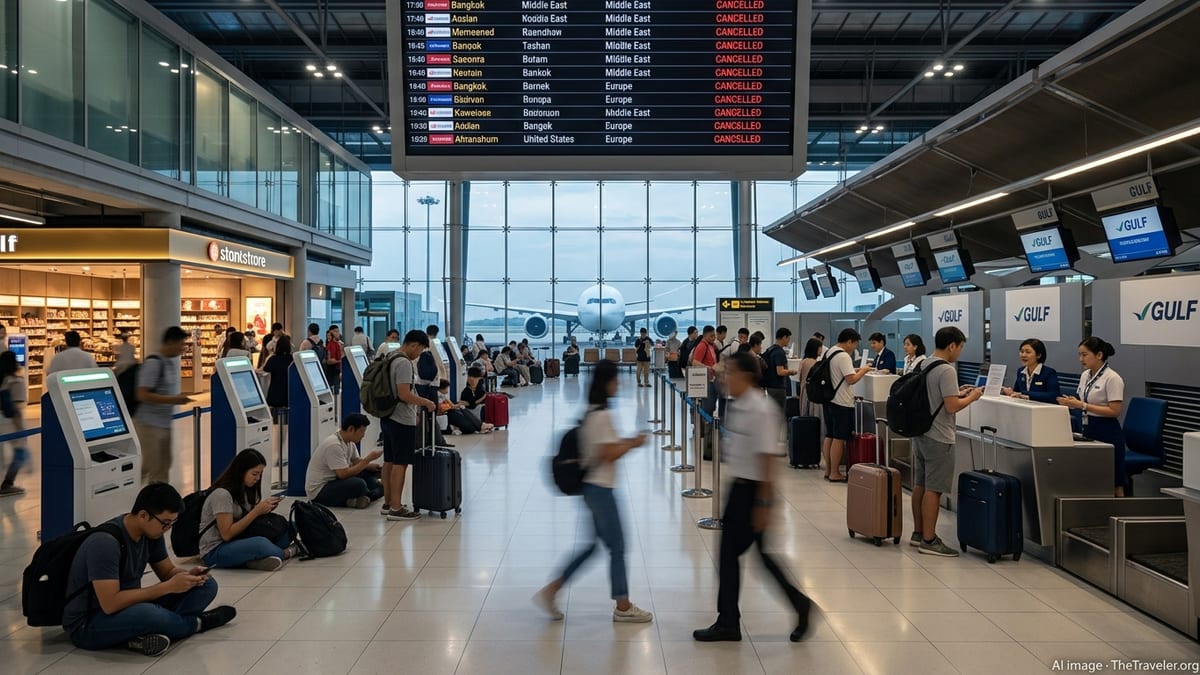
Fresh Cancellations Hit Bangkok and Phuket Gateways
Bangkok Suvarnabhumi and Phuket International, two of Southeast Asia’s busiest holiday gateways, have seen a cluster of cancellations involving El Al, Gulf Air, Kuwait Airways and several regional competitors. Flight-monitoring data and airline updates indicate that roughly 20 services touching Thailand have been withdrawn over the latest 24 to 48 hour period, affecting departures and arrivals on both long-haul and regional sectors.
The disrupted flights primarily involve routes linking Thailand with the Middle East and onward connections to Europe, North America and other parts of Asia. Among the impacted corridors are services between Bangkok and Tel Aviv, Bahrain and Kuwait, as well as connecting itineraries via regional hubs such as Kuala Lumpur. Travellers on multi-leg journeys are reporting missed onward connections and forced rebookings as schedules adjust.
These latest cancellations come on top of already reduced timetables across the region following weeks of conflict-related airspace closures and operational restrictions. While many airlines had begun cautiously restoring capacity, the renewed adjustments around Thailand highlight how fragile the recovery of long-haul connectivity remains.
Thailand’s tourism sector, now well into a busy high season, is particularly sensitive to sudden schedule changes. Even a few dozen cancelled sectors can translate into several thousand passengers having to reroute or delay trips, putting extra pressure on airlines, airports and tour operators.
Routes to Tel Aviv, Bahrain, Kuwait and Kuala Lumpur Most Affected
The latest disruption has concentrated on high-profile corridors that connect Thailand to the Middle East and onward global networks. Services to Tel Aviv, operated or codeshared by El Al and partner carriers, have seen repeated adjustments in recent weeks, and the newest cancellations from Bangkok add further uncertainty for travellers attempting to reach or transit Israel.
Flights operating via Bahrain and Kuwait, key hubs for Gulf Air and Kuwait Airways respectively, have also been trimmed. The cancellations are reverberating beyond point-to-point traffic, as many passengers rely on these carriers for one-stop journeys between Thailand and European or North American cities. Travel forums and customer updates describe itineraries such as Bangkok to Bahrain to Europe, or Phuket to Kuwait to South Asia, being cancelled or shifted onto alternative routings.
Connections via Kuala Lumpur are experiencing indirect impacts as well. While Malaysia’s main hub remains operational, the removal of some Thailand–Gulf and Thailand–Israel services means passengers are being rerouted through Kuala Lumpur at short notice, tightening capacity on certain regional sectors. This creates an additional layer of competition for seats, especially for travellers seeking last-minute alternatives.
For those with imminent departures, the pattern emerging from public schedules is one of rolling changes rather than a single blanket suspension. That makes it difficult for travellers to predict which specific flights will operate, particularly on itineraries involving multiple carriers or codeshares.
Regional Tensions and Airspace Restrictions Drive Operational Decisions
The cancellations are unfolding against the backdrop of the ongoing 2026 Iran war and a series of missile and drone strikes that have affected Israel and several neighboring states since late February. Publicly available aviation data and news coverage show that airspace over parts of Iran, Iraq, Israel, Jordan, Kuwait and nearby countries has been restricted or intermittently closed at various points, compelling airlines to reroute or suspend services.
Carriers such as El Al, Gulf Air and Kuwait Airways have had to navigate a shifting operational environment that includes changing overflight permissions, extended routings around closed corridors and heightened security assessments. These constraints often make certain long-haul links, including those to and from Thailand, considerably more complex and costly to operate on short notice.
Industry analyses published in recent weeks point to steep cancellation rates on routes touching Israel and parts of the Gulf region, with some airlines temporarily withdrawing from affected markets altogether. Where flights do continue, schedules have often been thinned out, with fewer weekly frequencies or downgraded aircraft types.
Thailand’s role as a major long-haul leisure destination means that any disruption in Middle Eastern connectivity has outsized consequences. Gulf carriers are central to the flow of visitors from Europe and the Middle East into Bangkok and Phuket, and their aircraft also carry large numbers of Thai travelers working or studying abroad.
What Passengers in Thailand Should Expect Right Now
Travellers departing from or arriving into Bangkok and Phuket over the coming days should expect continued volatility on routes involving Middle Eastern transit points. Public timetables show frequent short-notice adjustments, with some flights cancelled within 24 to 48 hours of departure and others retimed or rerouted via different hubs.
Airlines impacted by the latest wave of schedule changes have generally been offering options such as free rebooking on alternative dates, rerouting via other hubs, or refunds in line with their standard policies. However, passenger accounts shared on travel forums suggest that processes and flexibility vary by carrier and by ticket type, particularly for those booked on separate, self-organised connecting flights.
Check-in and call center queues in Thailand are reported to be longer than usual on days with multiple cancellations, as travellers seek same-day alternatives. Those with fixed plans, such as tour departures or cruise connections, may find that only indirect routings with multiple stops remain available at short notice, often at higher fares.
Travel advisers are encouraging passengers to monitor bookings closely in the 48 hours before departure, keep contact details updated with their airline, and allow extra time at the airport in case of last-minute gate or timing changes. For complex itineraries involving separate tickets, many passengers are choosing to consolidate bookings with a single carrier or alliance to reduce missed-connection risk.
Planning Ahead: Rerouting Options and Medium-Term Outlook
Despite the wave of cancellations, Thailand remains accessible via a wide range of alternative routings. Major carriers based in East Asia, Europe and other parts of the Middle East continue to serve Bangkok and Phuket, and some have been adding capacity to pick up displaced demand. Itineraries that once relied on a single Gulf transit point are increasingly being reconfigured through hubs such as Singapore, Seoul, Tokyo or European gateways.
For travellers whose flights with El Al, Gulf Air or Kuwait Airways have been cancelled, the most practical short-term approach is often to seek rerouting on partner airlines or to rebook independently through still-operating hubs. While this can mean longer travel times and additional connections, it may be the most reliable way to maintain travel dates while the regional situation remains fluid.
Looking ahead into April, published schedules suggest that airlines are reviewing operations in relatively short cycles, aligning with evolving airspace permissions and security assessments. That means conditions could improve quickly if restrictions ease, but further cancellations are also possible if tensions escalate or new constraints are introduced.
For now, travellers using Bangkok and Phuket as gateways to or from Tel Aviv, Bahrain, Kuwait, Kuala Lumpur and other affected destinations should build flexibility into their plans. Refundable or changeable fares, comprehensive travel insurance and a willingness to accept reroutings via alternative hubs are becoming key tools for navigating an increasingly unpredictable network linking Thailand to the wider Middle East.