

More news on this day
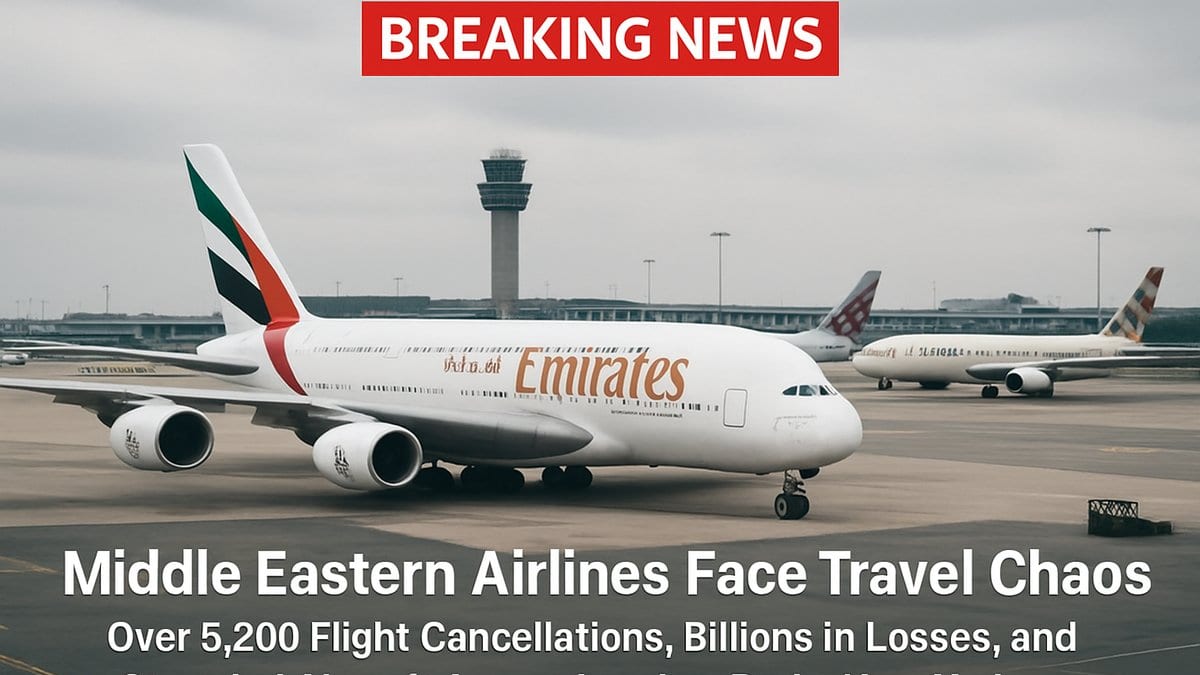
Middle Eastern airlines are confronting a fast-moving operational and financial crisis as more than 5,200 flight cancellations connected to the region’s conflict reverberate across major hubs in London, Paris and New York, grounding aircraft, straining networks and erasing billions from projected revenues.
Get the latest news straight to your inbox!
Conflict-Driven Airspace Closures Reshape Global Routes
Publicly available tallies of the economic impact of the 2026 Iran war indicate that extensive airspace closures across the Middle East have removed key corridors linking Europe, Asia and Africa. Several states in the region have imposed broad restrictions on civilian overflights, forcing airlines to suspend services altogether or adopt significant detours that upend carefully calibrated schedules.
According to recent conflict and aviation assessments, the major Gulf hubs that normally function as crossroads between continents have seen a sharp pullback in operations as carriers review risk exposure and crew safety. Routes that relied on direct transits over Iran, Iraq, Syria and adjacent airspace now require long diversions or temporary suspension, markedly reducing the number of flights available each day.
Within this environment, Middle Eastern airlines that built their business models around high-frequency transfer traffic are among the hardest hit. Network structures that previously maximized aircraft utilization and short connection times are now under strain, with cancelled rotations, reduced frequencies and downgraded aircraft types becoming common as planners attempt to match capacity to volatile conditions.
Industry analyses suggest that what began as a regional security crisis has quickly translated into a structural shock for global aviation flows. For many travelers, the most visible consequence is not the closed airspace itself, but the cascading schedule changes and cancellations they encounter departing from, or connecting through, Europe and North America.
Over 5,200 Cancellations and a Mounting Financial Toll
Specialist travel and aviation coverage tracking the fallout from the conflict reports that Middle Eastern airlines have collectively cancelled more than 5,200 flights during the current disruption window. The figure includes a mix of long haul services to Europe and North America and shorter regional segments that feed major Gulf and Levantine hubs, highlighting the breadth of the shock across different market segments.
Sector commentary places the financial impact in the billions, once lost ticket revenue, rebooking costs, extra fuel for diversion routes and passenger care obligations are taken into account. For airlines that rely heavily on premium long haul demand between cities such as Dubai, Doha or Riyadh and destinations like London, Paris and New York, the sudden removal of entire daily rotations has an outsized effect on yields and cash flow.
Recent analysis focused on the economics of the cancellations emphasizes that the direct loss of airfare revenue is only part of the picture. Airlines are also absorbing substantial costs linked to parking fees, handling charges, crew repositioning and maintenance checks for aircraft that are flying fewer hours than originally planned. For carriers that operate large fleets of widebody aircraft, even short periods of underutilization can shift annual profitability forecasts.
Financial projections compiled by industry groups point to a widening gap between earlier optimistic outlooks for 2026 and the realities now facing the region’s airlines. Expectations of strong capacity growth and record passenger volumes have been replaced by scenarios that assume suppressed demand, constrained schedules and higher operating costs well into the peak summer travel season.
Stranded Aircraft at High-Cost Global Hubs
One of the most visible manifestations of the crisis is the number of Middle Eastern aircraft parked at high-cost international hubs. Travel industry reporting singles out London Heathrow, Paris Charles de Gaulle and New York John F. Kennedy as among the most impacted airports, with multiple widebody jets from Gulf and Levant carriers left idle for extended periods as schedules are repeatedly redrawn.
Operational breakdowns of the situation describe how aircraft that would typically perform tightly sequenced rotations across three continents are now sitting on the ground for long stretches while planners await clearer information on airspace access or security conditions. Those idle hours translate into parking, handling and staffing expenses at airports where fees rank among the highest in the world, compounding the financial pressure created by lost ticket revenue.
Some analyses of the stranded-fleet problem note that a single grounded widebody at a major hub can generate hundreds of thousands of dollars in combined opportunity costs and direct charges over a matter of days. Scaled across dozens of aircraft and thousands of cancelled or truncated flights, the resulting idle-asset burden becomes a central driver of the wider losses facing the sector.
The parking challenge is especially acute at constrained hubs such as Heathrow, where stand availability is limited and turnaround precision normally underpins airline and airport performance. As Middle Eastern carriers negotiate revised stand allocations or tow aircraft to remote positions, knock-on effects on other operators’ schedules and airport congestion become increasingly likely.
Ripple Effects for Passengers in London, Paris and New York
For travelers, the crisis is most apparent in the form of disrupted itineraries and extended unplanned layovers. Recent disruption summaries collated from schedule trackers and airport dashboards show that London, Paris and New York have emerged as key pinch points, with Middle Eastern cancellations often triggering missed connections onto transatlantic, transpacific or regional flights.
Reports focused on European and North American hubs indicate that even where total cancellation numbers remain modest relative to daily traffic volumes, the concentration of disruptions at certain times of day has magnified the impact. When an inbound Gulf or Levant flight fails to arrive, passengers who had planned to connect onward to destinations across the United States, Canada or continental Europe can find themselves stranded, sometimes overnight, as remaining seats on alternative services quickly fill.
Published coverage points out that London and Paris, in particular, serve as critical bridges between Middle Eastern hubs and secondary cities across the Atlantic. Delays and cancellations on these trunk routes have led to growing queues at transfer desks, longer waits for baggage, and heavy reliance on hotels near the airport while airlines work through rebooking backlogs. In New York, the disruption is most visible at JFK, where multiple Middle Eastern operators normally maintain dense schedules built around peak evening transatlantic banks.
Consumer guidance from passenger rights organizations advises affected travelers to monitor airline apps and departure boards closely, to confirm whether their journey is still routed via the Middle East or has been rebooked via alternative hubs. In some jurisdictions, including the United Kingdom and European Union, certain travelers on eligible flights may be entitled to meals, accommodation or compensation, depending on the cause and length of disruption, though conflict-related airspace closures can complicate eligibility.
Strategic Responses and Uncertain Recovery Timeline
Airlines across the Middle East are now pursuing a combination of tactical and strategic responses as they navigate the crisis. Public information from schedule and fleet databases suggests that carriers are consolidating frequencies on core routes, trimming marginal services, and redeploying some widebody aircraft to markets less exposed to the conflict in an effort to preserve utilization and generate revenue where demand remains resilient.
Network planners appear to be examining alternative connection patterns that rely more heavily on southern or northern corridors, including routings via the Caucasus, North Africa or the eastern Mediterranean, though such detours often increase fuel consumption and crew duty times. Low cost and hybrid carriers in the region are also adjusting, with some focusing more sharply on point to point leisure markets that can be served without traversing affected airspace.
Aviation forecasters caution that the recovery trajectory is highly dependent on geopolitical developments and the duration of airspace restrictions. If closures persist or broaden, many Middle Eastern airlines may need to revise fleet growth plans, delay aircraft deliveries, or seek additional financing to bridge what could become a multi season revenue gap. Conversely, a sustained de escalation could allow for a gradual restoration of suspended routes, though rebuilding passenger confidence and restoring previous booking patterns may take time.
For now, the combination of more than 5,200 cancellations, billions in projected losses and dozens of idle aircraft across leading hubs in London, Paris and New York underscores the extent to which the Middle East conflict has become a defining challenge for global aviation in 2026. Travelers planning itineraries through the region’s major carriers are being urged by travel advisors and industry observers to remain flexible, stay informed and prepare for the possibility of further last minute changes.