

More news on this day
Rapidly escalating tensions in the Middle East have forced Swiss International Air Lines (SWISS) to cancel flights to Dubai and Tel Aviv, stranding thousands of passengers and underscoring how fragile global air travel becomes when key regional hubs go dark.
SWISS Suspends Tel Aviv and Dubai Routes Amid Security Fears
SWISS confirmed over the weekend that it has halted all flights between Zurich and Tel Aviv until March 7 and cancelled its scheduled Zurich to Dubai services for Saturday and Sunday. The airline cited widespread airspace closures and a rapidly deteriorating security situation following United States and Israeli strikes on Iran. For the carrier, part of the Lufthansa Group, the move is framed firmly as a safety-first decision.
According to statements from the airline, 14 rotations on the Zurich–Tel Aviv route have been scrubbed, alongside the Dubai cancellations, as planners grapple with fast-changing flight permissions and risk assessments. Internal crisis teams in Zurich are coordinating with airport authorities and regulators while monitoring whether approved corridors over neighboring states can be restored in the coming days.
Operationally, SWISS faces the dual challenge of repositioning aircraft and managing crew duty limits at a time when many of its jets and pilots are out of place. One Airbus A220 remains grounded in Tel Aviv with a small engineering team on site, with the airline emphasizing that securing the aircraft and enabling a swift restart of services once the moratorium ends are immediate priorities.
The pause to Dubai, normally a key long-haul link for Swiss and European travelers heading to Asia and Africa, is especially significant because Dubai International is itself shut to normal traffic following missile and drone strikes on regional hubs. Even if SWISS were able to reinstate its own schedule, many of the connections passengers rely on would remain broken.
Wider Middle East Airspace Closures Ripple Across Global Networks
The SWISS cancellations are part of a far broader aviation shock triggered after Iran and several neighbors closed or severely restricted their airspace in response to the latest military strikes. Authorities in Israel, Iran, Iraq, Qatar, the United Arab Emirates, Kuwait, Bahrain, and others have imposed sweeping bans or tight controls, effectively severing some of the world’s most heavily used east–west flight corridors.
Dubai, Abu Dhabi, Doha, Kuwait City, and Tel Aviv have all seen large numbers of services grounded as airports suspend operations or operate in a very limited fashion under heightened threat levels. Analytics firms estimate that well over 1,800 flights were canceled across the region on Saturday alone, with cancellations on Sunday already running into the thousands as airlines updated schedules to reflect the unfolding crisis.
For global passengers, the effect is immediate and far-reaching. Routes that typically overfly the Gulf and Iran to connect Europe with South and East Asia now require long detours over Saudi Arabia or much farther north and south, driving up fuel burn, flight times, and costs. Some long haul flights have turned back midair or diverted to cities such as Istanbul and Rome, producing what crew describe as “flights to nowhere” that leave travelers back where they started or in unplanned transit stops.
Major carriers across continents, including Lufthansa, Emirates, Qatar Airways, Etihad, British Airways, Air India, and multiple North American and Asian airlines, have either suspended Middle East routes or are operating skeleton services under strict security guidance. As each new closure or advisory is issued, airlines recut their networks, adding another layer of uncertainty for anyone scheduled to travel in or through the region this week.
Passengers Stranded in Dubai, Tel Aviv and Beyond
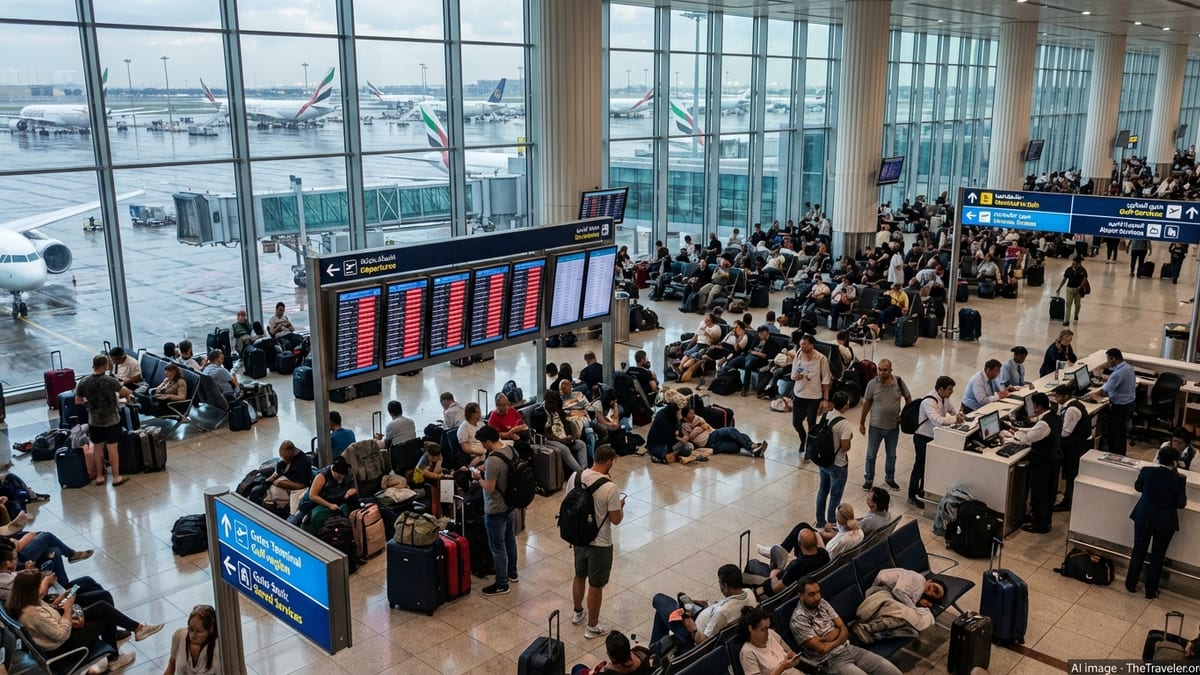
The human fallout of these sudden cancellations is visible across airports and hotels from the Gulf to Europe. In Dubai, normally one of the world’s busiest hubs, thousands of passengers have found themselves stuck in terminals or local accommodation as airlines halt operations and hotels fill up. With Dubai International and Abu Dhabi’s Zayed International Airport both affected by missile strikes, authorities have urged people not to come to the airports unless explicitly told to do so by an airline.
In Tel Aviv, SWISS customers whose flights were due to operate in the coming days now face an indefinite wait for a way out until Israeli airspace reopens and carriers judge conditions safe enough to resume. While some passengers are being rebooked on future services or partner airlines willing to route around restricted zones, capacity is tight and alternative routings often involve long detours via Europe or North Africa.
Travelers report difficulty reaching airline call centers and customer service channels as demand for information spikes. Long queues have formed at ticket desks in unaffected European hubs, as passengers try to secure the last remaining seats to alternative gateways in the region such as Jeddah or Cairo, from where they may still face overland journeys or further hops to reach their final destinations.
Airlines including SWISS are offering a mix of free rebooking, route changes where feasible, and refunds. However, with so many carriers cutting capacity into the Middle East at once, many stranded travelers are discovering that there is simply no short-term solution beyond waiting for airspace to reopen and schedules to stabilize.
What Affected Travelers Need to Know Right Now
For passengers booked on SWISS services to Dubai or Tel Aviv in the coming days, the core message is to assume that the original itinerary will not operate as planned. Travelers are being advised to monitor their booking profiles and airline apps closely, as schedule changes and cancellations may appear there before wider public announcements. Given the intense pressure on call centers, digital channels and push notifications are likely to be the fastest way to receive updates.
Most airlines, including SWISS and its Lufthansa Group partners, have activated flexible rebooking policies for flights touching the affected region, typically allowing one free change of travel date or destination, subject to seat availability. Some are also permitting full refunds for passengers unwilling or unable to travel under the current security advisories. Travelers should carefully check the specific conditions and validity windows published by their carrier before making changes.
Experts caution against heading to the airport without a confirmed new flight, as many terminals are already crowded with stranded passengers and local authorities are focused on security operations. Instead, travelers should stay in their accommodation, keep receipts for any additional expenses, and maintain regular contact with airlines and, where relevant, travel agents or tour operators, who may be able to negotiate group solutions with carriers.
Those with imminent non-essential trips to the wider Middle East are being urged to consider postponement. Governments in Europe and North America have updated travel advisories and, in some cases, warned against all but essential travel to parts of the Gulf and Israel. Travel insurance coverage will depend heavily on policy wording and when a trip was booked, so travelers should review exclusions related to war, terrorism, and government advisories before making significant changes.
How Long Will the Disruption Last?
With tensions still high and military activity ongoing, industry analysts say it is too early to predict when SWISS and other carriers will restore regular services to Dubai, Tel Aviv, and neighboring hubs. For now, airlines are working with relatively short planning horizons: many have publicly suspended flights until dates around March 3 to March 8, with the clear caveat that further extensions are possible if risk levels remain elevated.
Even after formal airspace closures are lifted, recovery will take time. Aircraft and crews will be out of position, maintenance checks may be overdue, and airports will need to clear large backlogs of both passengers and cargo. Airlines will likely prioritize repatriation and backlog-clearing flights before resuming full commercial schedules, meaning that available seats could remain scarce for days or weeks.
For travelers, the safest assumption is that the broader Middle East aviation network will remain fragile in the short term. Anyone planning to transit through Dubai, Abu Dhabi, Doha, or Tel Aviv should be prepared for last-minute changes, prolonged layovers, or rerouting via secondary hubs. Flexibility, patience, and a willingness to adjust itineraries will be crucial.
What is clear is that the SWISS cancellations to Dubai and Tel Aviv are not isolated events but emblematic of a wider system under stress. As airlines, governments, and aviation authorities navigate an evolving security crisis, passengers are once again reminded that in this part of the world, geopolitics can reshape travel plans in a matter of hours.