

More news on this day
Thousands of travelers across the Middle East, Europe and North America were stranded on March 10 as escalating conflict-related airspace closures forced carriers in the United Arab Emirates, Qatar, Saudi Arabia, Kuwait, Jordan, Bahrain and beyond to cancel 906 flights and delay a further 407 services, disrupting operations for Saudia, Emirates, Etihad, British Airways, KLM, Ryanair and many others.
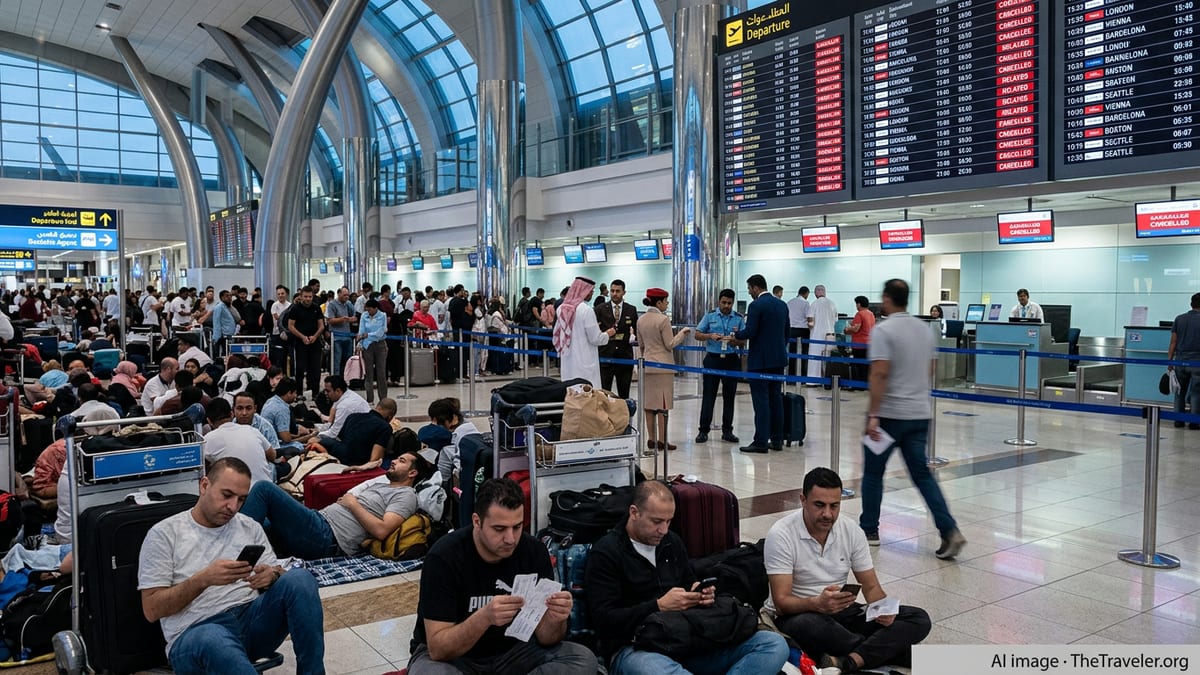
Airspace Closures Ripple From Gulf Hubs to Global Gateways
Today’s latest wave of cancellations is the most acute sign yet of how deeply the regional security crisis is undermining global air travel. Since United States and Israeli strikes on Iran on February 28 triggered retaliatory attacks and a rolling series of airspace restrictions, key Gulf states including the UAE, Qatar, Kuwait, Bahrain and Jordan have either closed or heavily curtailed their skies for commercial traffic.
Major hubs such as Dubai, Abu Dhabi and Doha, normally among the world’s busiest transit points linking Europe, Asia, Africa and the Americas, are operating only skeleton schedules or limited repatriation services. Emirates has extended the suspension of flights to and from Abu Dhabi, Doha, Amman, Kuwait and Bahrain through late on March 10, while Etihad and Qatar Airways continue to run sharply reduced operations to and from their home bases.
The consequences are radiating far beyond the Gulf. Airlines are rerouting long haul services around closed corridors, adding hours to flight times between Europe and Asia, while others have opted to suspend routes entirely. Industry data compiled today shows at least 906 cancellations and 407 delays across carriers operating in or over the affected region, with disruption concentrated at Gulf hubs but increasingly visible in major Western cities.
In parallel, airports as far afield as Dhaka have reported hundreds of cancellations since February 28 on services bound for the Gulf, underlining how dependent many labor and transit markets are on these air corridors. As additional carriers in Europe and Asia adjust their schedules, the cumulative figure is expected to rise further this week.
Global Airlines Slash Schedules as Conflict Escalates
Flag carriers and low cost airlines alike have curtailed services in response to shifting risk assessments and evolving government directives. Saudia has suspended flights to Amman, Kuwait, Abu Dhabi, Doha and Bahrain until at least the end of March 10, while also halting select routes to Moscow and Peshawar. Turkish Airlines and other Turkish carriers have extended cancellations to Iraq, Syria, Lebanon and Jordan, and have now added Doha, Dubai, Kuwait, Bahrain, Abu Dhabi and Dammam to the list through mid March.
European and North American airlines are also scaling back. Air France has cancelled services to Tel Aviv and Beirut and has extended suspensions on flights to Dubai and Riyadh. British Airways, KLM and other European operators have either rerouted flights to avoid the most sensitive airspace or, in some cases, temporarily suspended Middle East routes, with knock on effects for feeders to and from London, Paris, Amsterdam, Madrid and other hubs.
Low cost carriers such as Wizz Air and Ryanair have acted aggressively, cancelling flights to Dubai, Abu Dhabi and key Saudi destinations for multiple days at a time. For budget conscious travelers who rely on these airlines to reach Gulf connection points from secondary European cities, the suspensions have effectively cut off affordable access to onward long haul routes.
Even where flights remain technically possible, crew scheduling constraints, aircraft positioning challenges and the need for longer flight plans around closed corridors have forced airlines to trim frequencies. Carriers warn that schedules published even a day in advance should be treated as provisional and subject to last minute change.
Travelers Stranded From Doha and Riyadh to London and Chicago
As cancellations mounted overnight and into Tuesday, crowds built up at airports from Abu Dhabi and Riyadh to London Heathrow, Paris Charles de Gaulle, Madrid Barajas, Newark Liberty and Chicago O’Hare. Many passengers awoke to messages that their flights had been cancelled or severely delayed, often after multiple previous rebookings.
At Hamad International Airport in Doha, Qatar Airways is operating only a limited schedule, prioritizing repatriation flights and key trunk routes. Passengers without confirmed seats have been urged not to approach the terminal, as airport authorities and airline staff attempt to manage crowds and prevent congestion in departure halls already operating near capacity.
In the UAE, Dubai and Abu Dhabi airports are experiencing a similar pattern. Emirates and Etihad are focusing on core routes and aircraft repositioning, leaving many transit passengers stuck midsjourney in the Gulf. Some travelers have been diverted to alternative hubs in Istanbul, Cairo or Muscat, only to encounter further cancellations as the crisis widens.
Across Europe and North America, the disruption is most visible in delayed or cancelled inbound and outbound Middle East services, but the knock on effects are spreading into domestic networks. Missed connections are forcing airlines to reaccommodate passengers on later flights, filling remaining seats and leaving limited capacity for additional rebookings, particularly on popular transatlantic and intra European routes.
Limited Repatriation Flights Offer Partial Relief
Amid the continuing turmoil, some carriers have begun to add limited repatriation and relief flights. Emirates has said it expects to restore a larger share of its international schedule in the coming days as parts of UAE airspace reopen under tighter security protocols. Etihad is operating a reduced roster of flights from Abu Dhabi, while Qatar Airways has announced a narrow window of services between March 9 and 11 for select destinations.
Indian carriers, including Air India and Air India Express, are running scheduled services to Jeddah and Muscat and have been authorized to mount dozens of additional non scheduled flights to and from UAE airports today. Their focus is on repatriating stranded citizens and migrant workers who had been transiting through Gulf hubs when the conflict flared.
Elsewhere, regional airlines such as Oman Air have cancelled flights to multiple Gulf destinations through mid March in order to comply with airspace restrictions, but are signaling that schedules will be reviewed day by day. Industry analysts caution that any easing will likely be uneven, with some corridors reopening faster than others depending on military risk assessments and diplomatic developments.
Even on operating repatriation flights, capacity is constrained. Larger wide body aircraft are in high demand, and airlines are juggling competing priorities between commercial passengers, government directed evacuation missions and cargo commitments. Seats on available flights are selling out quickly, often at elevated prices despite calls from consumer advocates for fare caps in the crisis zone.
What Travelers Can Do Today
With conditions shifting by the hour, travel experts stress that the single most important step for affected passengers is to stay closely in touch with their airline through official channels and to avoid unnecessary trips to the airport without a confirmed, operating booking. Many carriers, including Emirates, Etihad, Qatar Airways and Saudia, have activated flexible rebooking and refund policies for tickets issued before the crisis and for travel dates spanning late February through at least March 10.
Passengers whose flights have been cancelled are generally being offered fee free date changes, credits or refunds, and in some cases re routing on partner airlines when safe corridors exist. However, travelers are reporting long call center waits and overloaded chat systems, making it difficult to secure new itineraries in time to take advantage of limited seats.
For journeys that must proceed, advisors recommend considering alternative routings that bypass the Gulf entirely, using hubs in Europe, South Asia or East Asia where feasible. That can mean longer flying times and additional connections, but may offer the only viable way home in the short term. Travelers are also being urged to build in extra time for security checks and possible schedule changes when flying anywhere near the broader region.
As the conflict and associated airspace restrictions continue with no firm end date, airlines and passengers alike face the prospect of prolonged uncertainty. For now, the combination of 906 cancellations and 407 delays recorded today is less a peak than another severe spike in a rolling crisis that has reshaped global air routes and left thousands of travelers waiting for a clear path home.