

More news on this day
Escalating conflict centered on Iran and the Gulf has upended commercial aviation across the Middle East, sending jet fuel prices sharply higher, closing key airspaces and forcing Gulf carriers to slash schedules as airlines worldwide scramble to reroute flights and reassess demand.
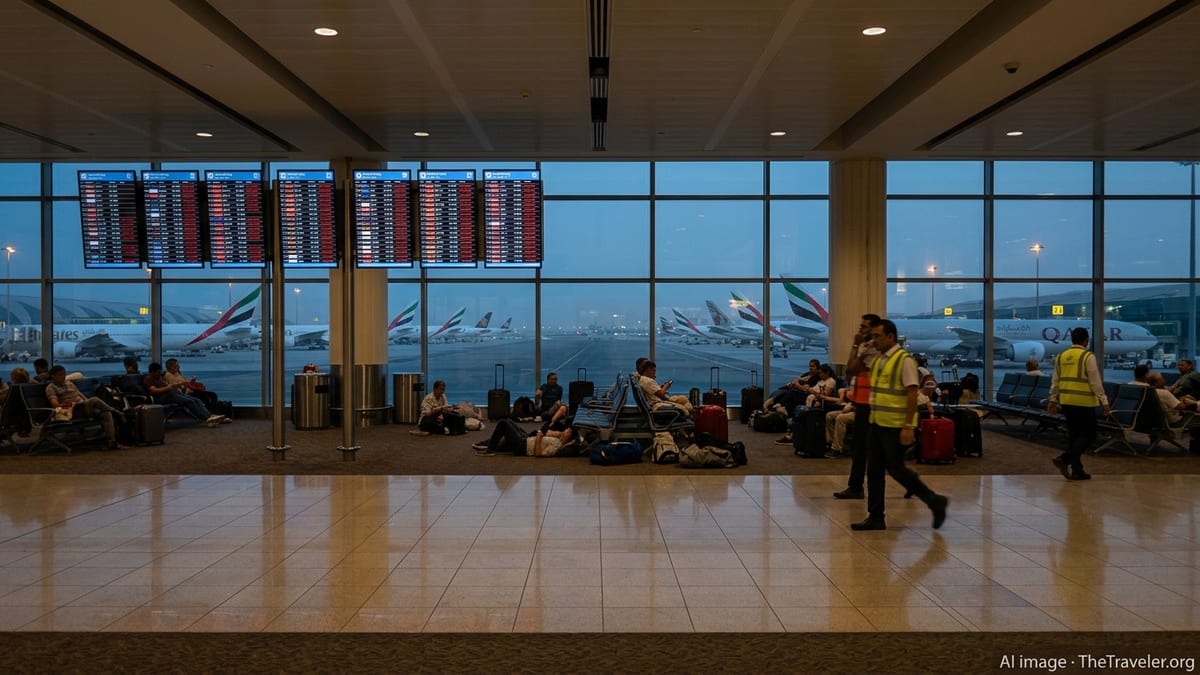
Airspace Closures Cripple Gulf Super-Connector Hubs
The latest round of hostilities, which intensified from late February 2026, has led to sweeping airspace restrictions across the Gulf, including in the United Arab Emirates, Qatar, Iran, Iraq and Israel. For several days from February 28, authorities ordered near-total closures in multiple states, effectively shutting down some of the world’s most important long-haul transit hubs.
Emirates, Etihad Airways and Qatar Airways, which together normally carry a large share of Europe–Asia and Europe–Australia traffic through Dubai, Abu Dhabi and Doha, initially suspended scheduled operations from their home hubs as missile and drone attacks targeted infrastructure across the region. Passenger flows that typically see around 90,000 people a day connecting through these hubs were abruptly cut, stranding travelers from North America, Europe, Asia and Australasia.
By March 6, Emirates and Etihad had begun to restore reduced schedules, with Dubai and Abu Dhabi operating at a fraction of normal capacity and serving a limited list of destinations. Qatar’s Hamad International Airport, however, remained subject to tight restrictions, with Doha’s airspace only partially reopened via controlled corridors and most regular Qatar Airways services still suspended or rerouted via neighboring states.
Regional aviation authorities stress that safety assessments are ongoing and that airspace permissions may change at short notice. Airlines have warned passengers to expect rolling cancellations, diversions and lengthened journey times on routes touching the Middle East or traditionally routed over it.
Rerouted Flight Paths Add Hours and Costs
With large swathes of Middle East airspace now considered high risk, carriers have rapidly redrawn some of the world’s busiest long-haul corridors. Many Europe–Asia flights that once passed over Iran, Iraq and the eastern Mediterranean are being shifted south over Saudi Arabia and the Arabian Sea, or pushed far north and east to avoid the region altogether.
The closures compound existing constraints created by Russian airspace bans since 2022, leaving airlines with a shrinking set of viable great-circle options. For some city pairs, particularly between Western Europe and North or Southeast Asia, these double detours can add two to three hours of flying time, inflating fuel burn and crew costs while squeezing aircraft and airport capacity.
Gulf carriers that built their business models on efficient overflight through relatively uncongested skies now face ground delays, more complex flight-planning workarounds and bottlenecks in the remaining open corridors. Saudi Arabian airspace, for example, has become a key conduit for rerouted traffic, prompting warnings of congestion and further knock-on delays as air traffic controllers manage increased volumes.
For travelers, the operational reality is longer flights, more missed connections and a higher risk of overnight disruptions in outstation cities where aircraft have been repositioned. Travel managers are advising passengers to allow extra buffer time for critical trips and to be prepared for last-minute changes to routings and transit points.
Jet Fuel Prices Surge on Strait of Hormuz Disruption
The aviation turmoil is inseparable from the parallel energy shock rippling through global fuel markets. Military strikes and heightened maritime risk in and around the Strait of Hormuz, through which roughly a fifth of the world’s oil and liquefied natural gas typically flows, have sharply curtailed tanker traffic and unsettled supplies of refined products.
Benchmark crude prices have jumped since the end of February, while refined markets for jet fuel, diesel and gasoline have tightened rapidly. Analysts report European jet fuel prices soaring to levels not seen in several years, with spot assessments in some hubs climbing by hundreds of dollars per tonne in the opening days of March as traders price in disrupted Gulf exports and longer shipping routes.
For airlines, fuel already represents the single largest operating cost line, and the sudden spike is erasing some of the margin gains achieved during the post-pandemic travel rebound. Carriers that hedged a portion of their fuel needs are temporarily cushioned, but many still face higher spot exposure on unhedged volumes, while new hedges are now significantly more expensive.
Industry executives in North America and Europe have warned that sustained conflict and shipping disruption could force higher fares, surcharges or capacity cuts, especially on long-haul routes where fuel accounts for an outsized share of total operating costs. Low-cost carriers, with thinner margins and less hedging flexibility, may be particularly vulnerable if the spike persists into the northern summer season.
Gulf Carriers Slash Capacity as Demand Outlook Darkens
For the Gulf’s flagship airlines, the crisis comes at a pivotal moment. Emirates, Qatar Airways and Etihad entered 2026 with strong demand, high load factors and ambitious growth plans tied to fleet renewals and new long-haul markets. The sudden shock has forced a rapid pivot from expansion to triage.
In the near term, all three have focused on safety-driven cancellations, selective route resumptions and the operation of relief or repatriation flights where airspace corridors are available. Schedules are being rebuilt day by day, with some aircraft and crews repositioned to secondary hubs or wet-leased to support alternative routings.
Booking trends reveal early signs of softer demand for itineraries involving Gulf transit points, particularly from leisure travelers who can defer or rebook trips. Corporate travel managers are also reevaluating routings for staff to minimize exposure to potential flashpoints and to avoid multiple connections in a volatile region.
Nevertheless, the underlying structural role of Gulf hubs in connecting Europe, the Americas, Africa and Asia suggests that suppressed demand may rebound quickly if security conditions improve and fuel markets stabilize. Much will depend on how long airspace restrictions remain in place and whether the conflict escalates or moves toward a negotiated de-escalation.
Airlines and Travelers Brace for a Prolonged Period of Uncertainty
Global aviation bodies and industry analysts caution that even a short-lived military flare-up in the Gulf can have long-lasting ripple effects on network planning, pricing and traveler confidence. Airlines now face the dual challenge of absorbing higher fuel and insurance costs while operating less efficient routings through congested skies.
Insurance underwriters have reportedly raised war-risk premiums for flights transiting or approaching the conflict zone, adding another variable cost at a time when margins are already under pressure. Some carriers may decide that certain routes are no longer commercially viable under current conditions and reassign aircraft to alternative long-haul markets or high-yield short-haul routes instead.
For travelers, the situation translates into heightened uncertainty around schedules, fares and routing options, particularly for trips connecting Europe or North America with South Asia, Southeast Asia and East Africa. Flexible tickets, comprehensive travel insurance and close monitoring of airline communication channels are emerging as essential tools for those who must fly through the wider region in the coming weeks.
With no clear timeline for a resolution to the conflict, aviation stakeholders are preparing contingency plans that range from deeper capacity cuts to further fare adjustments. The industry’s experience navigating previous geopolitical shocks suggests that once stability and predictable airspace access return, traffic could recover swiftly, but until then the Middle East will remain a flashpoint reshaping commercial aviation and the global fuel landscape in real time.