

More news on this day
Escalating conflict across the Middle East is unleashing a new wave of disruption across global travel, with airspace closures stranding passengers, surging jet fuel prices pushing up fares, and high-end destinations bracing for a sharp downturn in luxury tourism demand.
Get the latest news straight to your inbox!
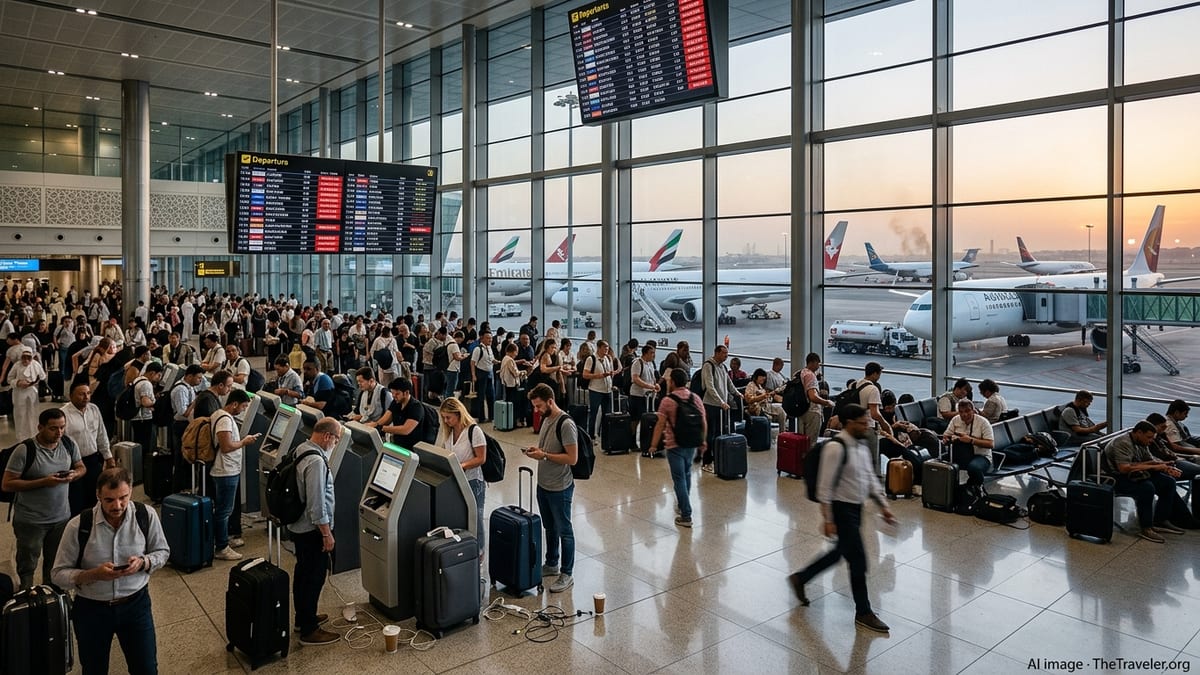
Airspace Closures Trigger Worldwide Flight Cancellations
The latest phase of the Iran war and widening regional hostilities has turned much of Middle Eastern airspace into a patchwork of closures and restrictions, forcing airlines on Europe Asia corridors to ground or reroute services. Publicly available flight-tracking data and industry reports show that as of early March 2026, airspace over Iran, Iraq, Israel, Jordan, Lebanon, Bahrain, Kuwait, Qatar, the United Arab Emirates, Oman and Saudi Arabia has been heavily curtailed, cutting through some of the world’s busiest long-haul corridors.
Coverage from aviation analysts indicates that the sudden closures have added between two and five hours to many Europe Asia journeys, with carriers diverting north via narrow Caucasus corridors or south via Egypt and the Arabian Sea. Longer routes are swallowing up scarce aircraft and crew hours, prompting widespread cancellations as airlines attempt to keep remaining schedules predictable.
Reports from recent strikes and missile exchanges across the region describe hundreds of thousands of travelers diverted or stranded as airports in key hubs including Dubai, Abu Dhabi and Doha temporarily halted operations during peak waves of hostilities. Airlines have been consolidating departures, swapping larger aircraft onto trunk routes and cutting marginal frequencies as they attempt to manage the volatility.
Industry presentations and safety briefings suggest the scale of rerouting now exceeds earlier disruptions seen after the closure of Russian and Ukrainian airspace in 2022, compounding the operational strain on carriers that had only just rebuilt long-haul networks after the pandemic period.
Jet Fuel Shock Drives Rapid Fare Increases
At the heart of the travel turmoil is a sharp spike in energy costs. The conflict has rattled oil markets by threatening shipping through the Strait of Hormuz and damaging key export and refining infrastructure in the Gulf, sending crude prices back above 100 dollars a barrel for the first time in several years according to business and energy outlets. With almost one fifth of global jet fuel supplies typically linked to flows through the Gulf, aviation fuel prices have climbed even more steeply than crude.
Specialist aviation and business publications report that benchmark jet fuel prices have surged from around 85 to 90 dollars a barrel before the latest escalation to price bands between 150 and 200 dollars in recent days. Airlines and regional carriers quoted in financial coverage say aviation turbine fuel now accounts for close to 40 percent of operating costs in some markets, compared with roughly a quarter in calmer years.
To contain the shock, airlines in Asia, Europe and the Middle East have moved quickly to reprice tickets. Trade press coverage indicates that many carriers have imposed or reinstated fuel surcharges on long-haul tickets, lifted base fares across both leisure and corporate cabins, and withdrawn promotional pricing on peak routes. Some large airlines have also suspended earnings guidance for 2026, citing uncertainty around energy markets and routing constraints.
Analysts note that while major European groups tend to hedge a substantial share of their fuel, many Asian airlines remain more exposed to spot prices. Travel economics commentary suggests that even a 10 percent increase in fuel costs can erase profit margins in a sector where average global net margins were projected at under 4 percent this year, magnifying the risk of capacity cuts if high prices persist.
Luxury Tourism Hubs Face a Crisis of Confidence
The disruption is particularly acute for the luxury segment, which depends heavily on seamless long-haul connectivity and the stability of marquee destinations in the Gulf and eastern Mediterranean. Before the latest escalation, Dubai, Doha, Abu Dhabi and coastal resort regions in Oman, Israel and parts of Turkey had positioned themselves as global magnets for high-net-worth travelers, combining flagship hotels, branded residences and high-spend retail.
Recent travel industry research already pointed to a more challenging outlook for luxury tourism in 2025 and 2026, with analysts warning that geopolitical tension, inflation and slower global growth could temper spending at the very top end. The current conflict has accelerated those headwinds. Travel agencies and corporate travel managers cited in regional media describe a steady flow of itinerary changes from affluent clients, who are asking to reroute via secondary hubs or shift vacations away from the Middle East entirely.
Economic studies on the impact of the Iran war suggest that Europe and key Asian economies are facing a broader energy-driven slowdown, leaving fewer households and companies willing to commit to high-end long-haul trips. Luxury hospitality operators in the Gulf now face the dual challenge of softer demand and higher operating costs, as imported food, energy and staffing become more expensive in tandem with elevated fuel and freight rates.
Consultancy reports tracking global wealth flows also indicate that investment-led travel linked to real estate purchases, residency programs and private banking has started to pivot more strongly toward destinations seen as safer or less exposed to regional conflict. Cities such as Singapore, London, and select U.S. gateways are expected to be relative beneficiaries, while resort-led luxury developments in the Middle East could struggle to hit earlier sales and occupancy targets if tensions remain elevated.
Airlines and Travelers Scramble to Adapt
As the crisis deepens, airlines are leaning on a toolkit honed through earlier shocks, from the pandemic to the war in Ukraine. Publicly available filings and press statements show carriers expanding fuel hedging, parking older widebody aircraft to free up cash, and reallocating capacity to shorter regional routes that avoid the most volatile airspace yet still capture resilient demand.
On key Europe Asia and Asia North America flows, travel data providers report a shift in traffic toward routes via northern European, Central Asian and East African hubs that remain open and can absorb additional connections. Some Middle Eastern carriers continue to operate skeleton services using carefully deconflicted corridors, but schedules often change at short notice, complicating forward planning for both leisure and corporate travelers.
For passengers, the new reality involves longer journeys, higher prices and a level of uncertainty not seen since the height of the pandemic. Consumer guidance from travel associations urges flyers to build in additional connection time, monitor airline apps closely for last minute changes, and consider flexible tickets or comprehensive insurance where available, particularly on itineraries transiting or overflying the Middle East.
Industry observers warn that if airspace closures and energy market turmoil persist into the summer peak, the current wave of disruption could evolve into a full-fledged capacity crunch. That scenario would test the resilience of airlines that entered 2026 expecting a year of steady growth and record leisure demand, and it would mark another setback for luxury tourism destinations that had banked on stability to sustain high-spending visitors.