

More news on this day
Ongoing regional conflict centered on Iran is continuing to wreak havoc on air travel across the Gulf, with fresh waves of flight cancellations and diversions disrupting passengers in Bahrain, Kuwait, Qatar, Saudi Arabia and the United Arab Emirates.
Get the latest news straight to your inbox!
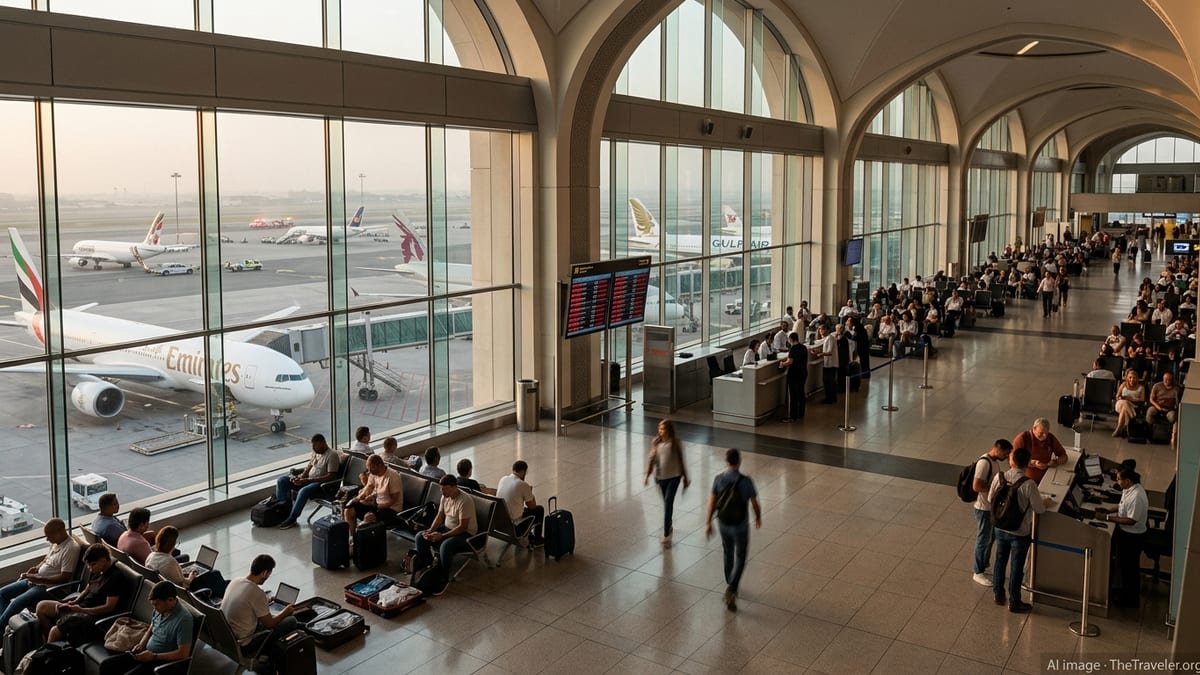
Conflict Escalation Ripples Across Gulf Aviation Hubs
Recent developments in the 2026 Iran war, including missile and drone strikes affecting Qatar and the United Arab Emirates, have sharply intensified disruption across key Gulf aviation hubs. Publicly available information shows that airspace closures and safety restrictions are continuing to constrain commercial operations at airports in Muharraq, Kuwait City, Doha, Riyadh and Dubai, among others.
In Qatar, reports indicate that Hamad International Airport in Doha has faced extended disruption since late February, when Qatari authorities closed national airspace following Iranian missile barrages. Although limited emergency and evacuation flights have gradually resumed, standard commercial schedules for Qatar Airways remain heavily curtailed, with many regular routes still suspended or operating at reduced frequencies.
In the UAE, open sources describe a series of Iranian missile and drone attacks targeting Abu Dhabi and Dubai, including an incident in mid March in which a drone strike triggered a fuel tank fire at Dubai International Airport. The attack led to a temporary suspension of flights and diversions to secondary airports, adding further pressure to an already strained regional network as airlines attempted to reroute aircraft and crew.
These conflict-related shocks have combined with existing airspace bans and overflight restrictions to create a highly fragmented operating environment. Carriers whose business models depend on the Gulf’s traditional role as a global connecting hub are being forced into day by day schedule changes, rolling cancellations and last minute aircraft redeployments.
Gulf Air, Qatar Airways and Emirates Lead Cancellation Totals
Within this unstable backdrop, regional flag carriers including Gulf Air, Qatar Airways and Emirates continue to shoulder the largest share of disruption. Industry tracking data and aviation analysis shared in recent days point to at least 174 flight cancellations and substantial additional delays across the main Gulf gateways as the latest wave of conflict has unfolded.
Gulf Air, based in Bahrain and traditionally reliant on its Muharraq hub, has been particularly affected by the combination of airspace constraints and proximity to conflict zones. Reports from travelers and airline communication channels suggest that a significant portion of the carrier’s scheduled departures through Bahrain have been cancelled or rerouted via alternative airports in Saudi Arabia, with some passengers rebooked through Dammam when Bahrain operations have been restricted.
Qatar Airways, long positioned as a major global network carrier, has similarly moved to an interim timetable as Doha’s connectivity has been sharply reduced. Publicly available updates describe a pattern of rolling schedule revisions, with core long haul routes prioritised while many regional services remain grounded. Even as the airline tentatively restores select intercontinental routes, aviation forums and schedule snapshots highlight ongoing cancellations to and from Doha, feeding into the broader tally of disrupted services.
Emirates, operating principally out of Dubai, has also faced repeated interruptions as flight operations at Dubai International Airport have fluctuated in response to security assessments and infrastructure damage. While the airline has mounted large scale repatriation operations and gradually resumed limited commercial flights, the cumulative impact of earlier suspensions, temporary airport closures and subsequent retiming has contributed significantly to the more than 170 cancellations currently being referenced in regional coverage.
Airspace Closures and Missile Threats Drive Operational Uncertainty
The primary driver of the ongoing aviation turmoil remains the complex and rapidly changing web of airspace restrictions linked to the conflict. Published analyses of the 2026 Iran war’s economic impact note that simultaneous closures or severe limitations in the airspace of the UAE, Qatar, Kuwait, Bahrain and other Gulf states have at times resulted in thousands of daily cancellations across the wider region.
For airlines based in the Gulf, these closures are not confined to simple point to point suspensions. Carriers must continually recalculate viable corridors to bypass conflict zones, missile trajectories and drone threat envelopes, often leading to circuitous routings that undermine the efficiency of hub and spoke operations. This dynamic is particularly acute for Qatar Airways and Emirates, whose networks depend on dense banks of closely timed connections that become almost impossible to maintain when key airways are shut at short notice.
Even when airports remain technically open, recurring missile and drone alerts have introduced new levels of uncertainty. In the UAE, public statements from officials and subsequent media coverage have described warnings about ballistic missile threats over major cities, with interception debris and isolated strikes causing damage near aviation infrastructure in Abu Dhabi and Dubai. Similar concerns have been raised in Qatar, where interceptions over populated areas have periodically showered shrapnel close to key transport corridors.
Each alert can trigger temporary ground stops, runway inspections and diversions, prolonging delays and prompting airlines to cancel services preemptively rather than risk last minute operational shutdowns. The result has been a stop start pattern of partial resumptions quickly followed by new waves of cancellations whenever the security situation deteriorates or new strikes are reported.
Passenger Strain Mounts as Repatriation and Interim Schedules Expand
For passengers, the evolving patchwork of cancellations and limited resumptions has translated into long waits, repeated rebookings and difficult choices about whether to remain in the region or seek alternative exit routes. First hand accounts shared on public travel forums over the past two weeks describe travelers stranded in Bahrain, Kuwait, Doha, Riyadh and Dubai after last minute cancellations, with some itineraries collapsing multiple times as different hubs came under renewed restrictions.
In response, several Gulf carriers have shifted from full commercial timetables to hybrid models that mix ad hoc repatriation flights with thin interim schedules on selected corridors. Emirates has organised large numbers of special departures aimed at clearing backlogs of stranded visitors in Dubai, while maintaining reduced scheduled operations where possible. Qatar Airways has gradually added a limited number of long haul destinations back into its network under an interim plan that still features widespread cancellations of previously advertised services.
Other regional and international airlines are adapting in parallel. Some have suspended all flights into the Gulf for defined periods, while others are operating select routes at lower frequencies, often with technical stops outside the conflict zone to avoid restricted airspace. For travelers attempting to move between Asia, Europe, Africa and the Americas, this has disrupted traditional one stop Gulf connections and pushed demand toward alternative hubs in Turkey, Europe and South Asia.
With flight availability changing rapidly, public guidance on travel forums and in consumer reporting consistently stresses the importance of checking flight status repeatedly rather than relying on original itineraries. Many passengers are being encouraged to explore refunds, waivers or alternative carriers where possible, although reports of long customer service queues and delayed responses remain common.
Outlook: Prolonged Disruption Likely if Conflict Persists
Economic and aviation analyses now circulating suggest that the Gulf’s airline and tourism sectors could face prolonged turbulence if the conflict around Iran continues at its current intensity. Commentaries from regional business media have warned that extended airspace closures and repeat strikes on or near critical infrastructure would represent a serious setback for hub strategies in Doha, Dubai and other cities that have invested heavily in aviation led growth.
The reference to 174 flight cancellations across key Gulf hubs in current reporting is widely seen as a snapshot rather than a ceiling. Given the scale of the networks operated by Gulf Air, Qatar Airways, Emirates and other regional airlines, every additional day of constrained airspace and elevated security risk has the potential to add dozens of new cancellations, particularly on high frequency regional routes linking Bahrain, Kuwait, Qatar, Saudi Arabia and the UAE.
At the same time, there are tentative signs that carriers are planning for a phased recovery scenario. Some airlines have begun publishing skeletal schedules for late March and beyond, contingent on security conditions, and are positioning widebody aircraft to restart high demand intercontinental links as soon as circumstances allow. However, aviation observers emphasise that any sustainable normalization will depend on a durable improvement in the security environment, including reduced missile and drone activity and more predictable airspace access.
Until then, travel across the Gulf is expected to remain volatile, with passengers advised by publicly available guidance to anticipate further cancellations and operational changes at short notice. For the region’s airlines and airports, the challenge will be to balance safety led caution with the pressure to restore the Gulf’s role as one of the world’s most important crossroads for international air travel.