

More news on this day
Global air travel is facing a new wave of disruption as renewed conflict in the Middle East prompts Cathay Pacific, Scoot, Singapore Airlines, Lufthansa and other major carriers to cancel or reroute flights, forcing passengers across multiple continents to rapidly adjust their travel plans.
Get the latest news straight to your inbox!
Rapid Airspace Closures Ripple Across Global Networks
According to recent operational updates from regional aviation authorities and airlines, escalating tensions involving Iran, Israel and Gulf states have led to the closure or severe restriction of key Middle East air corridors used by long-haul flights between Europe, Asia, Africa and Australia. Several flight information regions across the Gulf and parts of the Levant are now effectively off-limits to most civil traffic, triggering widespread schedule changes.
Publicly available briefings and industry analyses indicate that closures around Iranian and neighboring airspace have created bottlenecks for routes that traditionally cross the Persian Gulf and northern Middle East. As aircraft divert around conflict areas, flight paths are being re-drawn over southern alternatives such as Saudi Arabia, Egypt and the Arabian Sea where possible, adding substantial distance and complexity.
War-risk insurers are also reassessing exposure in the region, and aviation security advisories have become more stringent. The combination of regulatory restrictions, insurer conditions and airline risk assessments is resulting in hundreds of cancellations and last-minute reroutes, with knock-on effects that extend far beyond the Middle East itself.
The disruption is not a short-lived weather-style delay but a structural shift in how airlines can safely and legally move aircraft between continents. For travelers, that means even flights that do not touch the Middle East on departure or arrival may still be affected if they usually transit its airspace.
How Major Airlines Are Responding: Cathay, Scoot, SIA, Lufthansa and More
Cathay Pacific has adjusted a range of Europe and Middle East services that typically overfly high-risk areas, with reports indicating a mix of outright cancellations and extended routings. Some Hong Kong to Europe flights are operating on longer southern tracks, lengthening flight times and complicating crew scheduling. Travelers connecting through Hong Kong on multi-leg itineraries are therefore seeing tighter transfer windows or forced overnight stops.
In Southeast Asia, Scoot and Singapore Airlines are among the most visibly affected. Low-cost and full-service operations from Singapore to destinations in the Gulf and eastern Mediterranean have been thinned out, and some departures have been consolidated onto fewer frequencies. Publicly available schedules show selected services suspended for several days at a time while carriers rework routings and await clearer guidance on airspace access.
European groups such as Lufthansa have meanwhile cut or curtailed flights into the Gulf and beyond when safe, commercially viable routings are not available. Where alternatives exist, aircraft are routing further south or making additional technical stops for fuel, which can reduce aircraft availability for later rotations. Similar measures are being reported at other European and Asian carriers, including adjustments by airlines that serve the Middle East primarily as a transit bridge between Europe and South or Southeast Asia.
Because of the interconnected nature of airline alliances and codeshares, schedule changes by one carrier can quickly cascade across partner networks. A canceled Lufthansa or Singapore Airlines sector, for example, may invalidate onward connections that were ticketed on partner airlines under a single booking reference.
What Travelers Are Experiencing on the Ground
For passengers, the most immediate impact is an increase in last-minute cancellations, long delays and significant rerouting. Recent traveler reports describe flights from India and Southeast Asia to Europe being rebooked via entirely different hubs, sometimes adding many hours and one or two extra stops to the journey. Some long-haul services now include technical refueling stops outside the conflict zone, even when the origin and destination remain unchanged.
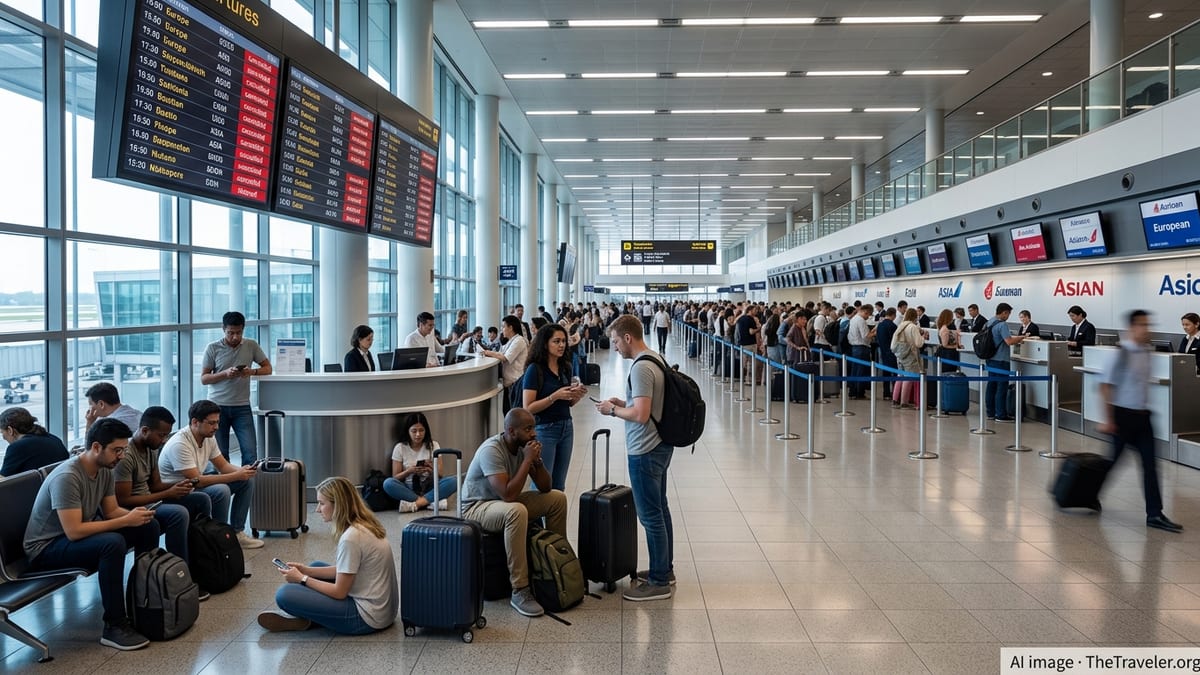
Airports in unaffected hubs are feeling the strain as airlines attempt to funnel disrupted traffic through alternative routes. Check-in queues are lengthening where multiple flights’ worth of passengers are trying to secure new itineraries at once. In some cases, same-day rebooking is not available because rerouted aircraft can carry fewer passengers or are already fully booked due to consolidations.
Confusion is particularly acute for travelers who booked itineraries involving self-transfers or separate tickets. When one leg is canceled due to airspace closures, subsequent segments on unrelated bookings may be automatically marked as no-show. Insurance guidance shared in public forums stresses the importance of documenting disruption as caused by conflict-related restrictions in order to support potential claims for additional accommodation or replacement tickets.
Passengers in transit hubs close to the affected region are also facing intermittent airport closures or curfews. Even when airports remain technically open, airlines may temporarily suspend operations while they reassess risk after new military activity or missile launches, resulting in rolling waves of delays that are difficult to predict far in advance.
Why Flights Are Being Rerouted or Canceled Instead of Flying Around
At first glance, it may appear that aircraft could simply detour around conflict zones, but the operational reality is more complex. Each additional mile flown increases fuel burn, and extended routings can push certain long-haul flights close to or beyond their viable range limits, particularly on westbound sectors facing headwinds. In those cases, airlines must either add a refueling stop or cancel the service entirely.
Crew duty time limitations are another critical factor. Longer routings may require additional pilots and cabin crew or even unplanned crew layovers at intermediate points, all of which add cost and scheduling challenges. Airlines are juggling limited spare crew capacity worldwide, and not every base or hub can easily absorb sudden multi-hour extensions to flight duty periods.
There are also constraints in neighboring airspaces that are seeing increased traffic. As more airlines divert around the core conflict zone, certain alternative corridors are becoming congested, prompting air traffic control to impose flow restrictions. These capacity limits can turn a theoretically available routing into a practical bottleneck, leading carriers to trim frequencies rather than operate consistently delayed services.
Finally, differing national and corporate risk thresholds mean that not all airlines will make the same choices. Some carriers may accept certain constrained routings that others consider too close to active conflict areas. Travelers comparing schedules will therefore see a patchwork of operating patterns, even on similar city pairs.
Key Advice for Affected and Future Travelers
Travel industry guidance emerging from the current disruption emphasizes preparation and flexibility. Passengers with upcoming flights on Cathay Pacific, Scoot, Singapore Airlines, Lufthansa or any airline transiting between Europe, Asia, Africa and Australia are being urged to check their flight status repeatedly in the 24 hours before departure. Automated notifications sometimes lag behind real-time changes, so consulting the airline’s latest operational update is vital.
Where travel is not time-critical, some experts recommend considering routings that avoid the broader Middle East altogether, even if they require detours via North America, Central Asia or secondary European hubs. While such itineraries can be longer, they may be less exposed to sudden airspace closures and the knock-on effects of conflict escalation.
Travelers whose flights are canceled or significantly delayed should keep detailed records, including screenshots of airline messages that reference airspace restrictions or security-related decisions. These documents can be useful when seeking refunds, compensation where applicable, or support from travel insurance providers, especially when policies distinguish between routine operational disruption and events linked to armed conflict.
With no clear timeline for a full reopening of affected airspace, the current Middle East conflict is expected to remain a prominent factor in global flight planning in the near term. For now, the most reliable strategy for travelers is to stay informed, allow extra time for connections, and build contingency plans into any itinerary that would normally cross the Gulf or neighboring regions.