

More news on this day
Escalating conflict in the Middle East is rippling across global aviation networks, prompting New Zealand and a growing list of countries including the United Kingdom, Germany, France, Switzerland and Fiji to brace for or implement widespread flight cancellations as major European and Pacific carriers suspend or reroute services.
Get the latest news straight to your inbox!
Middle East Airspace Closures Paralyse Key Global Corridors
Recent strikes involving Iran, the United States and Israel have led to the closure or severe restriction of airspace in multiple Middle Eastern states, including the United Arab Emirates, Qatar, Israel, Iran, Iraq and Bahrain. Publicly available government and industry reports describe Dubai International Airport, one of the world’s busiest hubs, as effectively shut, with thousands of flights cancelled or heavily delayed as airlines scramble to find alternative routings.
Economic reporting from New Zealand’s Ministry of Foreign Affairs and Trade indicates that more than 5,000 flights were cancelled in the first days of the crisis, with global disruption affecting an estimated tens of thousands more services as airlines avoid the region entirely. Carriers that usually link Europe and Asia via the Gulf now face detours that are significantly longer, with additional fuel requirements compounded by existing restrictions over Russian and Ukrainian airspace.
The combination of closed airspace, suspended services and elongated routings is being described in public commentary as one of the most severe shocks to international aviation since the height of the pandemic. Unlike health-driven border measures, however, the current disruption stems from direct conflict and associated security concerns along some of the world’s most heavily used flight corridors.
European Flag Carriers Suspend Services as Risk Landscape Shifts
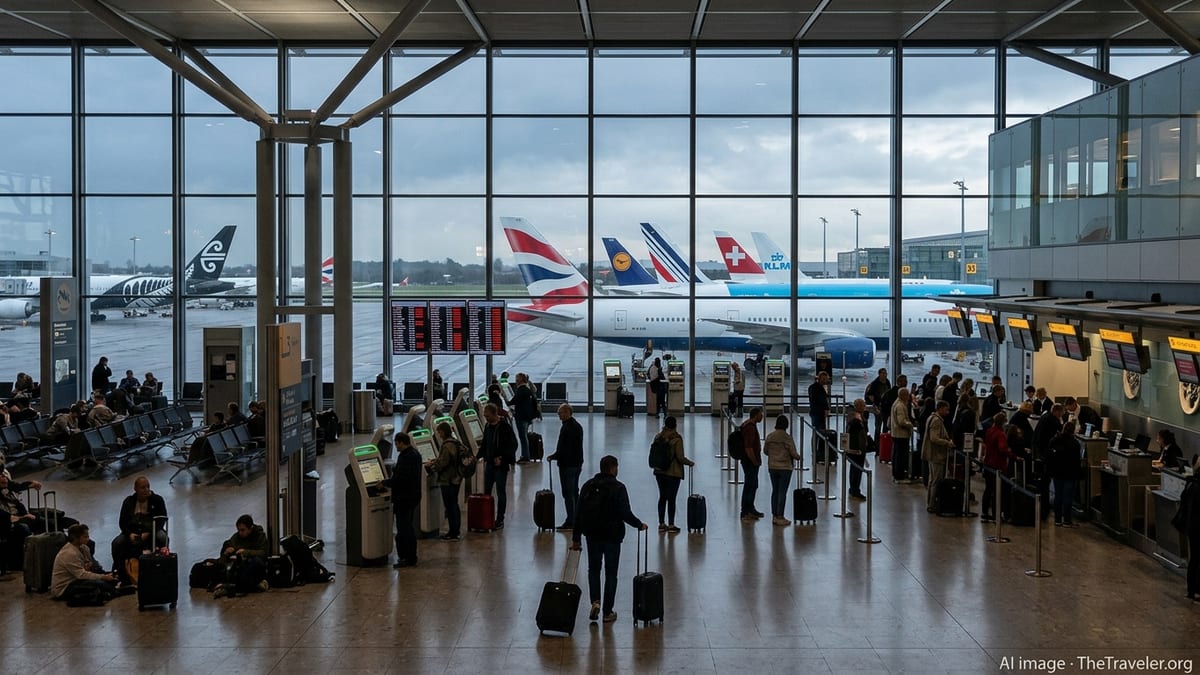
Major European airlines have been among the first to announce sweeping adjustments in response to the deteriorating security situation. Published coverage shows British Airways, Lufthansa, Air France, KLM and Swiss International Air Lines suspending or sharply curtailing services involving affected Middle Eastern airspace, particularly flights to and from regional hubs and routes that would normally overfly Iran or neighbouring states.
These decisions build on earlier suspensions linked to the Gaza conflict, when many of the same carriers halted flights to Tel Aviv and began rerouting long-haul operations away from sensitive areas. The latest escalation has widened that pattern, with network planners now re-evaluating not only point-to-point services into the region, but also long-haul connections between Europe, Asia, Africa and Oceania that traditionally rely on the Gulf as a bridge.
Public schedules and airline statements indicate that some carriers are opting to suspend routes outright, while others are introducing technical stops in safer locations to refuel on longer detours. The net effect for travellers is a reduction in frequency, longer travel times, and a higher risk of last-minute changes as conditions evolve day by day.
New Zealand and Pacific Travellers Face Indirect but Mounting Disruption
New Zealand is geographically distant from the Middle East, yet many of its long-haul passengers rely on European and Gulf carriers for connections to the United Kingdom and continental Europe. A travel advisory from Allianz Partners New Zealand notes that with key Middle Eastern hubs closed or restricted, flights from New Zealand to Europe and the UK that normally transit through the region are facing cancellations, missed connections and extended delays.
Publicly accessible New Zealand economic reports highlight that airspace closures in the Middle East have interacted with existing constraints elsewhere, leaving airlines with very limited routing options. As a result, some New Zealand-bound itineraries that would once have passed through Dubai, Doha or Abu Dhabi are being rebooked via Asian or North American gateways, where capacity is already tight.
Local commentary suggests that travellers from New Zealand are experiencing a mix of outright cancellations and complex rebookings, with alternative routes often involving additional stops and overnight layovers. While some airlines are offering flexible change policies, the sudden surge in demand for non-Middle East routings is pushing up fares and reducing availability, particularly during peak travel periods.
In the wider Pacific, Fiji also appears in public discussions of affected markets, with travel industry reporting noting that services linking the island nation to Europe and beyond are exposed to the same global network disruptions. Although Fiji-based carriers do not rely on Middle Eastern hubs to the same extent as some Asian and European airlines, the broader reshuffling of capacity is affecting codeshare and interline options that funnel visitors to and from the South Pacific.
Knock-On Effects: Fuel Costs, Capacity Squeeze and Airline Finances
Beyond immediate cancellations, analysts are warning of significant secondary impacts on airline finances and ticket prices. Detours around closed Middle Eastern airspace lengthen flight times between Europe and Asia, increasing fuel burn at a time when regional conflict is already pushing up global energy prices. New Zealand-focused commentary notes that Air New Zealand, which is not overflying the Middle East, is still facing higher jet fuel costs as a result of the conflict-driven shock to supply routes.
For European carriers, the combination of longer routes, additional crew hours and disrupted aircraft rotations is expected to weigh heavily on operating margins. Industry observers point out that capacity pulled from Middle Eastern routes may be redeployed elsewhere, but this is unlikely to fully offset the revenue loss from suspended services and the increased cost base created by detours.
Passengers are already reporting higher fares on remaining routes, particularly for last-minute bookings that avoid the Middle East. With many airlines offering fee waivers or flexible changes for itineraries involving the region, carriers are absorbing short-term financial hits in an effort to maintain customer goodwill and manage operational complexity. How long these policies can be sustained will depend on the duration and intensity of the conflict.
Travel Advice: Monitor Bookings Closely and Expect Ongoing Volatility
Travel advisories issued by New Zealand and other governments urge passengers with existing or planned itineraries through the Middle East, or on airlines that typically use Middle Eastern airspace, to monitor their bookings closely and remain prepared for rapid changes. Public information stresses the importance of checking flight status frequently, ensuring contact details are up to date with airlines and travel agents, and allowing extra time for connections where possible.
Travel insurance providers in New Zealand and abroad are also highlighting that many policies exclude disruptions caused by war or conflict. Advisory notices recommend that travellers review policy wording carefully before departure and keep receipts and documentation for any additional accommodation or transport costs in case partial claims are possible.
With no clear timeline for a resolution to the conflict, aviation analysts anticipate a prolonged period of volatility. Airlines in New Zealand, the United Kingdom, Germany, France, Switzerland, Fiji and other affected markets are expected to continue adjusting schedules, rerouting traffic and, in some cases, suspending services altogether as they balance safety, regulatory requirements and commercial viability in an increasingly constrained global airspace environment.