

More news on this day
Escalating conflict centered on Iran has unleashed the most severe disruption to global air travel since the pandemic, with Dubai and Abu Dhabi at the heart of an unprecedented shutdown of Middle East airspace that is rippling across routes between Europe, Asia, Africa and Australia.
Get the latest news straight to your inbox!
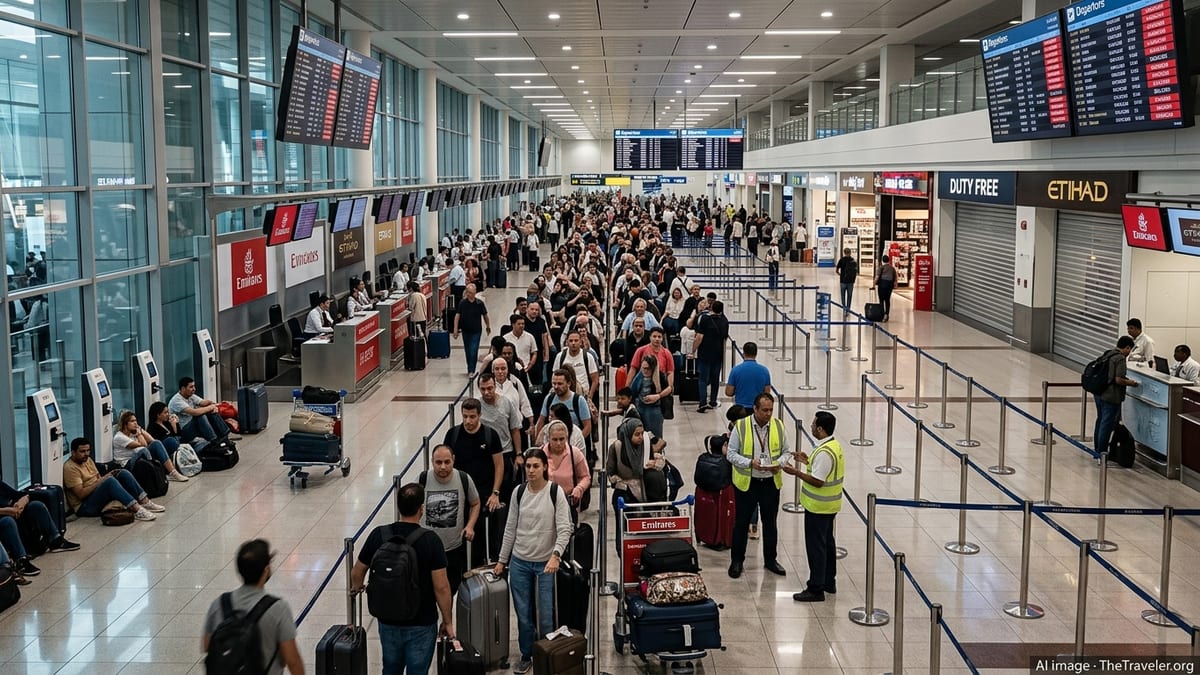
Gulf Mega-Hubs Brought to a Standstill
Airspace closures that began on 28 February 2026 have effectively throttled the Gulf’s role as the primary bridge between continents. Public flight-tracking data and industry analyses show that airports in Dubai, Abu Dhabi and Doha, normally handling around 90,000 passengers a day, have operated at a fraction of capacity or been closed outright for days at a time as the war in Iran escalates and missiles and drones periodically target infrastructure in the United Arab Emirates and Qatar.
Reports indicate that nearly 25,000 flights across the Middle East have been cancelled since hostilities flared, with thousands more diverted or delayed as carriers scramble to avoid closed skies over Iran, Iraq, Israel, Kuwait, Qatar, Bahrain and the UAE. Aviation data firms cited in recent coverage estimate that more than half of all scheduled flights in the region were wiped from timetables in the first week alone, stranding passengers at Gulf hubs and forcing complex rebookings through secondary airports in Europe, Turkey and South Asia.
Dubai International, the world’s busiest airport for international travel, has been particularly exposed. Publicly available information describes a drone strike that ignited a fuel tank at the airport, triggering a temporary suspension of flights and leaving Emirates, flydubai and dozens of foreign airlines with grounded aircraft and disrupted rotations. Abu Dhabi’s main airport has also reported interruptions following nearby strikes and debris incidents linked to the wider conflict zone.
While some operations have resumed on a limited basis, data from route trackers and airline schedules show Dubai still running at roughly a quarter of normal capacity by mid March, with Abu Dhabi and Doha constrained by lingering airspace restrictions and emergency procedures that prioritize evacuation and cargo movements over regular connecting traffic.
Asia–Europe Corridor Squeezed as Routes Lengthen
The Middle East conflict has hit the already fragile Europe–Asia aviation corridor at its most sensitive point. Since Russia’s airspace became largely unavailable to many Western carriers in 2022, long-haul airlines have relied even more heavily on Gulf hubs and southern routing to connect cities such as London, Frankfurt and Paris with Bangkok, Singapore, Sydney and Auckland. The closure or restriction of large portions of Middle Eastern airspace has removed that safety valve.
Travel intelligence services report that more than 3,400 flights were cancelled or diverted in just the first days of March as carriers were forced to redraw routes around Iran and its neighbors. Airlines have been steering aircraft north across Turkey and Central Asia or tracking far south over Egypt, the Red Sea and the Arabian Sea. These deviations typically add between 60 minutes and three hours to flight times, substantially increasing fuel burn and pushing crew duty limits to the edge.
The impact on fares has been immediate. Market trackers focusing on premium long-haul travel note that some last minute economy tickets on Asia–Europe itineraries, which would normally connect via Dubai or Doha, have surged above 7,000 dollars as capacity tightens and travelers compete for limited seats on alternative routings. This sharp spike comes on top of pre existing cost pressures from high fuel prices and congested air corridors.
For global travelers, the disruption has transformed once seamless connections through Dubai or Abu Dhabi into a patchwork of multi stop journeys. Many itineraries now route through Istanbul, Jeddah, Muscat or European hubs, often with extended layovers and little certainty that subsequent legs will operate on time. Travel advisories and airline notices are urging passengers to prepare for rolling changes to schedules well into the northern summer season.
Record Losses and Soaring Operating Costs for Airlines
The financial toll on airlines is mounting rapidly and, according to sector analysts, could erase much of the industry’s fragile post pandemic recovery. Even before the latest escalation, global carriers were expected to achieve a modest net profit margin of around 3.9 percent in 2026, leaving little buffer for large unplanned shocks. The combination of mass cancellations, rerouting costs and lost high yield connecting traffic is now pressuring that margin across the board.
Industry focused publications estimate that airlines have already suffered more than 23,000 conflict related cancellations tied directly to Middle Eastern airspace closures, with aggregate losses in the air travel market approaching 20 billion dollars. Operational cost breakdowns suggest that some carriers are spending an additional 6,000 to 8,000 dollars per flight hour on rerouted services once extra fuel, crew, maintenance and contingency planning are factored in.
Gulf based airlines are among the hardest hit. With hubs in Dubai and Abu Dhabi intermittently closed or constrained, Emirates, Etihad and flydubai have seen their flagship long haul networks temporarily shrink as aircraft sit on the ground and lucrative east west connecting flows are severed. Reports describe hundreds of wide body jets effectively sidelined during the most intense periods of disruption, a scenario that erodes revenue while fixed costs such as leases and staffing remain largely unchanged.
Foreign carriers are absorbing their own share of the shock. European and Asian airlines that previously relied on overflying Iran and neighboring states to shorten flight times are now burning significantly more fuel and flying longer block hours on each sector. Some have suspended services to the Gulf entirely, while others maintain skeletal schedules under special conditions. The result is a patchwork global network that is less efficient, more expensive to run and prone to sudden interruption whenever the security situation shifts.
Tourism, Business Travel and Cargo Links Disrupted
The upheaval in regional aviation is reverberating across tourism and trade in the Gulf. The United Arab Emirates and Qatar have spent years building reputations as safe, efficient stopover destinations and leisure hubs. The current conflict has sharply curtailed that role. Travel industry reports describe a plunge in inbound tourism to Dubai and Abu Dhabi as travelers defer holidays, redirect to alternative destinations or find themselves unable to obtain reliable itineraries.
Hotels and attractions in key visitor districts such as Dubai Marina, Downtown and Yas Island are reporting softer forward bookings, according to local tourism coverage, even as some properties continue to host stranded transit passengers and corporate travelers waiting for rebooked flights. Large scale events, conferences and exhibitions that rely on stable global air links are under review or being scaled back amid uncertainty over whether delegates can reach the Gulf on schedule.
Air cargo, a critical pillar of Gulf economies, is also under strain. With parts of the region’s airspace closed and hub operations curtailed, high value shipments that normally move through Dubai and Doha are being rerouted via secondary gateways or delayed. Logistics analyses note that time sensitive goods such as pharmaceuticals, electronics and perishable foods are particularly exposed to longer routes and tighter capacity, adding cost and complexity for supply chains that stretch between Asia, Europe and Africa.
For business travelers, the disruption has reshaped corporate mobility plans. Many firms are instructing staff to avoid non essential travel through conflict affected airspace and to favor virtual meetings where possible. When trips are approved, itineraries often include additional contingency time, backup routing options and flexible tickets, raising the overall cost of doing business in and through the Gulf’s traditional aviation hubs.
Uncertain Outlook as Conflict and Energy Risks Deepen
Forward looking assessments from economists and aviation specialists point to a highly uncertain outlook for Middle East air travel. The broader 2026 Iran war has already triggered a new energy shock, including disruptions at major gas and oil facilities and a partial halt of tanker traffic through the Strait of Hormuz. These developments are feeding into higher global fuel prices, which in turn amplify the cost pressures facing airlines just as they cope with rerouting and capacity constraints.
Published economic analysis suggests that prolonged conflict could push several energy dependent economies into recession by the end of 2026, a scenario that would likely dampen demand for discretionary long haul leisure travel while leaving essential business and migrant worker flows to absorb even higher fares. For carriers based in the Gulf, whose business models depend heavily on connecting diverse markets through a single hub, such a shift represents a fundamental challenge.
Regulators and aviation authorities across affected states continue to issue rolling flight notices that reopen and reclog segments of airspace as security conditions change, keeping operational planning in a state of flux. Routing patterns that appear viable one day can become inaccessible the next, complicating crew scheduling, aircraft maintenance and passenger rebooking processes on a global scale.
For now, industry observers see little prospect of a rapid return to pre conflict norms. Even if shooting subsides, infrastructure repairs, security reassessments and lingering traveler caution are expected to delay a full restoration of capacity at Dubai, Abu Dhabi and other Gulf gateways. As a result, airlines and passengers alike are bracing for an extended period in which the world’s most important crossroads for international air travel remains fragile, costly and prone to sudden disruption.