

More news on this day
Escalating conflict across the Middle East has thrown global aviation into turmoil, with shutdowns at major Gulf hubs in Dubai, Doha and Abu Dhabi disrupting long-haul connections and prompting a wave of cancellations by UK and European travellers planning holidays to New Zealand.
Get the latest news straight to your inbox!
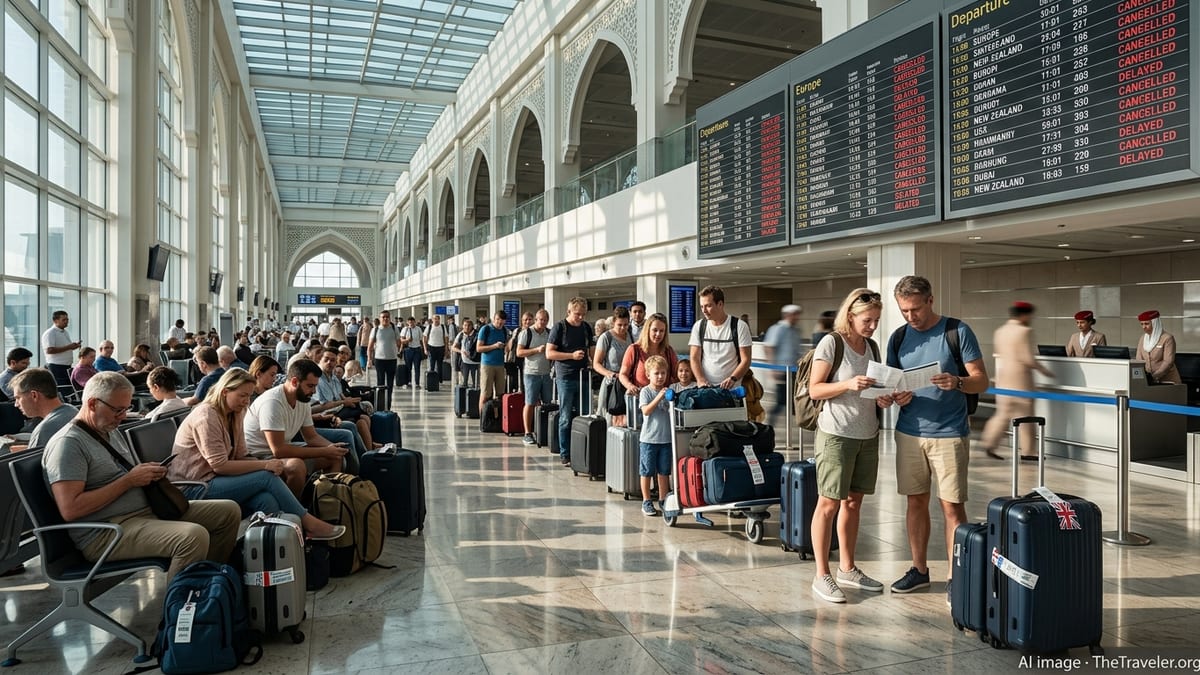
Gulf Airspace Closures Ripple Across Global Flight Networks
Middle Eastern airspace has become one of the most volatile regions in global aviation following coordinated strikes on Iran on 28 February 2026 and subsequent retaliatory attacks. Published coverage by international outlets indicates that airspace in multiple Gulf states, including the United Arab Emirates and Qatar, has been temporarily closed or severely restricted, forcing airlines to suspend large parts of their networks.
Dubai, Abu Dhabi and Doha, three of the most important transit hubs linking Europe with Asia and Oceania, have borne the brunt of the disruption. Reports from aviation analytics firms and travel risk advisories describe Dubai International, Abu Dhabi International and Hamad International operating at a fraction of normal capacity, in some cases limited to repatriation or relief flights only. Flight tracking data cited in news coverage shows thousands of cancellations and diversions over recent weeks.
Client advisories circulated to corporate travellers in early March highlight that Emirates has temporarily halted most operations to and from Dubai, while Etihad departures from Abu Dhabi and Qatar Airways flights to and from Doha have been heavily curtailed. Travel management companies describe the situation as the most severe test for the aviation sector since the Covid pandemic, with schedules repeatedly redrawn as military activity and airspace restrictions evolve.
Insurance and maritime briefings from the same period underscore the wider regional context. Shipping lanes through the Strait of Hormuz have faced heightened security risks, and several Gulf ports have reported operational constraints. Combined, these factors are contributing to higher fuel costs and war risk surcharges that are feeding through to long-haul ticket prices, including on routes to and from New Zealand.
UK and European Travellers Reassess Long-Haul Itineraries
The immediate consequence for travellers in the UK and continental Europe is a sharp reassessment of plans that rely on Gulf transit hubs. Trade media in Britain report that travel agents and tour operators have seen a noticeable shift in customer behaviour since the conflict escalated, with enquiries for the Middle East and surrounding regions dropping and late sales softening across some eastern Mediterranean destinations.
Industry reports in early March describe growing numbers of customers who had booked itineraries via Dubai transferring to perceived safer alternatives. In some cases, travellers have rebooked to destinations such as Egypt or Mediterranean resorts that can be reached without transiting closed or restricted airspace. In others, they have abandoned long-haul trips entirely, opting instead for UK or short-haul European breaks.
Specialist travel rights coverage in the UK notes that package holiday customers due to travel to or via the Middle East have been offered a mixture of refunds, rebooking options or credit notes, depending on the provider. One major tour operator highlighted in consumer reporting has cancelled and refunded all holidays to the United Arab Emirates, Qatar and several neighbouring states for departures in early March, signalling the scale of concern around ongoing instability.
Information collated by consumer finance outlets stresses that, under UK and European passenger rights regulations, travellers whose flights are cancelled are entitled to a refund or alternative routing, though additional compensation is unlikely where disruption is linked to war or airspace closure. This framework has become central to decisions by UK and European residents weighing whether to proceed with complex itineraries that depend on multiple connections through the Gulf.
New Zealand Holidays Caught in the Crossfire of Route Disruption
New Zealand, which sits at the far end of many global routes, has been particularly exposed to disruption at Middle Eastern hubs. Many itineraries between Europe or the UK and New Zealand rely on one-stop connections via Dubai, Doha or Abu Dhabi, taking advantage of high-frequency services operated by Emirates, Qatar Airways and Etihad.
Travel advisories produced for New Zealand residents note that airspace closures and airport shutdowns in the Gulf have led to widespread rerouting or cancellation of flights between Europe and New Zealand. One advisory from a major travel insurer in New Zealand points out that a significant share of Europe-bound traffic from the country now relies on Middle Eastern carriers, and that the current conflict has forced airlines to reconsider routings, capacity and pricing on these corridors.
Domestic New Zealand travel news outlets report that local travel agents have been busy assisting clients caught up in the turmoil, including customers from New Zealand, Australia and the UK who were transiting the region when the conflict intensified. Itineraries built around stopovers in Dubai, Doha or Abu Dhabi have been especially vulnerable, leaving travellers stranded or facing extended delays while alternative connections are arranged via Asia or North America.
For would-be visitors from the UK and Europe, the picture is similarly challenging. Reports from UK trade publications indicate that some travellers with New Zealand holidays booked for the coming months are choosing to cancel rather than accept lengthy detours or uncertain connection windows. Others are postponing trips until there is greater clarity on the duration of the conflict and the reliability of schedules through Gulf hubs.
Cancelled Bookings and Shifting Demand for Long-Haul Travel
The combination of operational shutdowns and customer anxiety is translating into tangible booking patterns. UK and European travel trade media describe a rise in cancellations and date changes for itineraries involving the Middle East, including those with final destinations far beyond the region such as New Zealand, South Africa and Southeast Asia.
Some agents, quoted in industry-facing coverage, report that clients originally due to travel to Dubai or via Dubai have opted to switch to alternative routings or destinations. In parallel, a New Zealand-focused travel advisory notes that jet fuel price volatility linked to Middle Eastern tensions has contributed to higher surcharges on long-haul routes, adding another layer of complexity for price-sensitive travellers planning trips at short notice.
While there is currently no indication of an elevated security risk within New Zealand itself, the logistics of reaching the country from Europe have become more complicated. Extended flight times, additional layovers and the risk of last-minute changes are discouraging some holidaymakers from committing to long-haul trips, particularly families and older travellers who value certainty and straightforward journeys.
Tour operators and airlines are attempting to respond by adjusting capacity on alternative corridors. Industry reports refer to increased use of Asian hubs and, where viable, North American gateways to maintain connectivity between Europe and New Zealand. However, the sudden concentration of demand on these routes is contributing to higher fares and limited seat availability during peak travel periods, which in turn reinforces the trend of some UK and European travellers cancelling or postponing New Zealand holidays.
Uncertain Outlook as Conflict Continues
Forecasts from risk consultancies and travel management companies suggest that disruption across Gulf airspace is likely to persist as long as the regional conflict remains unresolved. Advisories published in early March describe a volatile situation in which airports may reopen on a limited basis for repatriation or essential flights, only to face renewed restrictions in response to fresh military developments.
For UK and European travellers looking to reach New Zealand, the uncertainty has become a central factor in decision-making. Many are monitoring foreign travel advice from their home governments and guidance from airlines and tour operators before confirming bookings. Travel industry commentary points out that, even if airspace closures are gradually lifted, schedules could take weeks or months to stabilise as airlines reposition aircraft, crews and capacity.
Against this backdrop, some New Zealand tourism businesses that rely heavily on European and UK visitors are preparing for a softer shoulder season. While domestic and regional demand from Australia and the Pacific is expected to provide partial support, analysts quoted in tourism sector reporting warn that prolonged disruption at Middle Eastern hubs could temporarily weaken one of New Zealand’s most valuable long-haul markets.
As the conflict continues, the balance between travellers’ appetite for long-haul adventure and their tolerance for uncertainty is being tested. For now, published information indicates that many potential visitors from the UK and Europe are erring on the side of caution, delaying or cancelling New Zealand holidays that depend on a smooth passage through Dubai, Doha or Abu Dhabi.