

More news on this day
Air travel across the Eastern Mediterranean and Gulf is being rapidly rewritten as escalating conflict involving Israel, Iran and Hezbollah triggers mass flight cancellations and stark new security warnings for routes touching Cyprus, Israel, Lebanon, the United Arab Emirates and Qatar.
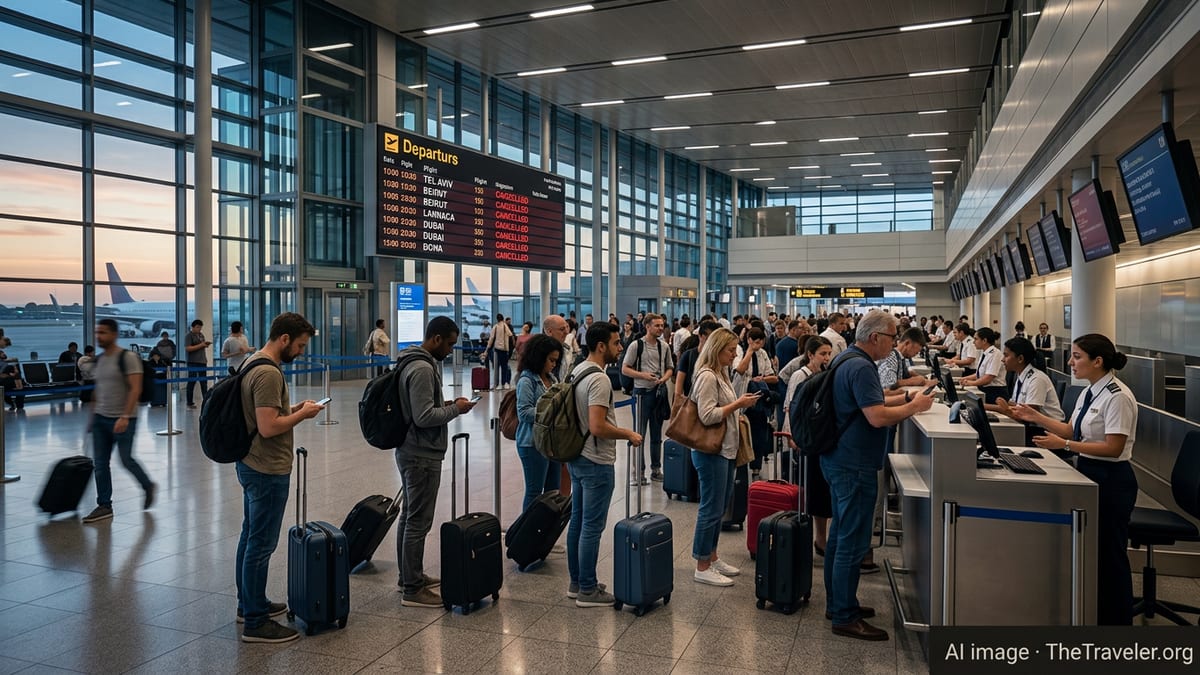
Cyprus Feels the Shockwaves as Flights Axed at Larnaca
Cyprus, long marketed as a safe sun-and-sea gateway on the edge of the Middle East, is now firmly on the front line of aviation disruption. Larnaca Airport cancelled 38 flights on Monday alone, as carriers reacted to surging tensions and shifting risk assessments for nearby Israel, Lebanon and the Gulf. The scrapped services mainly linked Cyprus with Tel Aviv, Beirut and major hubs in the United Arab Emirates, underscoring how tightly the island’s connectivity is bound to a suddenly unstable region.
The cancellations follow a drone strike on 1 March that hit the UK’s RAF Akrotiri base in Cyprus, an attack the Cypriot foreign minister said originated from Lebanon. While the base sits on sovereign British territory and commercial airports remain operational, the incident has sharpened concerns about spillover from the wider war and prompted airlines to reassess routings over the Eastern Mediterranean.
Tour operators report a spike in queries from British and European holidaymakers booked for spring trips to Cyprus, many of whom are now questioning the safety of flying through nearby conflict-affected airspace. Industry officials say bookings are holding for the Easter period but warn that further security incidents or prolonged airspace restrictions around Israel and Lebanon could force more schedule cuts from Larnaca and Paphos.
Local tourism leaders are urging governments and airlines to provide clearer timelines and contingency plans, arguing that uncertainty alone can be enough to push hesitant travelers to cancel. Hoteliers along Cyprus’s southern coast say they are already dealing with last-minute changes from guests unable to connect via Tel Aviv or Gulf hubs that normally feed traffic into the island.
Israel and Lebanon: Deep Red Warnings and Near-Total Aviation Disruption
Israel and Lebanon remain at the core of the crisis, both militarily and in terms of travel disruption. As fighting with Hezbollah escalates alongside the US-Israel war with Iran, major international airlines have pulled back sharply from Tel Aviv and Beirut. Routes from European carriers that had tentatively resumed after previous bouts of unrest have once again been suspended, in some cases indefinitely, as operators cite unacceptable risks from missile and drone activity.
Government advisories in North America, Europe and Asia classify Israel and Lebanon as do-not-travel destinations, with warnings of possible rocket and drone strikes on airports and civilian infrastructure. Insurers have raised premiums or withdrawn coverage for flights and tours, amplifying commercial pressure on airlines and travel companies already wary of crew safety and liability.
Within Israel, domestic connectivity has also been hit, with disrupted schedules and ad hoc changes to departure slots as authorities adjust to shifting security assessments. For Lebanon, where the national carrier is a critical lifeline, prolonged airspace restrictions and curtailed international services threaten to deepen an already severe economic crisis, cutting off tourism revenues and complicating the movement of aid workers and diaspora travelers.
Travel consultants say that for many leisure travelers, the question is no longer whether to postpone trips to Israel and Lebanon, but when it will be feasible to plan again. Corporate travel managers are likewise enforcing blanket bans on non-essential journeys, diverting meetings and conferences to alternative hubs in Europe or North Africa.
UK Tightens Advice as Cyprus Bases and Regional Routes Come Under Scrutiny
The United Kingdom, a key outbound market for Cyprus and Israel and home to military bases on the island, has responded with a series of updated travel advisories. The Foreign, Commonwealth and Development Office has strengthened its guidance on Cyprus, explicitly highlighting the risk of terrorism and urging Britons to keep departure plans under constant review, monitor news closely and ensure documents are ready in case rapid evacuation becomes necessary.
For Israel and Lebanon, the UK continues to advise against all travel to most areas, and against all but essential travel elsewhere, effectively shutting down mainstream tourism. Airlines serving British airports have reacted in kind, cutting or suspending routes to Tel Aviv and Beirut and adjusting schedules to bypass affected airspace. Some services that previously overflew parts of the Eastern Mediterranean are now routed further west or south, lengthening flight times and raising fuel costs.
The drone strike on RAF Akrotiri has also sparked political debate within the UK about the security of its overseas bases and the implications for adjacent civilian infrastructure. While British authorities insist there is no immediate threat to tourists in Cyprus’s main resorts, travel agents report an uptick in cancellations and rebookings from nervous families who had planned to use the island as a relaxed alternative to more volatile destinations.
At UK airports, airlines and tour operators are adjusting contingency plans first refined during the pandemic and previous Middle East flare-ups, including holding “rescue” capacity to repatriate citizens from hubs such as Dubai and Doha should the security situation deteriorate further.
UAE and Qatar Hubs Struggle Under Airspace Closures and Reduced Schedules
In the Gulf, the United Arab Emirates and Qatar, two of the world’s most important long-haul transit hubs, have endured unprecedented disruption. Airspace closures and missile and drone threats prompted Emirates, Etihad and Qatar Airways to suspend large parts of their operations from late February, grounding hundreds of aircraft and stranding passengers across multiple continents. While a limited number of services have now resumed from Dubai and Abu Dhabi, schedules remain sharply reduced and subject to last-minute change.
Qatar’s airspace has at times been effectively closed to commercial traffic, forcing the flag carrier to halt passenger services to and from Doha. Even as seaports and some cargo operations in Qatar and the UAE begin to stabilize under tight security, airlines are still navigating complex risk calculations, balancing operational viability against the prospect of further strikes and evolving regulatory guidance.
Travelers connecting between Europe, Asia and Africa via the Gulf are bearing the brunt of the upheaval. Many itineraries now involve lengthy detours over the Caucasus or the Arabian Sea, adding hours to journey times and pushing up ticket prices as airlines burn more fuel and redeploy scarce aircraft. Industry analysts warn that standard consumer compensation rules are unlikely to apply, since most cancellations are being classified as the result of extraordinary geopolitical events beyond airline control.
Local tourism economies in Dubai, Abu Dhabi and Doha are also feeling the pinch, with hotel bookings weakened by conference postponements and shifting corporate travel policies. Authorities in the UAE and Qatar have imposed strict access rules at airports to prevent overcrowding, allowing only passengers with confirmed departures into terminals and urging others not to travel without explicit airline confirmation.
Tourists Rethink Itineraries as Risk Maps Shift Across the Region
The mounting cancellations across Cyprus, Israel, Lebanon, the UAE and Qatar are forcing travelers worldwide to redraw their maps of what feels safe and practical. Destinations once marketed as stable bridges between East and West now appear on government lists of high or critical risk, prompting both casual tourists and seasoned business travelers to rethink long-planned itineraries.
Tour operators specializing in multi-country Middle East and Eastern Mediterranean tours say complex routing via Tel Aviv, Beirut, Dubai or Doha has become nearly impossible to guarantee in the short term. Instead, they are pushing customers toward itineraries that connect through southern Europe or North Africa, even when that adds cost and time. Airlines, for their part, are adjusting seasonal capacity away from the region, redeploying aircraft to transatlantic and intra-Asian routes where demand remains strong and security threats are lower.
Experts caution that while travel has historically rebounded quickly after previous crises, the scale and geographic spread of the current conflict make forecasting especially difficult. Much will depend on how long airspace restrictions around Israel, Lebanon and the Gulf stay in place, and whether further strikes affect civilian airports, energy infrastructure or maritime chokepoints such as the Strait of Hormuz.
For now, the advice from governments and industry alike is clear: anyone with upcoming trips involving Cyprus, Israel, Lebanon, the UAE or Qatar should check bookings frequently, register for official travel alerts and be prepared for sudden disruption. In a region where aviation is a lifeline as much as a convenience, the latest surge in cancellations is a stark reminder of how quickly security risks can ground even the most carefully laid travel plans.