

More news on this day
Escalating conflict centered on Iran and Israel is rippling through global aviation, prompting mass flight cancellations, ad hoc repatriation efforts and costly rerouting across key long-haul corridors linking Europe, Asia, Africa and the Americas.
Get the latest news straight to your inbox!
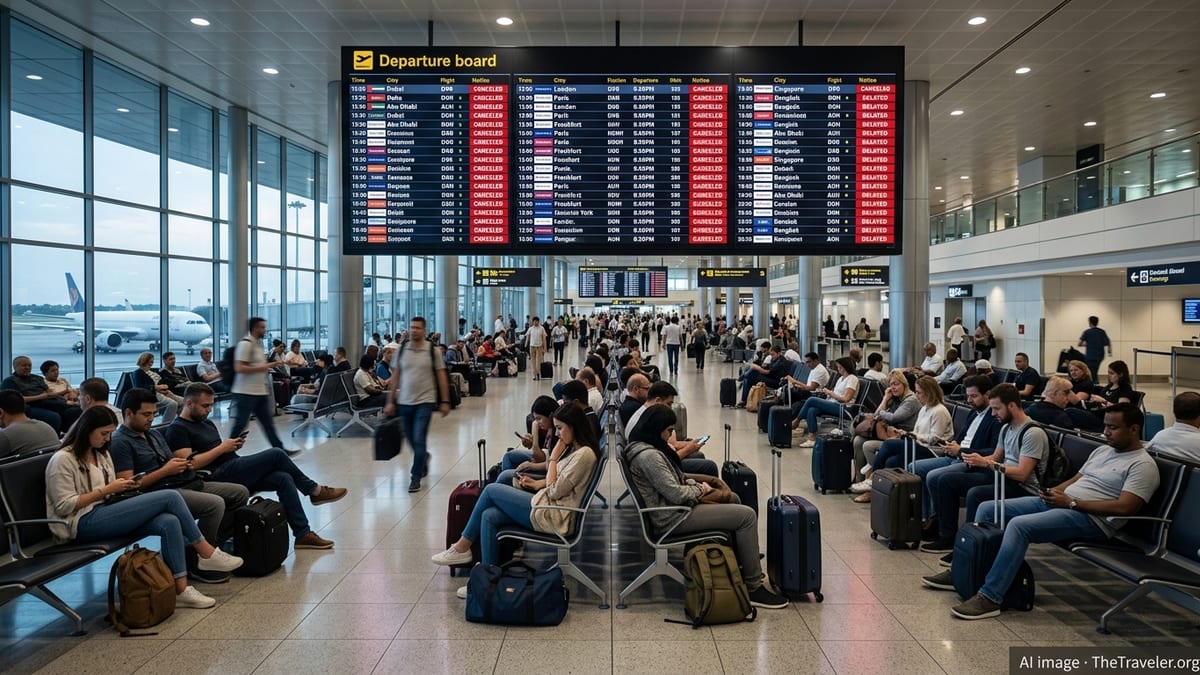
Airspace Closures Spark Mass Disruptions at Major Hubs
In late February 2026, coordinated U.S. and Israeli strikes on Iran and subsequent retaliatory attacks triggered sweeping airspace closures across the Gulf and wider Middle East. Publicly available air traffic data showed traffic over the United Arab Emirates and parts of neighboring states dropping sharply as authorities imposed temporary bans on overflights for safety reasons. Reports indicate that Dubai, Abu Dhabi and Doha, normally among the busiest international hubs, saw operations curtailed for days as airlines cancelled or diverted thousands of flights.
Coverage from international news outlets describes more than 1,800 flights cancelled by major Middle Eastern carriers alone in the immediate aftermath of the initial strikes, with hub airports reduced to skeleton operations or closed entirely for commercial traffic at peak disruption. Only limited services have resumed on some routes as regional authorities gradually reopen sections of airspace and carriers complete their own risk assessments.
Industry advisories updated in early March highlight that restrictions remain fluid, with some corridors reopening while others stay closed due to missile activity, drone incursions or concerns about potential misidentification of civilian aircraft. The result is a patchwork of operating conditions that forces airlines to redraw networks in real time, often with minimal notice to passengers already en route.
Global Carriers Suspend Routes and Lengthen Long-Haul Journeys
The turbulence is not confined to airlines based in the region. European and North American carriers have extended suspensions of flights to key Middle Eastern destinations and are reshaping long-haul operations that once relied heavily on Gulf and Levantine hubs. Recent reporting from regional business media notes that British Airways has halted flights to multiple cities including Dubai, Abu Dhabi, Amman, Bahrain and Tel Aviv, while Lufthansa, KLM, Swiss and other European groups have widened earlier suspensions across parts of the region.
Client advisories circulated to corporate travel managers in early March describe widespread cancellations or route cuts by Kuwait Airways and Oman Air, alongside ongoing suspensions at Iran’s main international gateway near Tehran. According to aviation reference databases, scheduled passenger operations at Imam Khomeini International Airport remain suspended as the war in Iran continues, effectively severing most direct commercial links into the country.
Elsewhere, long-haul flights between Europe and Asia that once transited Iranian, Iraqi or other high-risk airspace are being rerouted over Egypt, Saudi Arabia or Central Asia. Aviation risk analyses indicate that such detours can add 30 to 50 percent more fuel burn on certain sectors, reduce payload and extend flight times, particularly on routes already lengthened by earlier restrictions over Russia and Ukraine.
Stranded Travelers and Limited Repatriation Options
As cancellations mounted, hundreds of thousands of travelers found themselves stranded across the region and beyond. International wire services describe tourists, business travelers, migrant workers and religious pilgrims stuck in hotels and airports in the Gulf, Jordan, Lebanon and Egypt after their return flights were scrubbed or indefinitely delayed. Cruise passengers on itineraries calling at Middle Eastern ports have also been affected by late changes to embarkation and disembarkation ports as air links shifted.
Coverage in global travel media notes that governments have urged citizens in affected countries to depart while commercial options remain, while also organizing limited repatriation flights from select hubs. However, with many scheduled services still halted or operating at sharply reduced frequencies, options to leave on short notice remain constrained. Airlines are advising passengers not to travel to the airport unless they have received direct confirmation of a rebooked seat or a newly scheduled departure.
Travel insurers and consumer advocates caution that compensation may be limited because cancellations are tied to war and security risks, which are commonly excluded from standard policies. At the same time, carriers continue to face costs for hotel accommodation, meals and rebooking assistance where local regulations or commercial considerations encourage more flexible treatment of disrupted passengers.
Rising Fuel Costs and Airline Finances Under Pressure
The conflict’s impact extends beyond immediate schedule disruptions to the economics of global aviation. Reports from Associated Press and regional business outlets highlight a sharp rise in jet fuel prices since late February as attacks on shipping and energy infrastructure around the Strait of Hormuz constrained supply and pushed crude prices higher. Airlines in Asia, Europe and North America are contending with jet fuel bills that have climbed by hundreds of millions of dollars in aggregate since the latest escalation.
Airline executives speaking on recent earnings calls, as summarized in financial coverage, emphasize that strong passenger demand is so far helping offset higher operating costs, but warn that prolonged instability could weigh on profitability. In some markets, carriers have introduced fuel surcharges or quietly raised base fares on long-haul routes, particularly those now requiring extensive detours to avoid conflict zones. Analysts note that ultra-long-haul services are especially exposed, as additional track miles quickly compound fuel burn and crew costs.
For carriers in emerging markets with thinner balance sheets and higher taxation on aviation fuel, the squeeze is more acute. Industry commentary from South and Southeast Asia points to aviation turbine fuel now accounting for up to 40 percent of operating expenses in some cases, compared with roughly a quarter in more stable pricing periods. That leaves less room to absorb unexpected shocks linked to geopolitical events.
What Travelers Can Expect in the Coming Weeks
Travel experts and aviation risk consultancies expect conditions to remain volatile through at least the coming weeks, even if military activity moderates. Advisories updated in early March stress that short-notice airspace closures or new overflight restrictions are still possible if the conflict spreads geographically or if additional strikes target infrastructure near key flight paths. Airlines are therefore retaining contingency schedules and crew positioning plans that allow for rapid rerouting or further cancellations.
For passengers, industry guidance consistently recommends checking flight status frequently, monitoring airline apps and signing up for alerts rather than relying on printed itineraries. Travelers with connections through Gulf hubs or flights crossing the broader Middle East corridor between Europe and Asia face the greatest risk of disruption and may see longer layovers, last-minute changes of routing or, in some cases, forced overnight stays.
Booking patterns may also shift as travelers weigh convenience against perceived risk. Some may opt for itineraries that avoid the region entirely, choosing transatlantic or transpacific routings even when they add time and cost. Others, particularly business travelers with fixed commitments, are likely to continue flying into open hubs as airlines and airport authorities work to demonstrate that risk mitigation measures are in place.
Industry analysts note that global aviation has repeatedly adjusted to conflict-driven airspace restrictions over the past decade, from eastern Ukraine to the Persian Gulf. The current Middle East crisis, layered on top of existing limits over Russia and parts of North Africa, is testing that resilience once again and underscoring how quickly regional wars can reshape flight paths and travel plans far beyond the immediate conflict zone.