

More news on this day
Escalating conflict and widespread airspace closures across the Middle East are reshaping global flight patterns, pushing more travellers onto Singapore to Europe routes as Singapore Airlines, Lufthansa and other carriers rapidly rework schedules, aircraft deployment and fares to capture displaced demand.
Get the latest news straight to your inbox!
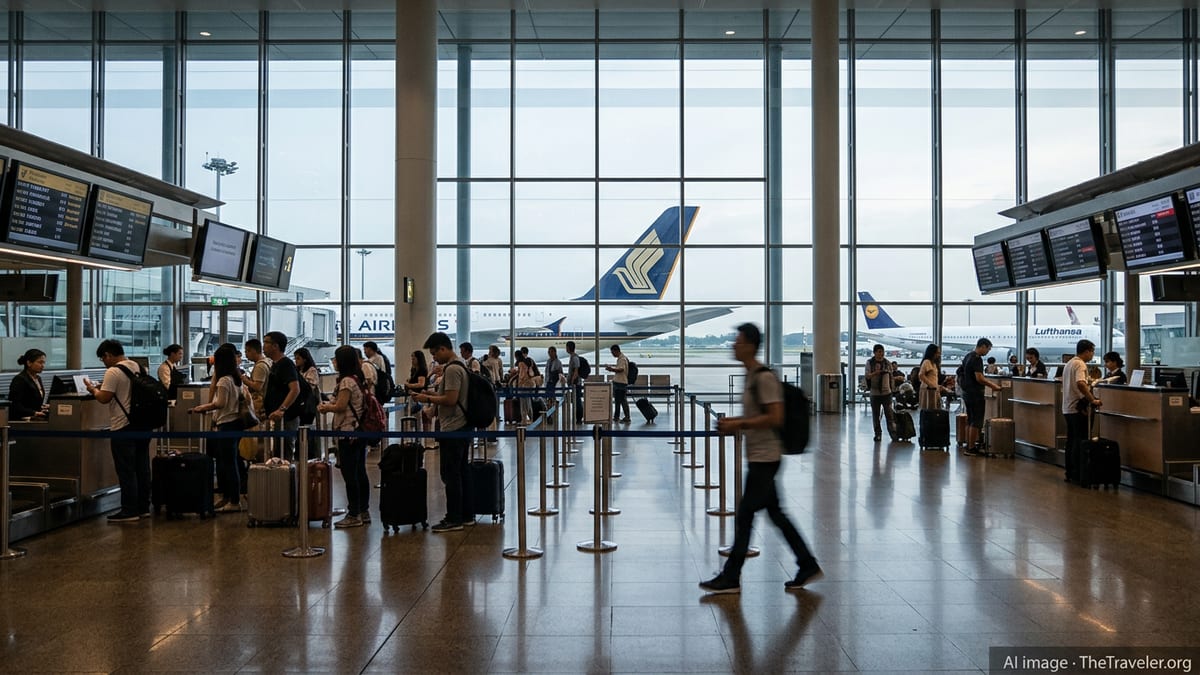
Middle East Conflict Turns Singapore Into a Key Detour
The latest phase of the Iran–Israel war and related regional tensions has triggered sweeping closures and restrictions across Middle Eastern airspace, including Iran, Iraq, Israel, Jordan and several Gulf states. Publicly available tracking data and industry analysis indicate that airlines flying between Europe and Asia are being pushed onto longer, more northerly or southerly corridors, dramatically reducing the usefulness of traditional hubs such as Dubai, Doha and Abu Dhabi.
Recent coverage from aviation analysts describes the Middle East corridor as the primary artery linking Europe with India and Southeast Asia. With that artery choked, carriers that can operate non-stop or near-non-stop between Asia and Europe without relying on Gulf stopovers have become far more attractive to passengers seeking certainty and shorter journey times. Singapore, already a leading transit hub, is emerging as one of the main winners in this sudden reshuffle of global traffic flows.
For travellers in Southeast Asia, Australia and parts of North Asia, itineraries that once routed via the Gulf are being rebooked through Singapore for onward connections to Frankfurt, Zurich, London, Paris and other European cities. Travel agents and booking platforms report a noticeable swing in search and booking patterns toward Singapore–Europe pairings, even as airlines work through rolling disruption on some individual flights.
The shift is also being amplified by separate constraints on other corridors, including ongoing Russian airspace restrictions for many European carriers. With traditional great-circle routes already compromised, the Middle East crisis has intensified competition for viable, safe and efficient paths between Europe and Asia, putting Singapore’s long-haul network in sharp focus.
How Singapore Airlines Is Repositioning Its Europe Network
Singapore Airlines entered 2026 with its largest post-pandemic schedule, planning more than 2,400 weekly passenger flights by March. Its European network has been a central pillar of that build-up, with increased frequencies and capacity on routes such as Frankfurt, London and Paris, along with fifth-freedom services within Europe that provide additional options for travellers once they reach the continent.
According to the carrier’s published schedule updates for the Northern Winter 2025–26 season, Singapore Airlines has been steadily upgrading aircraft and adding flights on several Europe routes, including boosting Frankfurt service to double-daily on some days and reintroducing Airbus A380s on selected high-demand sectors. These moves, initially aimed at capitalising on a broader recovery in long-haul travel, are now intersecting with the surge in demand resulting from the Middle East disruptions.
At the same time, Singapore Airlines is managing direct operational impacts from the conflict. The airline has issued multiple advisories in late February and early March 2026 detailing temporary cancellations on specific flights, particularly to and from the Gulf, as well as adjustments to routings to keep aircraft clear of conflict zones. Public information from the carrier stresses that it is continuously reviewing flight paths and schedules in response to evolving airspace restrictions.
Despite these tactical disruptions, the overall direction for Singapore Airlines appears to be toward higher Europe capacity and a stronger emphasis on non-stop connectivity. Industry observers note that the airline’s ability to offer one-stop itineraries from Australia, Southeast Asia and parts of East Asia to Europe via Changi, without relying on Middle Eastern hubs, is translating into a competitive advantage as travellers seek to avoid the most volatile parts of the region.
Lufthansa and European Carriers Reroute and Upgauge
On the European side, Lufthansa Group has emerged as one of the most visible examples of how airlines are adapting to the new risk environment. Public advisories and specialist travel reporting show that Lufthansa, Swiss and Austrian Airlines are now routinely avoiding Iranian and significant portions of Iraqi airspace, adding up to 90 minutes to some Asia-bound flights and complicating crew and fleet planning.
In parallel, Lufthansa has curtailed certain Middle East operations, including suspensions of Tehran services and overnight stops in Tel Aviv and Amman following updated guidance on conflict-zone risks. To compensate for the loss of these links and to serve continued strong demand between Europe and Asia, the group is leaning more heavily on its long-haul connections to major alternative hubs, including Singapore.
Travel-industry analysis indicates that Lufthansa’s partnerships and scheduling choices are increasingly focused on preserving connectivity between its German, Swiss and Austrian hubs and key Asian gateways that still have reliable access to Europe-bound airspace. Singapore, along with other points in Southeast and East Asia, features prominently in these revised patterns, with some flights operating on more southerly tracks via Saudi Arabia and Oman when necessary.
Other European network carriers, including Air France, KLM and British Airways, are implementing similar strategies, routing flights around high-risk airspace while leveraging alliances and codeshares to maintain access to cities served by partners such as Singapore Airlines. For passengers, this is translating into more itineraries that combine a European flag carrier on one leg with Singapore Airlines on another, especially on journeys that previously would have gone through Gulf hubs.
What Travellers Can Expect on Singapore–Europe Routes Now
For passengers planning trips between Singapore and Europe, the most immediate impact of the Middle East crisis is on journey time, reliability and price. Industry trackers report that detours around closed or restricted airspace are adding anywhere from one to several hours on affected Europe–Asia services, depending on the chosen path and prevailing air-traffic control constraints.
Singapore–Europe non-stop flights generally face fewer of these delays than services transiting Gulf hubs, but they are not immune. When airlines must thread through narrower corridors over the Caucasus or southern Mediterranean, congestion and flow control can ripple across the network, occasionally leading to knock-on delays even on flights that do not pass directly over the core conflict zones.
At the same time, the rerouting of demand away from Middle Eastern hubs is tightening capacity on popular Singapore–Europe city pairs. Public fare data and travel agency commentary point to rising prices on peak dates, particularly in school holiday periods and around major European events, as airlines adjust revenue management to reflect fuller cabins. Passengers booking close to departure are encountering fewer discounted economy seats and more dynamic pricing, especially on flexible and premium-cabin tickets.
Operationally, travellers can also expect schedule tweaks at relatively short notice. Airlines are frequently updating timetables as new airspace notices are issued, meaning that departure times, flight numbers or even operating days may change within days of travel. Carriers such as Singapore Airlines and Lufthansa are encouraging passengers to monitor booking portals and mobile apps closely for real-time updates.
Planning Ahead: Key Considerations for Singapore–Europe Flyers
Against this backdrop, travel experts advise that passengers treat Singapore–Europe trips during the current crisis as long-haul journeys through a highly dynamic operational environment. Booking early, choosing longer connection windows at hubs, and remaining flexible on dates and even airports within Europe can help reduce disruption risk.
For those starting in Southeast Asia or Australia, routing via Singapore to Europe is increasingly being viewed as a relatively stable alternative to itineraries through the Gulf. The combination of Singapore Airlines’ broad European network, European carriers’ growing reliance on Singapore as a key Asian gateway, and Changi Airport’s reputation for efficient handling is helping to absorb some of the shock from the Middle East closures.
However, travellers should remain prepared for extended flying times and potential last-minute rerouting. Premium cabins and higher fare classes are in some cases being used by airlines to prioritise rebooking options, meaning passengers on the most flexible tickets may find it easier to secure alternative flights if a disruption occurs.
Ultimately, the surge in Singapore–Europe traffic reflects both the resilience and the fragility of global aviation. As airlines such as Singapore Airlines, Lufthansa and their partners work to capture demand dislodged by the Middle East crisis, the balance between safety, efficiency and commercial opportunity will continue to shape how and where the world flies between Asia and Europe.