

More news on this day
A sudden escalation of conflict in the Middle East has shut key Gulf aviation hubs and choked vital air corridors, triggering a surge in airfares on Europe–Asia routes even as major Southeast Asian carriers including Thai Airways, Singapore Airlines and Vietnam Airlines keep their long-haul networks largely intact.
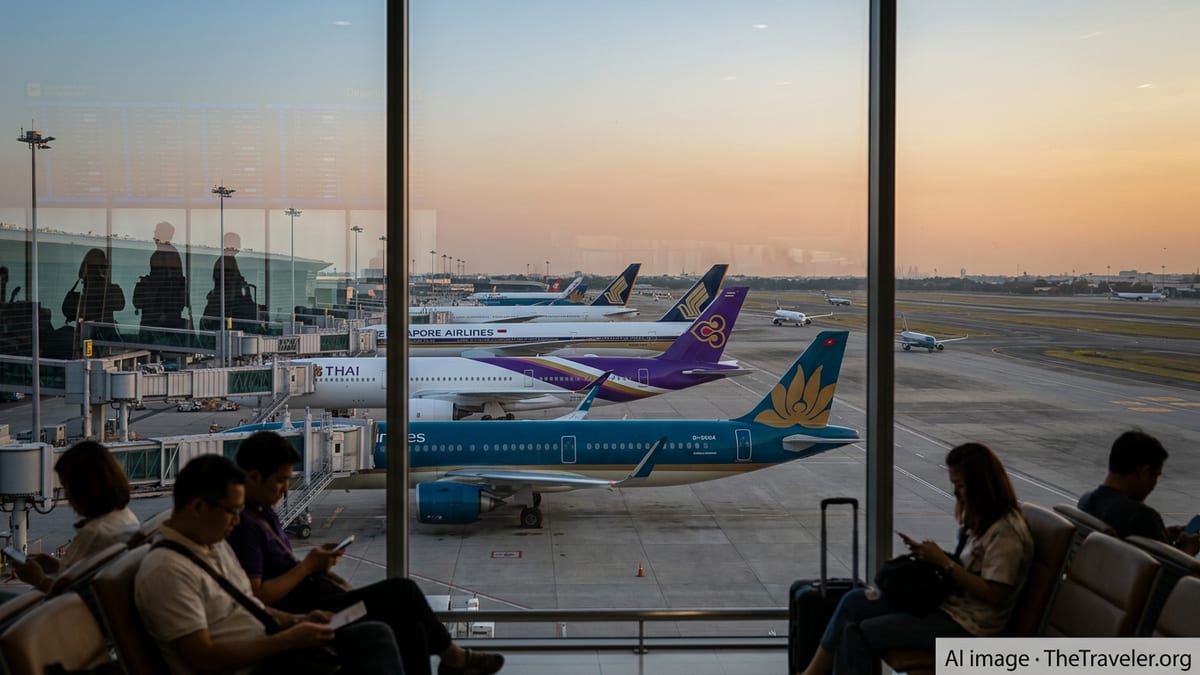
Gulf Hub Shutdowns Ripple Across Europe–Asia Network
Closures and severe restrictions at major Middle Eastern hubs such as Dubai, Doha and Abu Dhabi have upended normal traffic flows between Europe and Asia, forcing tens of thousands of passengers to abandon well-trodden one-stop itineraries via the Gulf. Airlines that rely on these hubs for connectivity between continents have cancelled or diverted thousands of flights in recent days, leaving aircraft and crew out of position and straining alternative routes.
With the “Silk Road” of the skies over Iran and Iraq effectively off limits, carriers are being pushed onto longer northern arcs via Central Asia and Turkey or southern loops over the Indian Ocean and East Africa. These detours add flight time, fuel burn and crew costs, sharply reducing the amount of flying each aircraft can perform in a day and tightening an already constrained global capacity picture.
The immediate impact on pricing has been dramatic. Industry fare trackers report one-way economy tickets on popular Asia–Europe sectors that typically sell for under 1,000 dollars now pricing between about 2,250 and 2,700 dollars, with many departures sold out for days ahead. On routes such as Hong Kong to London and Bangkok to London, remaining seats are concentrated in premium cabins, where last-minute business-class fares have jumped to several times pre-crisis levels.
Travel agencies across Australia, Europe and Asia say call volumes from stranded or anxious customers have surged, as travellers scramble to rebook itineraries that previously relied on Gulf stopovers. Agents are now racing to secure seats via secondary hubs in East and Southeast Asia or through Istanbul, even as availability tightens by the hour.
Thai Airways Reroutes but Keeps Europe Schedule Largely Intact
Thai Airways has emerged as one of the relative bright spots amid the upheaval, keeping its Bangkok–Europe network operating while implementing rapid route adjustments to steer clear of the most volatile airspace. The flag carrier has confirmed that all flights continue to operate as scheduled, but with revised routings that bypass the Middle East corridor and, in some cases, skirt sensitive stretches near the Pakistan–Afghanistan border.
Those longer routings are adding around 20 to 40 minutes to certain European sectors, according to regional aviation bulletins, but Thai Airways has stressed that safety and schedule integrity remain its priorities. The airline has told passengers to expect slightly extended flight times and a higher risk of weather- or traffic-related delays as more carriers crowd into the remaining safe corridors between Southeast Asia and the continent.
Behind the scenes, the operational challenge is significant. Longer flights require more fuel uplift in Bangkok, narrower payload margins during peak demand periods and more complex crew rostering to stay within duty-time limits. Yet Thai Airways’ ability to avoid mass cancellations has made it one of the few consistent options for travellers who previously relied on Gulf super-connectors to bridge Europe and Asia.
As capacity via the Middle East has evaporated, booking data show sharp interest in itineraries that connect Europe to Southeast Asia via Bangkok, with onward links into South Asia and Australasia. That shift is helping to fill Thai Airways’ European services even on traditionally softer travel days, supporting stronger yields at a time when the airline has only recently emerged from a lengthy restructuring.
Singapore Airlines and Vietnam Airlines Lean on Early Rerouting
Singapore Airlines, which had already moved to avoid Iranian airspace months before the latest escalations, is leveraging those earlier precautions to keep its Europe services running with relatively limited additional disruption. The airline and its low-cost arm Scoot have been using alternative routings since 2024 on flights between Southeast Asia and Europe, a strategy that now appears prescient as airspace closures spread across the Gulf region.
By maintaining consistent, if slightly longer, routings that bypass Iran and other high-risk zones, Singapore Airlines has spared customers the wave of abrupt cancellations now seen at Middle Eastern hubs. Its network planners are fine-tuning flight paths and adjusting departure times to mitigate congestion along the remaining north–south corridors, but the carrier’s core promise of daily links from its Changi base to key European capitals remains in place.
Vietnam Airlines is taking a similar approach from its hubs in Hanoi and Ho Chi Minh City, leaning on more northerly routes that overfly parts of China and Central Asia to connect with European gateways. While some services are operating with extended block times and padded schedules, the airline has so far signalled only selective disruptions, positioning itself as an alternative for travellers who might previously have chosen Gulf or Russian carriers for one-stop journeys.
Aviation analysts say these Southeast Asian airlines benefit from geography as well as strategy. Their home hubs sit far enough east and south that rerouting around the Middle East is operationally feasible without adding as much time as it would for European carriers trying to reach East Asia, many of which are already contending with restrictions on Russian airspace.
Layered Crises Compound Long-Running Cost Pressures
The Middle East conflict comes on top of several existing structural pressures that have been keeping Europe–Asia fares elevated since the pandemic. Restrictions on Russian airspace have already forced many Western airlines to lengthen routes to North Asia by up to four hours, an expensive detour that permanently raised operating costs on flights to Japan and Korea and reshaped the competitive landscape.
At the same time, aircraft supply remains tight as manufacturers struggle with production delays and airlines hold on to older jets longer than planned. Crew shortages in key markets and higher fuel prices linked to broader energy-market volatility further constrain how quickly carriers can add capacity when a shock hits. The sudden loss of Gulf hubs as through-routes to Europe has therefore collided with a system that had little slack to absorb disruption.
The result is an intense squeeze on remaining Europe–Asia capacity. Carriers able to keep flying safe alternative routes, such as Thai Airways, Singapore Airlines and Vietnam Airlines, are raising fares and tightening revenue-management controls to protect yields and preserve seats for higher‑paying last-minute bookings. For leisure travellers, this means that bargains are scarce and that travel dates may need to be shifted weeks out to find more normal pricing.
Industry observers warn that even if some Middle Eastern airspace reopens in the coming weeks, the backlog of displaced passengers and aircraft will take time to unwind. Until then, a premium is likely to remain baked into most cross-continent itineraries, and travellers may need to accept more complex routings, longer travel times and higher prices as the new normal.
Travellers Face Tough Choices as Carriers “Stand Strong”
The upheaval has created a stark divide between travellers with flexible plans and those who must fly now. Passengers trying to leave the Gulf region quickly are confronting sky‑high fares and limited options, with some turning to costly private charters to escape closed or overcrowded airports. Others are rerouting via secondary cities in South Asia or using overland journeys to reach functioning hubs before boarding long-haul flights to Europe or Asia.
By contrast, travellers starting or ending their journeys in Southeast Asia have a clearer, if still expensive, path. Thai Airways, Singapore Airlines and Vietnam Airlines are marketing their continued Europe services as a form of stability amid chaos, emphasising safety protocols and real-time monitoring of changing airspace restrictions. Their ability to “stand strong” on core routes is helping to keep some passenger flows moving between Europe and Asia, even as the traditional Gulf connectors are temporarily sidelined.
For many global travellers, the crisis is a reminder of how vulnerable modern aviation is to geopolitical shocks concentrated in a few critical corridors. The dense web of one-stop options that once made it simple to travel between Europe and Asia has, almost overnight, become a narrower and more fragile network. In that environment, Southeast Asian carriers that can safely navigate around conflict zones without grounding their fleets are poised to play an outsized role in keeping continents connected.
How long elevated fares will persist depends on both the trajectory of the conflict and how quickly airlines can re‑establish predictable schedules. For now, analysts advise travellers with non-essential plans to postpone or push their trips deeper into the booking window, when additional capacity and calmer markets could ease prices from their current highs.