

More news on this day
A rapidly widening war across the Middle East has turned one of the world’s busiest aviation corridors into a patchwork of no-fly zones, leaving hundreds of thousands of travelers stranded, forcing long detours between continents and driving up already high airfares just as the spring and summer travel seasons begin.
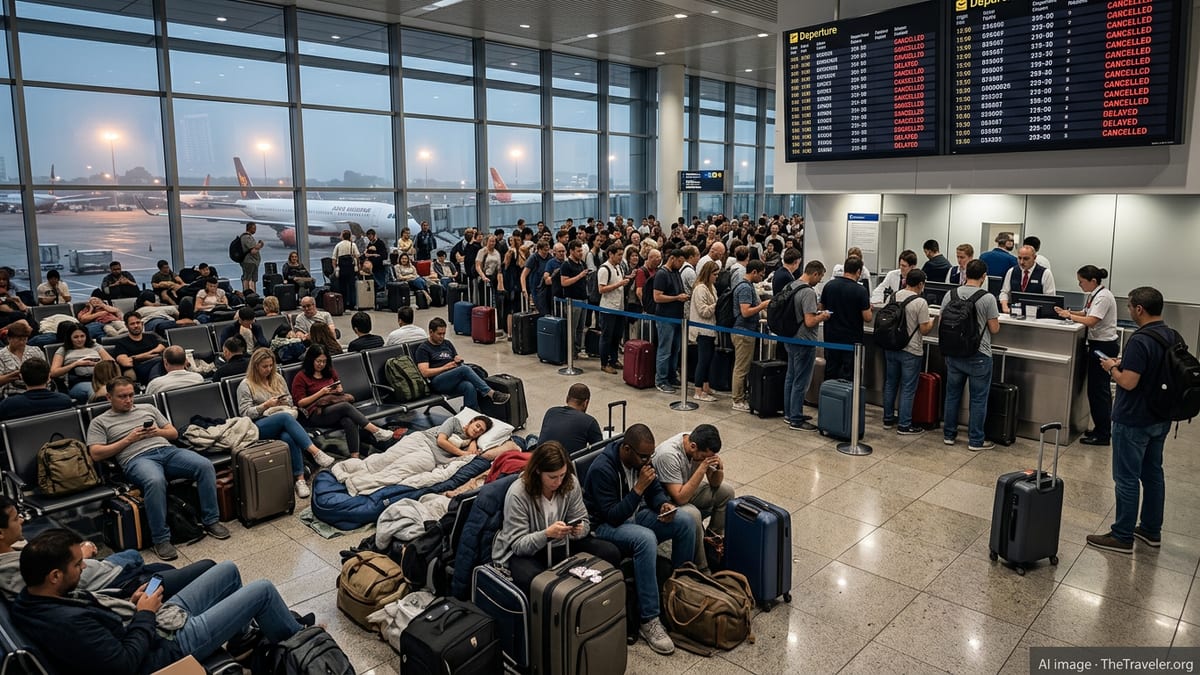
War Turns Gulf Super-Hubs Into Epicenters of Disruption
The latest shock came on February 28, when coordinated United States and Israeli strikes on Iran triggered large-scale retaliatory missile and drone attacks on Gulf states including Qatar and the United Arab Emirates. Within hours, Iran, Iraq, Kuwait, Bahrain, Qatar and several neighbors either fully closed or sharply restricted their airspace, according to aviation tracking services and local authorities. Hub airports in Dubai, Abu Dhabi and Doha, which normally funnel tens of thousands of passengers a day between Europe, Africa and Asia, saw operations slashed as arrivals and departures were cancelled or diverted.
Over the following days, analysts estimate that well over 1,800 flights operated by major Middle Eastern carriers were cancelled, with many more rerouted. Airlines such as Emirates, Qatar Airways and Etihad, which built their global business model on smooth transits through the Gulf, abruptly shifted to emergency schedules and limited evacuation services for stranded passengers. Terminals accustomed to choreographed, high-volume transfers instead filled with cots, queues and confused travelers juggling rebooking apps and urgent calls from home.
Authorities in the United States and Europe compounded the turmoil with sweeping new safety directives. The Federal Aviation Administration and European regulators issued strong warnings or de facto bans on commercial traffic through much of the region, particularly over Iran, Iraq and key parts of the Gulf, effectively severing some of the shortest links between West and East. Even as a handful of carefully controlled flights resume, officials warn that sudden closures are possible as the conflict evolves.
Rerouted Long-Haul Flights Add Hours and Drive Up Fares
For many travelers outside the region, the most immediate impact is not a cancelled ticket but a dramatically longer journey. With Iranian and large swathes of Gulf airspace considered too risky, airlines operating between Europe or North America and Asia are redrawing their route maps in real time. Some carriers are now flying far north via Turkey, the Caucasus and Central Asia, while others are dropping south over Egypt, Saudi Arabia and the Red Sea, looping around danger zones instead of slicing through them.
Immigration and mobility advisers tracking flight patterns report that these detours can add three to five hours to some of the world’s busiest long-haul legs. For passengers, that often means extra connections, missed same-day links and an increased risk of knock-on delays when weather or technical issues intervene further along the chain. For airlines already grappling with crew shortages and tight aircraft availability, the longer flying times burn more fuel and tie up jets and staff for additional hours.
Those higher operating costs are now feeding directly into ticket prices. Travel industry groups in markets such as India say bookings on routes that rely on Middle East connections have seen 20 to 25 percent cancellations or rescheduling in recent days, while remaining seats on alternative routings are becoming scarcer and more expensive. Corporate travel managers report last-minute fare spikes on Europe–Asia itineraries that avoid the Gulf entirely, as demand surges for the few remaining options that still feel predictable.
Budget-sensitive travelers are among the hardest hit. The Gulf super-hubs have long kept a lid on prices by pitting big network carriers against each other on connecting routes. With that competitive pressure suddenly reduced and capacity constrained, specialists warn that elevated fares could persist well into the northern hemisphere summer if the crisis continues.
Safety Advisories Turn Holiday Plans Into Evacuation Calculus
Government travel advisories have moved almost as fast as the missiles. The United States has urged its citizens across a broad swathe of the Middle East, from Israel and the Palestinian territories to the Gulf and parts of North Africa, to leave as soon as commercial options are available, citing serious safety risks. Many European capitals have issued parallel warnings and ordered the departure of non-essential embassy staff from Gulf states heavily involved in the confrontation.
That official alarm has placed tourists, business travelers and expatriate families in a difficult bind. In countries where commercial flights are heavily restricted, only a trickle of evacuation and special charter services are currently operating, and seats sell out quickly. Some passengers who arrived for winter sun or religious pilgrimages now find themselves scrambling to secure any outbound seat, sometimes at premium prices, while juggling visa limits, work obligations and family back home.
The ripple effects also extend to those who only ever planned to change planes in the region. Holidaymakers en route from Europe to Indian Ocean resorts or Southeast Asia, students flying between North America and South Asia, and migrant workers commuting between jobs in the Gulf and home countries have all seen itineraries shredded. In many cases, airlines are invoking special “unrest waivers” that allow free date or routing changes, but accommodation and incidental costs often fall on the traveler.
For those with upcoming trips, travel-risk consultants say the decision matrix has shifted from classic holiday planning to crisis assessment. They advise checking not only destination advisories but also the status of any transit hubs, the airline’s current routing, and the fine print of cancellation and insurance policies. Bookings that looked sensible even a week ago may now involve flying over or through airspace that regulators regard as unsafe, or that could be closed at short notice.
Insurance, Refunds and the Fine Print on “Force Majeure”
As travelers confront cancellations and last-minute changes, the small print of airline contracts and travel insurance policies has become critical. Most carriers classify large-scale conflict and related airspace closures as force majeure, a legal term that limits their obligation to provide compensation beyond refunds or rebooking. While many airlines are currently offering fee-free date changes or rerouting within a defined window, they are generally not required to cover hotels, meals or missed tours when war is the underlying cause.
Standard travel insurance offers a similarly uneven safety net. Policies that were purchased before tensions escalated and that include explicit coverage for war-related disruptions or government travel warnings may reimburse at least part of the additional costs. However, many mass-market plans exclude armed conflict, civil unrest or official advisories entirely, leaving policyholders to shoulder the losses themselves. Insurers are also tightening conditions for new policies, sometimes excluding the whole region from trip cancellation coverage.
Consumer advocates urge travelers to document every disruption, from airline cancellation notices to hotel invoices and taxi receipts, in case partial reimbursement becomes possible later. They also recommend avoiding non-refundable bookings for add-ons such as tours or domestic flights that are linked to a vulnerable international leg. Where possible, paying with credit cards that include robust travel protections can provide an extra layer of fallback if an airline or operator proves unresponsive.
Industry lawyers note that previous crises, from volcanic ash clouds to earlier conflicts around Israel and the Gulf, have sometimes prompted regulators and courts to push airlines toward more generous treatment of stranded passengers. Yet they caution that the unprecedented geographic scale of the current airspace shutdown could limit authorities’ willingness to impose additional financial burdens on carriers already absorbing heavy operational and security costs.
What Travelers Should Do Now if Their Route Crosses the Region
For anyone with tickets that touch the Middle East over the next few weeks, the first step is to verify where, exactly, the flight is supposed to go. Experts advise checking not just the city pairs on a booking confirmation but also the transit points and, where available, the approximate routing shown in airline apps or flight-tracking tools. An apparently simple journey from Europe to India or from North America to Southeast Asia may in fact rely on a Gulf connection that is no longer viable.
Travel agents and corporate travel managers are steering clients toward itineraries that route via alternative hubs in Europe or Asia, even when these options are more expensive or less convenient. In some cases that means adding a stop or overnight layover to avoid bottlenecked corridors. For flexible travelers who have not yet booked, shifting departure dates away from the next two to three weeks could reduce the risk of last-minute cancellations and make it easier to secure seats on non-Gulf routings.
Passengers who are already ticketed through the region should monitor airline communications daily, as schedules are being rebuilt at short notice. If a carrier issues a travel waiver, moving quickly is key, since rebooked seats on alternative routes are limited. Travelers are also being encouraged to register with their embassies when flying to or from high-risk countries, so that consular staff can reach them quickly if evacuation flights or new restrictions are announced.
Ultimately, the question many holidaymakers are now asking is whether their plans are already ruined. Industry specialists say that for trips heavily dependent on Gulf connections in the near term, the honest answer may be yes, at least in their original form. Yet for those willing to accept longer journeys, higher fares and more complex routings, a modified version of their itinerary may still be possible. As one aviation analyst put it this week, global travel is not stopping, but it is being forced to relearn how to move around a region that once sat at the very center of the world’s skies.