

More news on this day
Thousands of travelers across the Middle East and beyond remain stranded this week as Emirates, Etihad Airways and flydubai struggle to restore services following a dramatic shutdown of Gulf airspace triggered by the escalating conflict involving Iran, the United States and Israel.
How the Middle East Crisis Brought Air Travel to a Standstill
The current disruption began on February 28, when a wave of strikes between Iran, the United States and Israel led to the closure of key airspace across the Gulf and Levant, including Iran, Iraq, Kuwait, Bahrain, Qatar, Jordan and parts of the United Arab Emirates. Within hours, the region’s largest hubs in Dubai, Abu Dhabi and Doha suspended nearly all commercial flights, severing some of the world’s busiest east–west corridors.
Emirates, Etihad Airways and Qatar Airways, which normally funnel tens of thousands of passengers a day between Europe, Asia and Africa, were forced to ground or divert services as airlines re-routed around the conflict zone. Aviation analysts say daily cancellations quickly surged into the thousands as carriers from India, Europe and East Asia scrapped Middle East rotations or added hours to flight times to skirt closed skies.
The shutdown rippled far beyond the Gulf. Travelers who never intended to set foot in the region found their journeys unraveling as Dubai and Doha stopovers disappeared from global schedules, leaving passengers stranded in origin cities from Dhaka to London after onward connections collapsed.
In the days that followed, governments and airlines scrambled to assess damage, manage stranded passengers and negotiate limited operating corridors. Even as some Gulf airports cautiously reopened, restrictions on overflying Iranian and Iraqi airspace kept pressure on capacity, and the backlog of disrupted travelers continued to grow.
UAE Airlines Move From Full Suspension to Limited Schedules
Emirates, based at Dubai International Airport, initially suspended all scheduled passenger flights to and from Dubai through early March, operating only a handful of repatriation and freighter services. Over the past several days, the carrier has gradually reintroduced flights on select routes and now says it is serving dozens of destinations on a reduced timetable, while warning that schedules remain highly subject to change.
In Abu Dhabi, Etihad Airways followed a similar path, halting most commercial operations before resuming a limited passenger schedule from March 6 on key routes to Europe, Asia and the wider Middle East. The airline has prioritized travelers already in the network and those whose flights were cancelled, urging passengers not to go to the airport unless they have a confirmed rebooked itinerary.
Low cost carrier flydubai has restarted a constrained set of regional services from Dubai, focusing on short haul destinations where airspace remains open, such as certain routes via Oman and Saudi Arabia. Flight frequencies are markedly lower than normal, and many routes that ordinarily rely on overflights of Iran or Iraq remain suspended or heavily delayed.
Although capacity is slowly returning, the restoration is uneven. Routes that require long detours to avoid conflict zones are operating with reduced frequencies, while airlines keep aircraft and crew positioned for sudden changes in security assessments. Aviation forecasters expect it will take at least several more days before a clearer pattern of stable schedules emerges.
Thousands of Travelers Stranded and Facing Mounting Costs
The sudden shutdown has stranded passengers in multiple locations at once: inside the UAE, in transit points around the region, and in origin countries as outbound flights are cancelled with little notice. Local media in South Asia report hundreds of cancelled services from cities such as Dhaka and Kochi to Gulf hubs, leaving migrant workers and family visitors facing repeated rebookings and airport overnights.
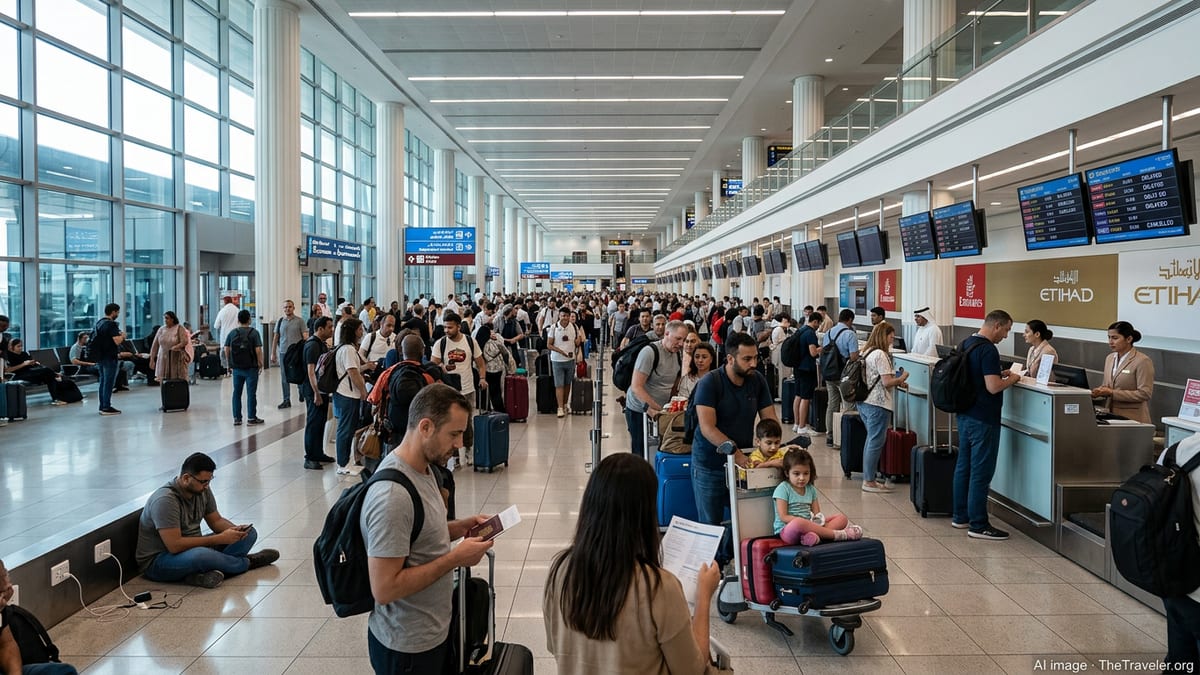
Travelers stuck in Dubai and Abu Dhabi describe crowded terminals, long lines at airline desks and hotel costs that can quickly soar. One tourist in Dubai reported daily expenses of around 500 dollars as she waited for a replacement flight, highlighting the financial pressure on visitors whose travel insurance may not fully cover conflict related disruption.
To ease the strain, several carriers and governments have launched relief efforts. Air India and Air India Express, for example, have scheduled dozens of additional flights to and from the UAE to repatriate Indian nationals, while Gulf and European airlines are operating special services to clear backlogs from key hubs. Nonetheless, demand vastly outstrips available seats, and many travelers are being told to expect multi day delays.
Airports are also struggling with crowd management. With Saudi Arabian airspace serving as a primary alternative corridor, congestion and knock on delays are being reported on rerouted flights, compounding the uncertainty for passengers who do manage to board.
What Affected Passengers Need to Know Right Now
For travelers with upcoming trips through the UAE or wider Middle East in the next week, industry and government advisories share a consistent message: do not assume your flight is operating, and do not go to the airport until your airline has issued a fresh confirmation. Schedules that appear bookable one day can be pulled the next if security conditions change or airspace permissions are adjusted.
Major carriers are waiving change fees and fare differences for many affected itineraries, particularly on flights scheduled through mid March. Travelers are being offered options to postpone travel, reroute via alternative hubs or convert tickets into vouchers, although exact policies vary by airline and fare type. Those who booked through online travel agencies or third party agents may need to work through intermediaries, which can slow rebooking.
Passengers already overseas should keep all receipts for hotels, meals and local transport, as some airlines and travel insurers may reimburse reasonable expenses when delays or cancellations are prolonged. However, compensation rules differ widely between regions. European regulations, for instance, offer stronger protections for flights departing the European Union, while many routes to and from the Gulf are governed by airline specific conditions rather than statutory schemes.
Experts also advise keeping a charged phone, downloaded airline apps and email access available at all times. Seat availability on relief and reinstated flights can change within minutes, and travelers who respond quickly to rebooking offers have the best chance of securing earlier departures.
Looking Ahead: How Long Will Disruptions Last?
Aviation analysts caution that while the most severe phase of the shutdown has passed, the system remains fragile. Some regional airspace closures are still in effect or subject to short notice reviews, forcing airlines to maintain longer routings and leaving little spare capacity to absorb new disruptions. Even if conflict intensity decreases, it will take time to unwind the backlog of stranded passengers.
Credit rating agencies and travel risk consultancies say large Gulf carriers are structurally better positioned than smaller airlines to weather several weeks of curtailed operations, but warn that extended turmoil would increase financial and operational stress across the sector. Air freight, much of which normally travels in the bellies of passenger jets, has also been hit, adding commercial pressure to restore routes as soon as safety agencies allow.
For individual travelers, the key variables over the coming days will be whether more airspace reopens over Iran and neighboring states, and how quickly Emirates, Etihad and flydubai can reallocate aircraft to priority markets. Until that happens, passengers should prepare for rolling schedule changes and remain flexible about routings, dates and even departure cities.
Travel industry observers say the crisis is reshaping booking behavior in real time, with demand shifting toward itineraries that avoid the Gulf altogether. Yet as long as UAE hubs remain central to global connectivity between continents, their struggle to resume normal flying will continue to shape the travel plans of hundreds of thousands of people worldwide.