

More news on this day
Flight operations at Switzerland’s two busiest airports descended into disruption on February 28 as at least 25 cancellations and around 140 delays hit services operated by Swiss, Emirates, El Al, easyJet and several other carriers, with knock-on effects rippling through Europe’s already strained aviation network.
Middle East Airspace Closures Ripple Into Swiss Hubs
The turbulence began after coordinated military strikes by the United States and Israel on Iran early on February 28 prompted widespread airspace closures across the Middle East, forcing airlines to halt or reroute services across one of the world’s busiest transit corridors. Authorities in Iran, Israel and multiple Gulf states moved quickly to restrict or shut their skies, choking off direct links between Europe and major hubs such as Dubai and Doha.
As airlines scrambled to redraw flight paths or suspend routes altogether, Switzerland’s Zurich Airport and Geneva Cointrin International Airport emerged as key European pressure points. Services linking the Swiss hubs with Dubai, Tel Aviv and other destinations across the wider region were among the first to be pulled, while long-haul flights to Asia that normally overfly the Middle East reported significant delays and diversions.
By Saturday afternoon, schedule data and airport information screens showed a mounting toll: approximately 25 flights involving a mix of flag carrier Swiss, Gulf heavyweight Emirates, Israel’s El Al, low-cost operator easyJet and several European rivals had been cancelled, while about 140 more were running late, many by several hours. Aviation analysts warned that these figures were likely to climb as the day progressed and the operational backlog deepened.
The disruption comes at a particularly sensitive time for Switzerland’s aviation sector, with late-winter leisure demand still high and business travel picking up ahead of the spring conference season. With aircraft and crews stranded out of position, planners at both Zurich and Geneva were left reworking rotations hour by hour.
Swiss, Emirates, El Al and easyJet Adjust Networks
Swiss International Air Lines moved swiftly to suspend all flights between Switzerland and Tel Aviv until March 7, citing passenger and crew safety as its overriding concern amid the volatile security environment. The decision affects 14 flights in both directions over the coming days and immediately removed a key link for business travellers, tourists and connecting passengers who rely on Zurich’s role as a European hub for routes into Israel.
The Swiss flag carrier also cancelled its Zurich to Dubai services scheduled for February 28 and 29, responding to the closure and restriction of multiple Middle Eastern airspaces and the temporary suspension of flights at Dubai International Airport. With aircraft and crew rosters finely balanced, those cancellations had a cascading impact on onward connections out of Zurich, from European feeder flights to transatlantic departures.
Emirates, which normally operates multiple daily services between Dubai and Zurich and serves Geneva seasonally or via partner links, has been among the hardest hit globally by the sudden shutdown of regional skies. Its Switzerland-bound flights were either cancelled outright or forced into lengthy diversions and technical stops, adding hours to travel times and placing additional strain on airport resources at both ends of the route.
Israel’s El Al, connecting Tel Aviv with key European gateways including Zurich and Geneva, also faced operational headwinds as Israel’s own airspace restrictions and the wider regional shutdown limited the viability of scheduled services. Low-cost carrier easyJet, a major presence at Geneva and a growing operator at Zurich, reported a mix of cancellations and rolling delays on routes to and from Mediterranean and Middle Eastern destinations as aircraft missed their slots or required rerouting to avoid affected air corridors.
Zurich and Geneva Passengers Confront Long Queues and Uncertainty
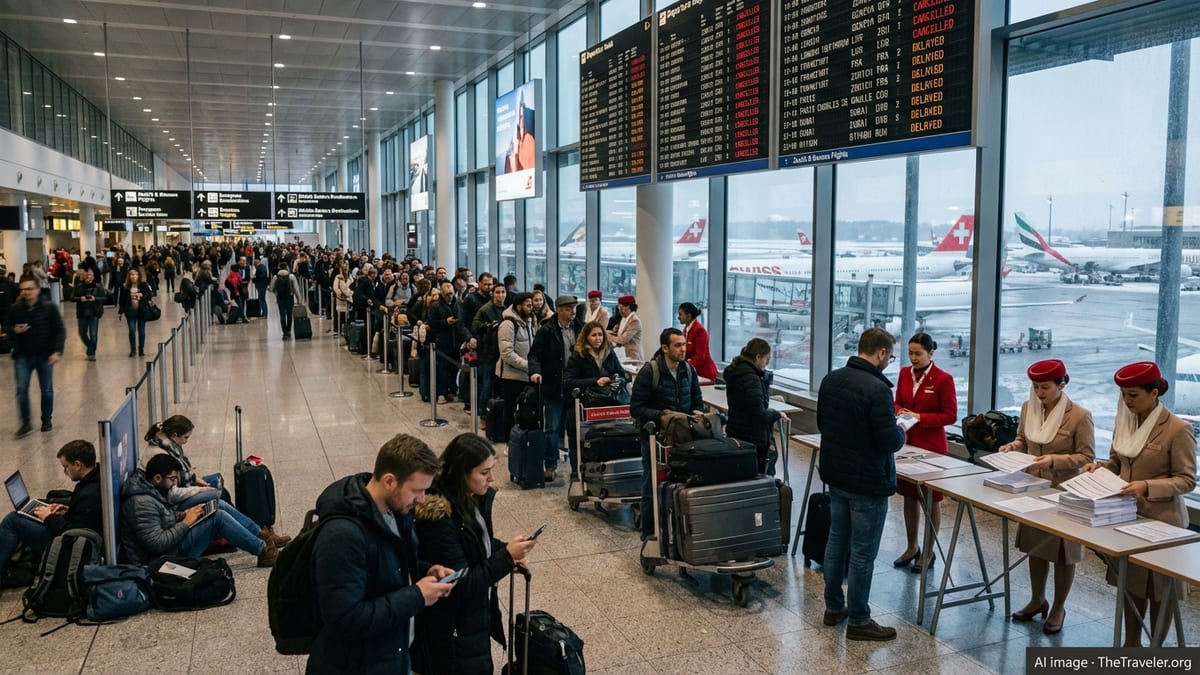
Inside terminal buildings, the operational crisis translated into long lines at check-in and transfer desks as passengers sought rebooking options, refunds or alternative routings that could bypass the Middle East. Departure boards at Zurich and Geneva on Saturday told the story in real time, with waves of red “cancelled” and amber “delayed” notices replacing the usual stream of on-time departures to cities such as Dubai, Tel Aviv, Doha and key connection points in Europe.
Families heading off on winter sun holidays, business travellers racing to make meetings in Asia and the Gulf, and transit passengers connecting between North America and South Asia were all caught up in the disruption. Many were advised to brace for overnight stays in Switzerland or intermediate hubs as airlines struggled to find available seats and compliant crew duty hours amid the rapidly changing situation.
Airport authorities in both cities deployed additional staff to manage passenger flows and stepped up public announcements to explain the causes of the delays. While reiterating that safety considerations take precedence over punctuality whenever airspace security is in doubt, officials acknowledged growing frustration among travellers who faced missed events, added hotel costs and the prospect of complex claims for compensation once operations stabilize.
Retailers and hospitality outlets within the terminals reported brisk business as stranded passengers sought food, phone chargers and last-minute toiletries. Airlines, meanwhile, worked to distribute meal vouchers and accommodation offers in accordance with European passenger rights regulations, even as they cautioned that severe weather elsewhere in Europe and capacity constraints might limit the support they could provide.
Operational Challenges and Knock-on Global Effects
Aviation experts noted that the Swiss disruption is part of a much wider shock to the global airline system, with thousands of flights affected worldwide as carriers attempt to navigate around large swathes of closed Middle Eastern airspace. Rerouted services from Asia to Europe via alternative corridors over Central Asia or Africa are significantly longer, increasing fuel burn and tightening aircraft availability for subsequent rotations.
For airlines such as Swiss and Emirates that rely on complex hub-and-spoke models, every cancelled sector or extended diversion can quickly produce secondary delays on unrelated routes. Aircraft arriving late into Zurich or Geneva from North America or Asia may miss their scheduled European connections, forcing last-minute schedule changes and contributing to the tally of roughly 140 delayed flights recorded across the two airports.
Operational planners are also wrestling with crew duty-time limitations, as pilots and cabin crew diverted around the Middle East reach their legal working limits more quickly on extended routings. This in turn requires additional crew to be positioned at various points along the network, a challenging task on a day when many key hubs are struggling with capacity constraints of their own.
Analysts warned that even if some restricted airspaces reopen in the coming days, it could take much longer for airline schedules to return to normal in Switzerland and elsewhere. With the Middle East serving as a critical bridge between Europe, Asia and Africa, any prolonged closure or partial shutdown of its skies risks creating a rolling backlog of delayed and displaced passengers that may take several days, if not weeks, to clear fully.
Advice for Affected Travelers in Switzerland
Travel agencies and consumer advocates in Switzerland urged passengers booked on flights from Zurich or Geneva over the coming days to monitor airline communications closely and to confirm flight status before heading to the airport. With schedules being updated frequently in response to the evolving security and airspace picture, same-day changes and rolling delays remain likely, particularly for itineraries involving the Middle East or connections to Asia and East Africa.
Passengers whose flights have been cancelled outright are being offered a range of options, from rebooking on alternative routings at no additional cost to full refunds. However, limited seat availability on unaffected corridors and the complexities of rerouting around closed skies mean that many travellers may still face substantial delays even after securing new itineraries.
Experts recommend that affected passengers retain all receipts for meals, accommodation and local transport while stranded, as these may be required when seeking reimbursement or compensation under relevant air passenger rights rules. Those with time-sensitive travel such as business meetings, cruises or package holidays are being advised to contact their tour operators and insurers promptly to document the impact of the disruption.
With geopolitical tensions in the Middle East still high and further airspace changes possible at short notice, airlines operating to and from Switzerland are preparing for an extended period of schedule volatility. For Swiss travellers, the events of February 28 are a reminder of how quickly distant conflicts can reshape the global map of air connectivity, even in a country far from the immediate front lines.