

More news on this day
Escalating conflict and sweeping airspace closures across the Middle East are throwing Australian travel plans into disarray, with major Gulf hubs shut, thousands of flights cancelled or diverted, and the federal government warning of serious global disruption in the days ahead.
Airspace Closures Hit Key Gulf Hubs and Europe Routes
Air travel through the Middle East has been plunged into chaos after recent United States and Israeli strikes on Iran triggered rapid airspace closures across Iran, Iraq, Kuwait, Bahrain and Qatar, and disrupted operations in the United Arab Emirates. Dubai International and Abu Dhabi’s Zayed International, two of the world’s busiest transit hubs, have been hit by missile strikes and forced to suspend normal operations while damage is assessed and safety checks continue.
The shutdowns have had an immediate knock on effect for Australians, many of whom rely on Gulf carriers to reach Europe, Africa and parts of Asia. Airlines including Emirates, Qatar Airways and Etihad have temporarily halted most flights in and out of their Middle East bases, while a wave of diversions has sent long haul services to unexpected stopovers such as Istanbul, Rome or Zurich, or back to their departure cities after many hours in the air.
Australia’s Foreign Minister Penny Wong on 2 March 2026 warned that Australians overseas should expect “serious travel disruptions” in the coming days, noting that many travellers in the region are currently unable to leave because of airport shutdowns and land border restrictions. Authorities say the pattern of cancellations, rolling delays and last minute re routing is likely to continue as airlines respond to evolving security assessments.
Thousands of Australians Stranded and More Facing Delays
Australian officials estimate that more than one hundred thousand Australians are currently stranded or delayed across Gulf states and nearby countries as the usual air bridge between Europe and Australia via the Middle East collapses. Travellers transiting through Doha, Dubai and Abu Dhabi have been among the hardest hit, with some airports briefly sheltering passengers away from windows during incoming strikes before closing terminals entirely.
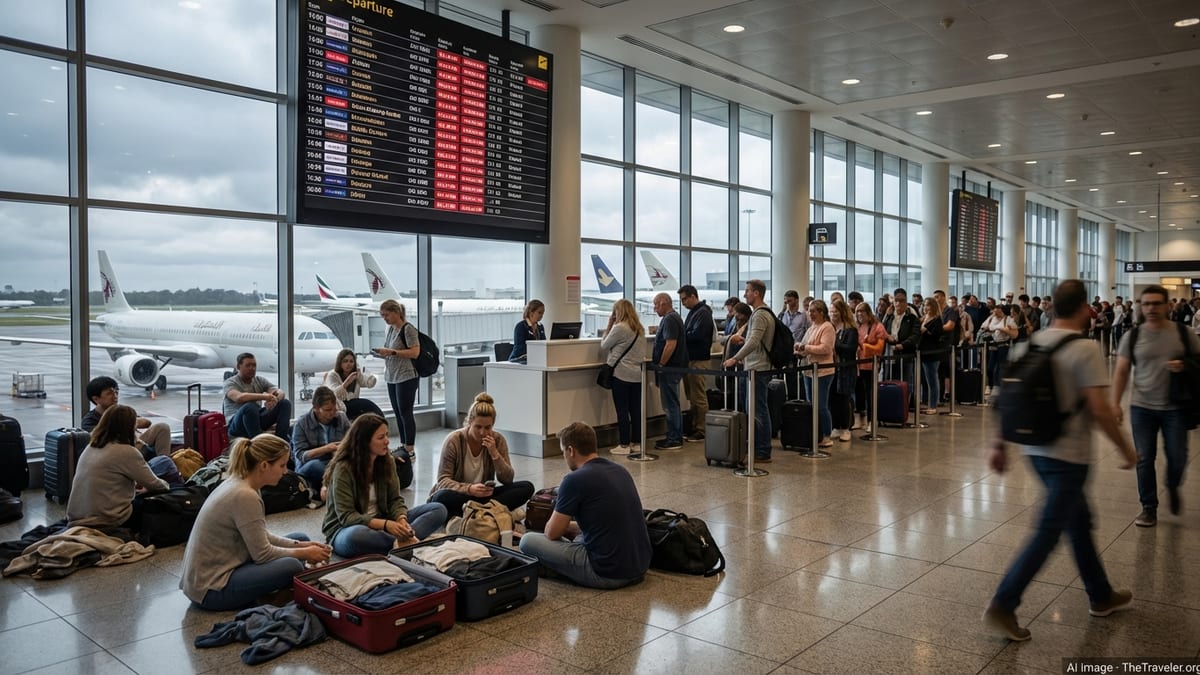
Reports from consular channels and local media describe crowded terminals, long queues at airline service desks and limited accommodation options as stranded passengers wait for clarity on when flights might resume. In some cases, Australians heading for Europe have been turned around mid flight and brought back to their point of origin after hours in the air when airspace closures were extended.
Even those not travelling to or through the Middle East are feeling the impact. Flights between Australia and Europe that would normally cross the region are being rerouted south via Egypt and Saudi Arabia or further north over Turkey and Central Asia, adding flight time, burning more fuel and creating a cascade of delays, missed connections and schedule changes for days to come.
What Airlines Are Doing for Australian Passengers
Major Gulf carriers serving Australia have moved quickly to suspend or sharply curtail services while they reassess security conditions. Emirates, Etihad and Qatar Airways have all advised that flights to and from their hub airports are on hold for at least the coming days, with flexible options for passengers whose trips fall within published waiver periods. These include fee free date changes and, in many cases, full refunds for travel during the peak disruption window.
Virgin Australia customers booked on partner operated services to Doha have seen multiple flights cancelled, with additional services scrapped at short notice as Qatari airspace remains restricted. The airline is offering rebooking, travel credits or refunds for affected passengers and is urging customers to monitor their booking details closely for updates as more schedule changes are expected.
Qantas, which does not operate its own flights into Gulf hubs, has so far avoided the worst of the chaos but is still affected on long haul routes. The carrier has issued a special commercial policy for customers holding Qantas issued tickets to, from or via the United Arab Emirates, Qatar, Israel, Jordan and Oman for departures through early March. Eligible travellers can rebook within a defined window without change fees or fare differences, subject to availability, and Qantas has flagged that it may adjust flight paths on some Europe services as conditions warrant.
Travel Advice, Insurance Gaps and Your Rights
The Australian government has activated its 24 hour crisis centre and is urging Australians to subscribe to Smartraveller updates and to expect that commercial flights, not government repatriation operations, will be the main pathway home. Officials stress that there are limits to what consular staff can do in an active conflict zone where airspace is restricted and airports are under threat, and that safety assessments must come before any evacuation planning.
For many travellers, the financial exposure is becoming clearer. Travel insurers generally classify war and related hostilities as force majeure events, which are commonly excluded from standard policies. That means coverage for cancellations, additional accommodation costs or alternative flights may be limited unless a specific benefit applies. Australians are being urged to read policy wording carefully, keep receipts for out of pocket expenses and contact their insurer directly to confirm what, if anything, can be claimed.
Consumer advocates and the Australian Travel Industry Association are warning travellers not to rush into cancelling future trips on their own initiative. In many cases, passengers who voluntarily cancel before the airline formally changes or cancels the service may forfeit the right to a full refund or fee free rebooking. Instead, they recommend waiting for the carrier or travel agent to confirm changes, and ensuring that all communication and offers are recorded in writing.
Practical Steps for Australians With Upcoming Travel
Australians with flights booked over the next several weeks are being told to assume disruption is likely, even if their itinerary does not explicitly include a Middle Eastern stop. Long haul routes between Australia and Europe are particularly exposed to shifting airspace restrictions, which can lengthen flight times, alter departure slots and lead to last minute aircraft changes.
Travel experts recommend checking your flight status frequently in the 24 to 48 hours before departure, using both airline apps and direct communications from your travel agent. Arriving at the airport earlier than usual, travelling with carry on essentials in case of unexpected overnight delays, and keeping flexible accommodation and touring plans at your destination can all help cushion the impact of sudden schedule changes.
For those yet to book, routing via Asian hubs such as Singapore, Hong Kong, Bangkok, Tokyo or Seoul may offer more stability in the short term, although these flights are already seeing higher demand and rising fares as passengers look for alternatives to Gulf carriers. Travellers with urgent need to reach Europe or North America may also consider itineraries via the United States or Canada, accepting longer total journey times in exchange for more predictable routings.
Officials and airlines agree on one point: the situation in the Middle East remains fluid. As security assessments and airspace restrictions evolve over coming days, Australian travellers should be prepared for sudden changes, stay informed through official channels, and build flexibility into any upcoming international plans.