

More news on this day
Escalating tensions around the Arabian Gulf and Red Sea are rippling across the cruise industry, forcing sweeping cancellations, sudden itinerary changes and urgent contingency plans from regional players Aroya Cruises and Celestyal Cruises as ships, crew and thousands of passengers remain in limbo.
Get the latest news straight to your inbox!
Geopolitical Flashpoint Hits the Arabian Gulf Cruise Season
A sharp deterioration in regional security since late February has turned the Arabian Gulf from an emerging cruise hotspot into a logistical and safety challenge. Heightened military activity, disrupted airspace and warnings around maritime corridors have led several cruise lines to suspend operations, with the impact particularly acute for brands that had staked new growth on Gulf itineraries.
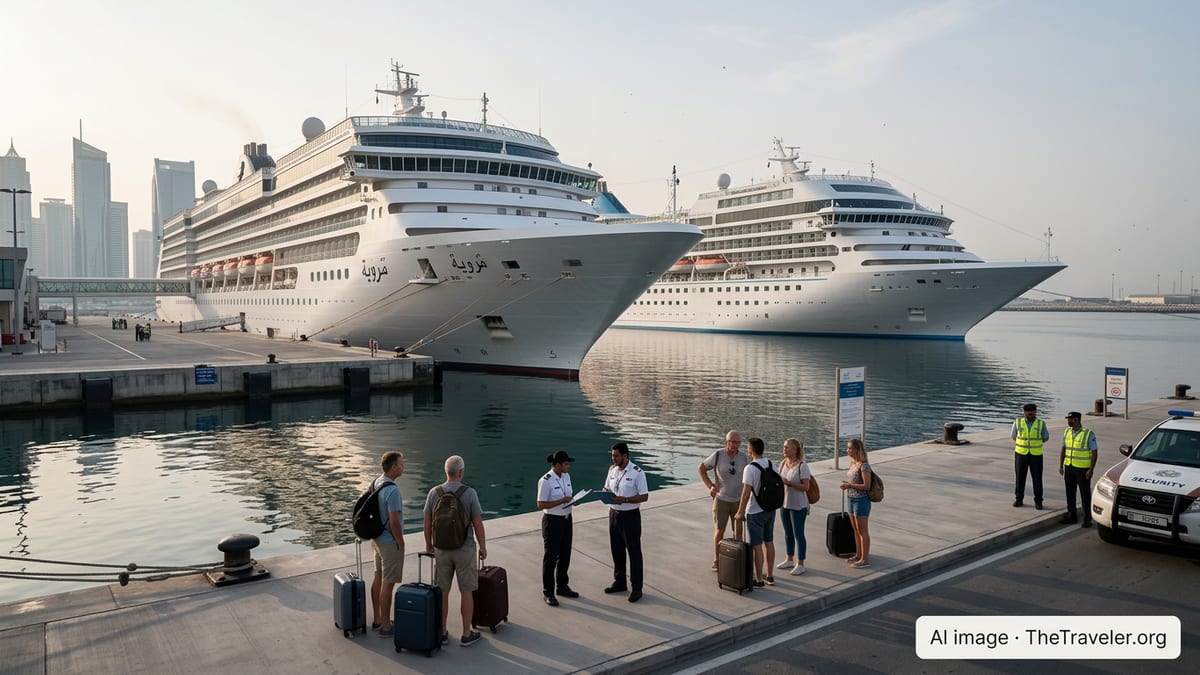
Industry trackers report that multiple ships are now effectively pinned in regional ports, unable to continue scheduled sailings or reposition as planned. Among them are Aroya Cruises’ flagship Aroya Manara and Celestyal Cruises’ Celestyal Journey and Celestyal Discovery, all currently based in the Gulf and central to their operators’ winter programs.
Port advisories indicate that although key terminals in Saudi Arabia and the wider region remain technically open, commercial traffic has dropped sharply as operators follow internal risk assessments and military guidance. Cruise lines are under pressure to weigh route viability against guest safety, while also navigating rapidly changing airspace restrictions that complicate fly-in and fly-out operations for passengers.
The result has been a cascade of last-minute changes affecting voyages scheduled through March and beyond, with many guests discovering that their long-planned Gulf escapes are being curtailed, rerouted or cancelled entirely.
Aroya Cruises Halts Season as Flagship Remains in Port
Saudi-based Aroya Cruises, which only recently entered the market with ambitions to showcase Red Sea and Arabian Gulf itineraries, has been forced into a defensive posture. Facing the same security and operational constraints as larger global brands, the line has cancelled its remaining 2025–26 Gulf sailings and is keeping its flagship Aroya Manara safely in port while it reassesses options.
The decision follows days of uncertainty for guests booked on near-term departures from Dubai and other regional hubs. Travellers have reported receiving holding statements from the line that it was monitoring the situation, before cancellations began to be communicated as the geopolitical picture worsened and other operators pulled out of the Gulf.
Aroya had promoted its cruises as a showcase of Saudi hospitality with itineraries tying together Gulf cityscapes and emerging Red Sea developments. The suspension now pauses one of the Middle East’s most closely watched cruise start-ups at a critical moment in its rollout, raising questions about how quickly the brand will be able to resume operations or reposition its ship should maritime conditions allow.
For affected passengers, the focus has shifted to refunds and rebooking. The line is offering options including full reimbursement or future cruise credits, according to travel agents working with impacted guests, though processing times and policy details vary by booking channel and departure date.
Celestyal Culls Arabian Gulf Program and Reroutes to Athens
Greek-based Celestyal Cruises, which had bet heavily on the Arabian Gulf as a winter counterpart to its Aegean program, has taken similarly drastic action. After initially trimming selected departures due to security concerns along key sea lanes, the company has now cancelled the remainder of its 2025–26 Gulf season.
Celestyal Journey and Celestyal Discovery, the two ships dedicated to the region, are to be withdrawn from Gulf deployments and repositioned to Athens ahead of their summer Mediterranean schedules. The line has also cancelled early-season Eastern Mediterranean sailings that relied on the ships being able to transit safely out of the Gulf in March.
In recent days Celestyal has informed guests that several late-March “Iconic Aegean” departures will not operate as planned while it finalises repositioning logistics. Travel advisors say clients have been offered rebooking on alternative Aegean itineraries later in the year, future cruise credits or refunds, depending on the fare type and booking terms.
The abrupt end to Celestyal’s Arabian Gulf season underscores how quickly regional conditions have overridden longer-term deployment plans. Only months ago, the company had been touting expanded Gulf offerings and special-event sailings around major sporting fixtures; now it is concentrating resources on stabilising its core Eastern Mediterranean program.
What Travellers Need to Know About Cancellations and Options
For passengers booked with Aroya or Celestyal in the coming weeks, the most immediate priority is clarity. Both lines say they are contacting affected guests in departure-date order, which means travellers on later spring sailings may still be waiting for definitive confirmation even as ships remain in port.
Travel agents report that most impacted customers are being given a choice between full refunds and future cruise credits, sometimes with added onboard credit incentives for rebooking. However, the handling of associated flights and hotels largely depends on whether these were purchased through the cruise line, a tour operator or independently, adding another layer of complexity for travellers trying to salvage holiday plans.
Insurance coverage is also playing a crucial role. Policies that include provisions for war, terrorism or government travel advisories may offer broader reimbursement for nonrefundable costs, whereas standard cancellation-only plans can be more restrictive. Advisors are urging clients to review policy wording carefully and to document all communications with cruise lines and suppliers.
Meanwhile, passengers already in the region have faced extended port stays and altered routes as captains avoid higher-risk areas. In some cases, disembarkation dates have been brought forward so that ships can reposition or remain alongside in safer harbours, with lines arranging charter flights or alternative transportation where feasible.
A Cautious Outlook for Future Middle East Sailings
The disruptions facing Aroya and Celestyal highlight the fragile nature of cruise expansion in geopolitically sensitive waters. While the Middle East had been touted as a rising star in winter cruising, offering warm-weather ports and new cultural itineraries, the current tensions have exposed the vulnerability of those plans to sudden shifts in the security landscape.
Analysts say that, in the short term, lines are likely to redeploy capacity to more stable regions such as the Mediterranean, Canary Islands and Caribbean, where demand remains strong and maritime corridors are less volatile. For Aroya, whose brand identity is closely tied to Saudi and regional cruising, that may be less straightforward, but strategic pauses and domestic-focused sailings could be used to bridge the gap until conditions improve.
For Celestyal and other internationally marketed lines, the episode is likely to influence future deployment decisions, including how much capacity to base in the Gulf and how to structure repositioning cruises that rely on transiting strategic chokepoints. Enhanced crisis planning, alternative routings and more flexible cancellation policies are already emerging as key themes.
For travellers, the message is to expect a more cautious approach to Middle East cruising in the near term. While operators stress that guest and crew safety remain paramount and that they will return when conditions allow, the swift unraveling of the current Gulf season is a reminder that itineraries in politically sensitive regions can change with little warning, even for voyages booked many months in advance.