

More news on this day
Air travel across the Gulf is facing renewed turmoil as Middle East airspace restrictions and shifting safety assessments trigger the cancellation of 173 flights and delays to at least 31 more, leaving passengers on Gulf Air, Qatar Airways and Saudia stranded or rerouted through a shrinking number of operational airports.
Get the latest news straight to your inbox!
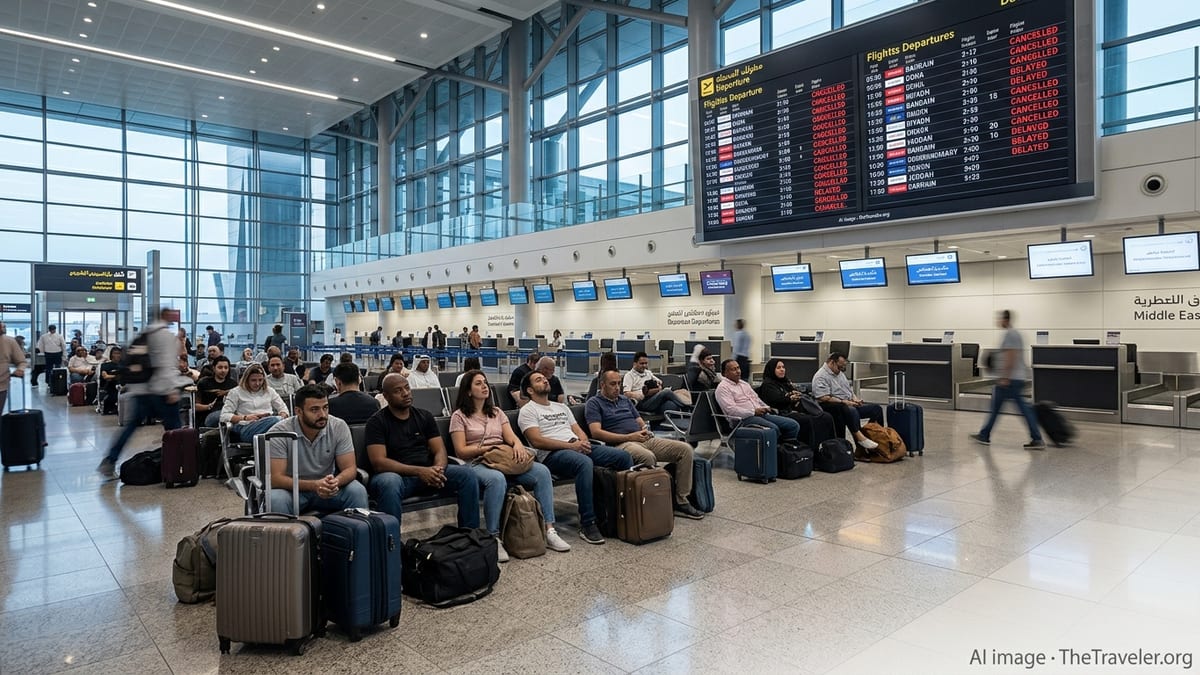
Conflict-Linked Airspace Closures Ripple Through Gulf Hubs
Published coverage of the 2026 Iran war and related airspace measures indicates that a tightening aviation environment in the Gulf has again converged on Bahrain, Qatar and parts of Saudi Arabia, where carriers are trimming or suspending services in response to risk assessments. Airspace closures or severe restrictions over Qatar, Bahrain and neighboring states have repeatedly forced airlines to reconfigure schedules, compressing traffic into a few remaining corridors and pushing operational capacity to its limits.
Industry advisories describe a patchwork of closures and partial reopenings over recent weeks, with Qatar and Bahrain among the states that have intermittently restricted civil aviation to protect airports and overflight routes near potential military targets. In practice, this has meant that many passenger services that would ordinarily transit Doha, Manama or nearby airspace have been grounded outright, contributing to the current tally of 173 cancellations and 31 delays affecting regional and long haul itineraries.
While the broader conflict is military in nature, its most visible impact for civilians has been at airport departure boards. Travel management bulletins and aviation forums show that carriers are continually revising schedules, sometimes within hours of departure, as air navigation authorities adjust what can safely operate. The result is an unstable timetable that frequently leaves passengers in Bahrain, Saudi Arabia and Qatar with little notice that flights are no longer running.
Analysts note that the Gulf’s role as a bridge between Europe, Asia and Africa has compounded the disruption. When a hub such as Doha or Bahrain cuts capacity, the effect reaches well beyond the Middle East, stranding passengers who never intended to stay in the region but relied on it for connections.
Gulf Air, Qatar Airways and Saudia: How Operations Are Affected
According to publicly available airline updates and scheduling data, Gulf Air, Qatar Airways and Saudia have all adjusted networks serving Bahrain, Qatar and Saudi Arabia, though the scale and nature of disruption differs by carrier. The current figure of 173 cancelled flights and 31 delays reflects combined schedule changes across multiple days, rather than a single 24 hour period.
For Gulf Air, Bahrain’s flag carrier, cancellations have clustered around services linking Manama with regional destinations and key long haul markets. Travel advisory documents and airport postings indicate that some routes have been suspended outright, while others are operating at significantly reduced frequency. In several cases, passengers have been offered rebooking via alternative points in Saudi Arabia, where airspace remains comparatively more accessible.
Qatar Airways has faced some of the most acute operational constraints due to the intermittent closure and partial reopening of Qatari airspace around Doha’s Hamad International Airport. Client advisories circulated to corporate travelers in early March reported a near total suspension of regular commercial services at points during the crisis, with only limited relief or repatriation flights operating on designated corridors. Subsequent updates suggest that a reduced schedule is restarting on selected routes, but normal hub activity has not fully resumed.
Saudia, operating from Saudi airports that have largely retained open airspace, has nonetheless cut back flights on several routes that would normally overfly restricted zones or serve neighboring states. Public information shows that some international services have been paused for safety and operational reasons even though Saudi airspace itself continues to function as one of the region’s main transit corridors. This has left the airline juggling rerouted services with increased demand from travelers seeking alternatives to closed hubs.
Airports Under Strain: Bahrain, Doha and Saudi Gateways
The disruption is most visible at Bahrain International Airport, Doha’s Hamad International Airport and a handful of major Saudi gateways, where cancellations and delays have stranded large numbers of passengers in transit. Images shared through traveler communities and media coverage describe crowded terminals, long queues for rebooking desks and an acute shortage of available onward seats as airlines trim schedules.
In Bahrain, airport departure and arrival boards have featured repeated cancellations for Gulf Air services as well as for foreign carriers using the airport as a regional stopover. The figure of 173 cancelled flights includes multiple rotations in and out of Manama that would typically connect South Asia, the Middle East and parts of Europe. With limited ground infrastructure compared with larger hubs, Bahrain has struggled to absorb the sudden volume of disrupted itineraries.
Doha has experienced an even more complex pattern. Reports indicate that full commercial operations were suspended for extended periods when Qatari airspace was effectively closed, leaving Hamad International functioning mainly as a base for limited emergency or relief movements. More recently, restricted reopening for certain routes has allowed Qatar Airways and selected partners to operate a narrow slate of flights, but many passengers still face cancellations or multi day delays as capacity remains well below normal.
In Saudi Arabia, airports such as Dammam, Jeddah and Riyadh have seen increased passenger flows as travelers and some airlines reorient away from closed or constrained hubs. Travel advisories describe Saudi Arabia operating as one of the only sizable east west aviation corridors still open in the region, channeling traffic that would customarily pass through Doha, Dubai or Abu Dhabi. This role has brought its own pressures, with Saudia and foreign airlines balancing rerouted flights against safety constraints near neighboring conflict zones.
What Travelers Need to Know About Routes, Rebooking and Safety
For passengers planning to travel through Bahrain, Saudi Arabia or Qatar in the coming days, the most important factor is that schedules remain fluid. Even flights that appear confirmed can be altered at short notice if airspace permissions change or if carriers further prune capacity. Travel management companies and airline notices alike emphasize the need to verify flight status repeatedly in the 24 hours before departure and to avoid going to the airport without confirmed information.
The bulk of the 173 cancellations and 31 delays involves services that either originate, terminate or connect through Bahrain International Airport, Hamad International Airport in Doha, and major Saudi gateways. Long haul routes between Europe and Asia that normally rely on one stop connections in the Gulf are particularly exposed. Where possible, some travelers are rebooking via alternative hubs in Saudi Arabia or outside the immediate conflict-affected region, though availability remains tight and fares on remaining services have risen.
Policy information published by airlines and highlighted in traveler forums suggests that Gulf Air, Qatar Airways and Saudia are offering varying mixes of refunds, date changes and rerouting options, often extending flexibility windows through the end of March. However, processes for securing these options can be slow due to overloaded call centers and airport desks, and some passengers report having to purchase backup tickets on other carriers while awaiting resolution of original bookings.
On the safety front, regional civil aviation authorities are applying conservative criteria when deciding whether to reopen airspace or authorize specific flight paths. Public documentation on these decisions indicates that risk assessments focus on potential exposure to missile or drone activity and proximity to military sites. For travelers, this means that the presence of cancellations is not necessarily an indicator of deteriorating safety at airports themselves, but rather of a precautionary approach intended to minimize any in flight risk.
Planning Ahead as the Situation Evolves
With the conflict and related airspace restrictions still evolving as of mid March 2026, aviation analysts expect that schedules for Gulf Air, Qatar Airways and Saudia will continue to shift over the coming weeks. Even as limited corridors reopen and some flights resume, the wider network will likely remain fragile, with further adjustments possible if security conditions change.
Travel experts recommend that passengers transiting the region keep itineraries as flexible as possible, favoring tickets that allow free date and route changes. Where travel is not urgent, postponement may reduce the risk of being caught in the next round of cancellations. Those who must travel are advised, in widely circulated guidance, to consider routing through the most stable available hubs, even if that means longer journey times or higher fares.
For now, the figure of 173 cancelled flights and 31 delays serves as a snapshot of a broader disruption that extends beyond Bahrain, Saudi Arabia and Qatar to global aviation networks. As airlines, airports and regulators in the Middle East recalibrate in real time, passengers remain on the front line of an air travel crisis shaped far more by geopolitics than by traditional commercial factors.