

More news on this day
The widening US-Israel-Iran war is triggering some of the most severe aviation disruption the Middle East has seen in decades, with airspace closures, missile strikes and emergency-only operations at key hubs upending travel plans from the Gulf to the Levant and rippling across global routes between Europe, Asia and Africa.
Get the latest news straight to your inbox!
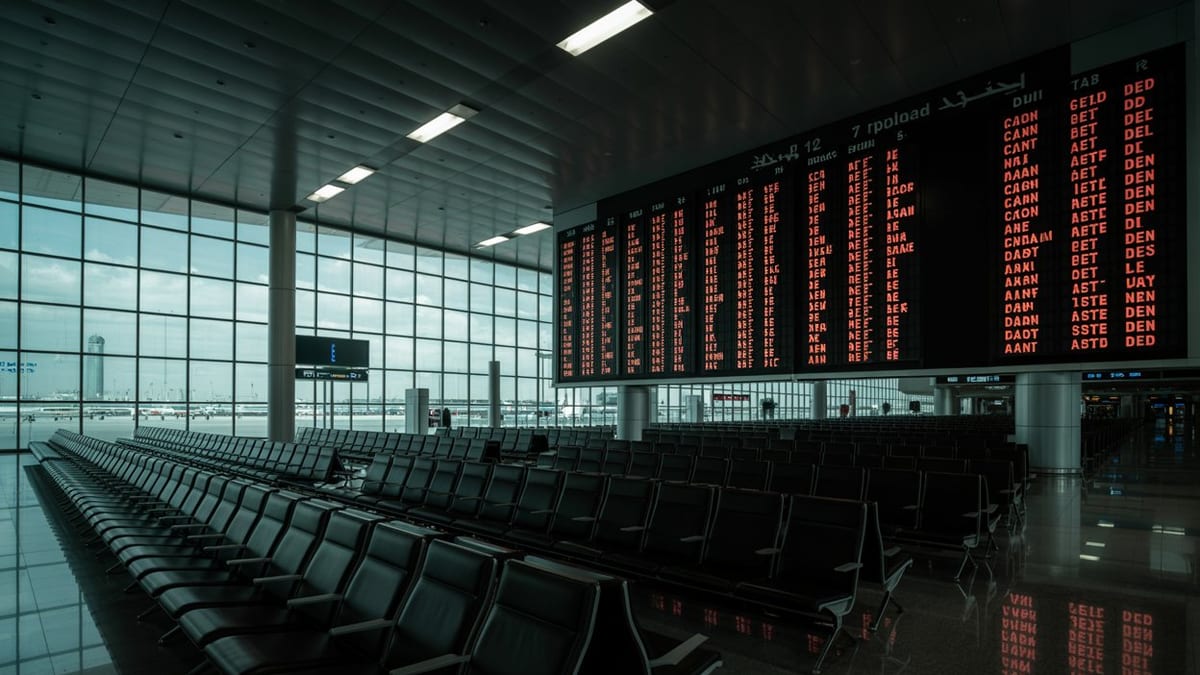
Image by Travel And Tour World
Airspace Lockdowns From Iran to Israel Redraw Global Routes
Since late February 2026, a cascade of airspace restrictions across Iran, Iraq, Israel and neighboring states has effectively carved a giant no-fly zone through the heart of the Middle East. Notices to air missions and regulator advisories show that large portions of the skies over Iran, Iraq, Israel, Jordan, Lebanon, Bahrain, Kuwait, Qatar and parts of the United Arab Emirates have been fully closed or subject to severe limitations, forcing airlines to redesign long-haul routes at short notice.
Publicly available flight-tracking data indicates that many Europe to Asia services are now detouring either far to the north via the Caucasus and Central Asia, or to the south over Egypt and the Arabian Sea. Aviation analysts cited in recent specialist reports estimate that these workarounds are adding two to five hours to typical journey times on some of the world’s busiest corridors, driving up fuel burn and crew costs and tightening already stretched aircraft schedules.
The European Union Aviation Safety Agency and several national regulators have extended advisories warning against overflights of Iran, Iraq, Israel and adjacent conflict areas. While some corridors remain technically open, many carriers are treating them as off-limits due to insurance, security and risk-management constraints, further concentrating traffic into a handful of narrow, congested routes.
The result is a system-wide shock that goes far beyond the region. Disruptions centered on the Gulf are now delaying flights and aircraft rotations as far afield as London, Singapore, Sydney and Manila, as airlines struggle to keep global networks functioning around a volatile patch of sky.
Gulf Hubs in the UAE and Bahrain: From Global Gateways to Bottlenecks
In the Persian Gulf, airports that normally rank among the world’s busiest have been operating at a fraction of capacity. After the initial US and Israeli strikes on Iran on February 28 and subsequent Iranian missile attacks, reports from regional and international media documented temporary closures or severe curbs at Dubai International, Abu Dhabi International and Doha’s Hamad International, with thousands of flights canceled in the first days of the conflict.
In the United Arab Emirates, publicly available information on airport operations shows that regular commercial schedules on flag carriers have largely been suspended at various points through March, replaced by a patchwork of limited outbound services, ad hoc repatriation flights and cargo operations. Emirates and Etihad have both published flexible rebooking and refund policies, allowing free date changes over multiweek windows and offering vouchers to travelers unwilling or unable to fly amid ongoing uncertainty.
Bahrain’s aviation sector has faced similar turbulence. Coverage in regional travel media indicates that Bahrain’s airspace has at times been effectively shut for regular traffic, prompting the kingdom’s national carrier to reroute via Saudi Arabia when possible and cancel a significant share of its regional schedule. Low-cost airlines in the Gulf have also extended suspensions on services linking Bahrain and the UAE with other regional destinations, citing continuing airspace closures and security assessments.
Even where terminals and runways remain intact, the economic stakes are high. Forecasts from international economics consultancies quoted in business press suggest that international arrivals to Gulf Cooperation Council states could fall by double-digit percentages in 2026 if the conflict drags on, underscoring how deeply aviation is woven into tourism, trade and employment in cities such as Dubai, Abu Dhabi and Manama.
Israel, Iran and Iraq: Direct Targets and Systemic Disruption
Countries closest to the fighting are experiencing the most acute aviation shock. Israel’s airspace has been periodically closed or heavily restricted since late February as missile exchanges intensified, severely limiting traffic to Tel Aviv and forcing foreign carriers to suspend routes. Some international airlines had already halted flights to Israel during earlier rounds of regional tension and have since extended those suspensions into March.
In Iran, the combination of direct strikes on infrastructure, military activity and Tehran’s own airspace measures has effectively severed the country from routine international passenger flows. Before the war, several Gulf and European carriers used Iranian airspace as a key east-west corridor; industry trackers now show almost all scheduled traffic skirting the country entirely. Qatar Airways and other regional operators have suspended most services to Iranian cities for months ahead, according to updated schedules highlighted in travel-industry reports.
Iraq, long a sensitive overflight zone, has also seen its skies largely emptied following airspace shutdowns announced after the initial wave of attacks. Airlines that had cautiously returned to routing over Iraq in recent years are again diverting, removing what had been a valuable shortcut between Europe and the Gulf. Combined with restrictions over Syria and parts of the eastern Mediterranean, the closure of Iraqi airspace has magnified the squeeze on available safe corridors.
These combined restrictions are reshaping the map for carriers that once depended on the region’s geography to offer fast one-stop connections between continents. Network planners are now weighing longer detours against possible future corridor reopenings, with many signaling in public statements that normality is unlikely to return quickly even if a cease-fire is reached.
Knock-on Effects for Travelers: Longer Journeys, Limited Rights
For individual travelers, the war’s impact is most visible in canceled trips, missed connections and unexpected stopovers. Data compiled by aviation consultancies and cited by international outlets suggest that more than 50,000 flights to and from the broader Middle East have been canceled since the conflict began, leaving hundreds of thousands of passengers stranded or forced to rethink routes at short notice.
Travelers bound for or transiting through hubs in the UAE, Bahrain, Qatar, Israel, Iran and Iraq are experiencing a mix of outright cancellations and extreme delays. Some passengers have been rebooked days later via alternative hubs such as Istanbul, Cairo or European cities, often with backtracking that can double total journey times. Others are choosing to postpone or abandon trips altogether, discouraged by rolling schedule changes and unfamiliar routings.
Consumer protections are proving patchy. In Europe, long-standing regulations provide compensation for significant delays only when disruptions are directly attributable to the airline, rather than to security crises or government-ordered airspace closures. Legal analyses referenced in travel advisories therefore indicate that many passengers affected by the current chaos may be entitled to assistance such as meals, accommodation or refunds, but not to additional cash payouts, given that the war is considered an extraordinary circumstance.
Travel companies are urging customers to monitor airline apps and airport departure boards closely, keep contact details updated on bookings and consider more flexible itineraries. Industry guidance increasingly recommends leaving extra buffer time when connecting between long-haul flights, purchasing travel insurance that specifically addresses war-related disruption and remaining prepared for rapid changes to routing even after check-in.
Regional Tourism and Business Travel Face a Long Road Back
Beyond the immediate scramble to get passengers home, the conflict threatens to reshape regional tourism and corporate travel patterns well into 2026. Gulf economies that have invested heavily in becoming global transit and leisure hubs are now confronting a sharp downturn in arrivals, while meetings, exhibitions and major events across the UAE, Bahrain and neighboring states are being postponed, moved online or relocated.
Hotel operators in cities such as Dubai and Abu Dhabi are reporting softer forward bookings and higher cancellation rates in trade press coverage, especially from European and Asian markets that traditionally rely on convenient one-stop flights via Gulf carriers. Cruise lines with scheduled calls in Gulf ports are adjusting itineraries, and outbound tourism from affected countries is slowing as residents delay discretionary travel.
Business travel is also under pressure. Companies with operations spanning Europe, the Gulf and Asia are re-evaluating how often staff need to fly and through which hubs, weighing the costs and risks of detours against alternatives such as regional offices, remote work or rerouting via Africa and Central Asia. Logistics updates from freight and supply-chain providers describe parallel challenges for air cargo, with higher rates and longer transit times on key lanes that once passed routinely through the Gulf.
Even if hostilities ease, aviation specialists quoted in recent analyses caution that restoring confidence will take time. Airlines will need clear, stable security assessments before shifting back to pre-war routings, insurers will reassess risk premiums, and travelers may continue to prefer itineraries that avoid conflict-adjacent skies. For now, the war has turned one of the world’s most important aviation crossroads into a chokepoint, reshaping how people move between continents in 2026.