

More news on this day
Severe weather across parts of the Middle East has triggered a fresh wave of air travel disruption, with around 60 flights reportedly scrapped and at least 46 more delayed, stranding passengers in Bahrain, Saudi Arabia, Jordan and other key regional hubs just as demand for regional and connecting travel remains high.
Get the latest news straight to your inbox!
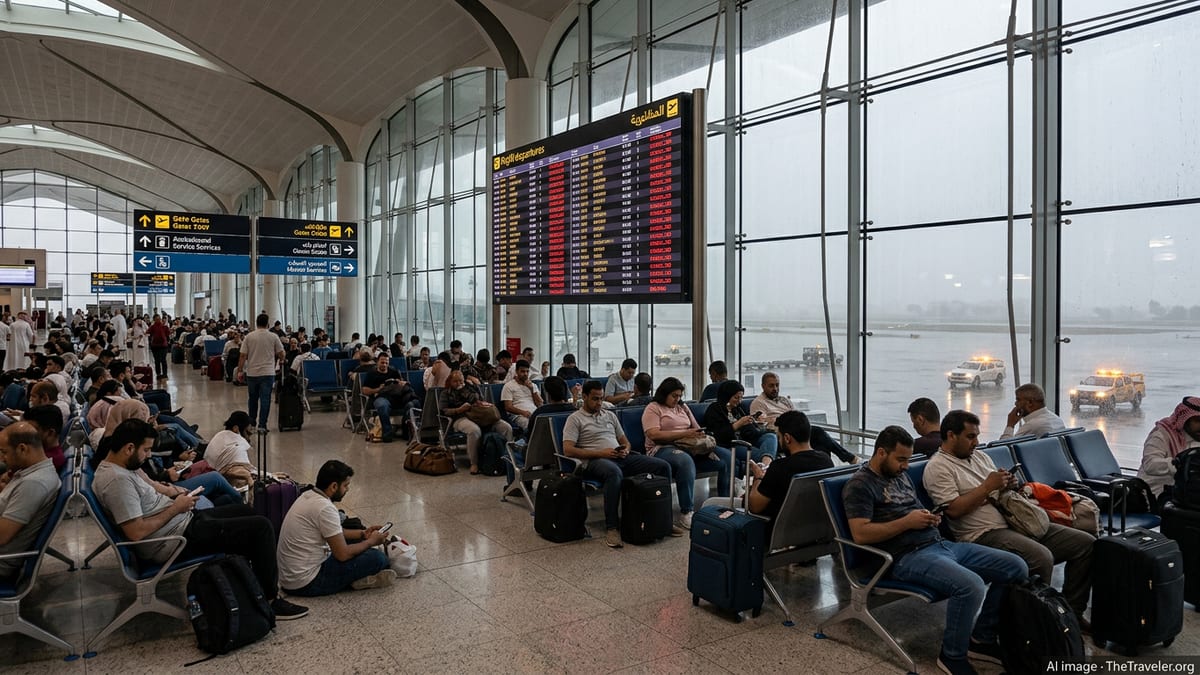
Storm Systems Slam Key Gulf and Levant Hubs
Publicly available flight tracking data and regional media coverage show that a series of strong storm systems and low-visibility conditions have swept across sections of the Gulf and Levant, forcing airlines to scale back operations over recent days. Heavy rain, localized flooding and sand-laden winds have reduced visibility at airports that normally serve as critical connectors between Europe, Asia and Africa, prompting widespread schedule changes.
Airports in Bahrain, eastern Saudi Arabia and Jordan have been among those seeing noticeable disruption, with arriving and departing services held on the ground or diverted when visibility dropped below safe landing and takeoff thresholds. In some cases, crews were unable to position aircraft or complete required duty cycles, further limiting the number of flights that could operate once conditions began to improve.
Regional aviation data compiled from airport boards and airline status pages indicate that roughly 60 flights have been canceled outright and at least 46 delayed, though the figures continue to shift as airlines consolidate services and re-time departures. The knock-on effect is being felt well beyond the countries directly hit by bad weather, as long-haul itineraries using Middle Eastern hubs for connections are forced into diversions, extended routings or overnight stops.
Travel industry analysts note that the Middle East’s role as a global transfer corridor magnifies the impact of even short-lived weather events. When several key hubs experience simultaneous disruption, passengers traveling between continents can face cascading delays, missed connections and complex rebooking scenarios, even if their origin and final destination are experiencing clear skies.
How Bahrain, Saudi Arabia and Jordan Are Affected
In Bahrain, publicly available flight information boards have shown waves of cancellations and long delays on both regional and long-haul services, particularly during periods of heavy rain and low cloud. Gulf Air and other carriers using Bahrain as a connecting point have adjusted schedules, in some cases combining flights or pushing departures into off-peak windows when conditions allow operations to resume.
Eastern Saudi Arabian airports, including key gateways serving the Dammam and Gulf coast areas, have also seen significant disruption. Published coverage and passenger reports describe services being held in holding patterns, diverted to alternate airports or returned to their origin when weather deteriorated unexpectedly. Where evening and overnight storms coincided with crew duty limits, some services were removed from the schedule entirely, contributing to the tally of scrapped flights.
In Jordan, Amman’s role as a hub for travel between the Levant, the Gulf and Europe has turned localized bad weather and regional airspace congestion into a wider operational challenge. According to airline status pages, some services into and out of Jordan have been delayed while aircraft and crews are repositioned around the region, particularly when upstream flights from the Gulf arrive late or are diverted.
Beyond these three countries, the same weather system and resulting congestion have affected neighboring states, with rerouted flights increasing traffic density in certain air corridors. This has occasionally led to additional air traffic flow restrictions, compounding delays even after conditions on the ground began to stabilize at specific airports.
What Passengers Are Experiencing on the Ground
Passengers transiting through affected airports report a mix of long queues at rebooking desks, busy airport hotels and crowded waiting areas as travelers wait out delays or attempt to piece together alternative routings. With the disruption spread across multiple hubs, replacement seats on near-term flights have in some cases become scarce, especially on popular Europe–Asia and South Asia–Gulf routes.
Travelers caught in Bahrain and eastern Saudi Arabia indicate that some flights have been pushed back repeatedly in rolling delays as airlines wait for safe weather windows and updated crew rosters. Others have been issued boarding passes for replacement flights many hours later, or even on the following day, when the original service was removed from the schedule entirely due to crew or aircraft positioning constraints.
In Jordan and other Levant points, some passengers have experienced missed onward connections when inbound flights from storm-hit Gulf hubs landed well behind schedule. Airlines are generally offering rebooking on the next available service, but with aircraft and crews spread thin, the next available seat can be many hours or even a full day away, especially for those traveling in peak periods.
For travelers already in the air when conditions changed, diversions have added additional time and complexity. Some flights have been rerouted to alternate airports with clearer conditions, where passengers were held on board while crews refueled and awaited updated routing, or were disembarked and processed through temporary arrangements before being re-accommodated.
Why Bad Weather Causes Such Widespread Disruption
While travelers often associate severe weather disruption with snowstorms or hurricanes, the Middle East faces its own aviation challenges driven by rainstorms, fog, dust storms and rapidly changing wind conditions. Any combination that meaningfully reduces visibility, alters crosswind components or impacts runway conditions can push operations below the safety margins airlines and aviation regulators require.
When conditions drop below approved minima, flights may be held on the ground at their departure airport to avoid a situation where they arrive to find the destination closed or heavily restricted. Aircraft already en route may enter holding patterns, consume additional fuel, or divert to alternates if there is no clear window for a safe approach. Each diversion or extended hold consumes crew duty time and aircraft availability, which then cascades through the rest of the day’s schedule.
In a region where many long-haul services operate late at night or in the early hours of the morning to optimize connections and avoid daytime heat, a few hours of disruption during those periods can have an outsized effect. If crews time out before they can depart or after a diversion, the aircraft may be stuck until a replacement crew can be positioned, something that is not always possible on the same day.
The interconnected nature of hub-and-spoke networks in the Middle East also increases vulnerability. When a key hub slows down because of weather, flights feeding into and out of that hub are affected across multiple continents, forcing airlines to decide whether to operate with significant delay, cancel and consolidate, or reroute passengers via alternative gateways, all of which contribute to the rising numbers of cancellations and delays.
What Travelers Should Do If Their Flight Is Affected
Airlines across the region are encouraging passengers, through public advisories and online updates, to monitor their flight status frequently and to use digital channels wherever possible. Travelers with upcoming departures through Bahrain, Saudi Arabia, Jordan or nearby hubs are being advised in published guidance to check airline apps or booking portals before leaving for the airport, as schedules may continue to change at short notice while weather systems move across the region.
For those whose flights have already been canceled, many carriers are offering fee waivers or flexible rebooking options, allowing passengers to move their trip to alternative dates or, in some cases, to re-route via a different hub once operations normalize. Refund policies vary by airline and ticket type, so passengers are urged, in publicly available consumer guidance, to review the conditions of carriage associated with their booking and to document any additional expenses linked to involuntary changes.
Travel experts recommend that passengers caught up in the disruption keep boarding passes, delay notifications and receipts for meals or accommodation arranged due to the disruption. These records can support later claims with airlines, travel insurers or credit card providers, particularly when policies include coverage for weather-related delays and cancellations.
Given the scale and evolving nature of the disruption, travelers with non-essential trips are also considering voluntary changes to avoid the busiest days, especially if their itineraries rely on tight connections through multiple Middle Eastern hubs. Those who must travel are advised to allow extra time between connections, remain flexible about routing, and prepare for the possibility that their journey may take longer than originally planned while airlines and airports work to restore normal operations.