

More news on this day
Air travel across the Gulf is facing intensifying disruption as airports in Bahrain, Doha and Riyadh contend with at least 140 flight cancellations and more than 40 delays, snarling operations for Gulf Air, Qatar Airways, Saudia, Emirates and other carriers and sending passengers scrambling for alternative routes through Dubai, Muscat and secondary hubs.
Get the latest news straight to your inbox!
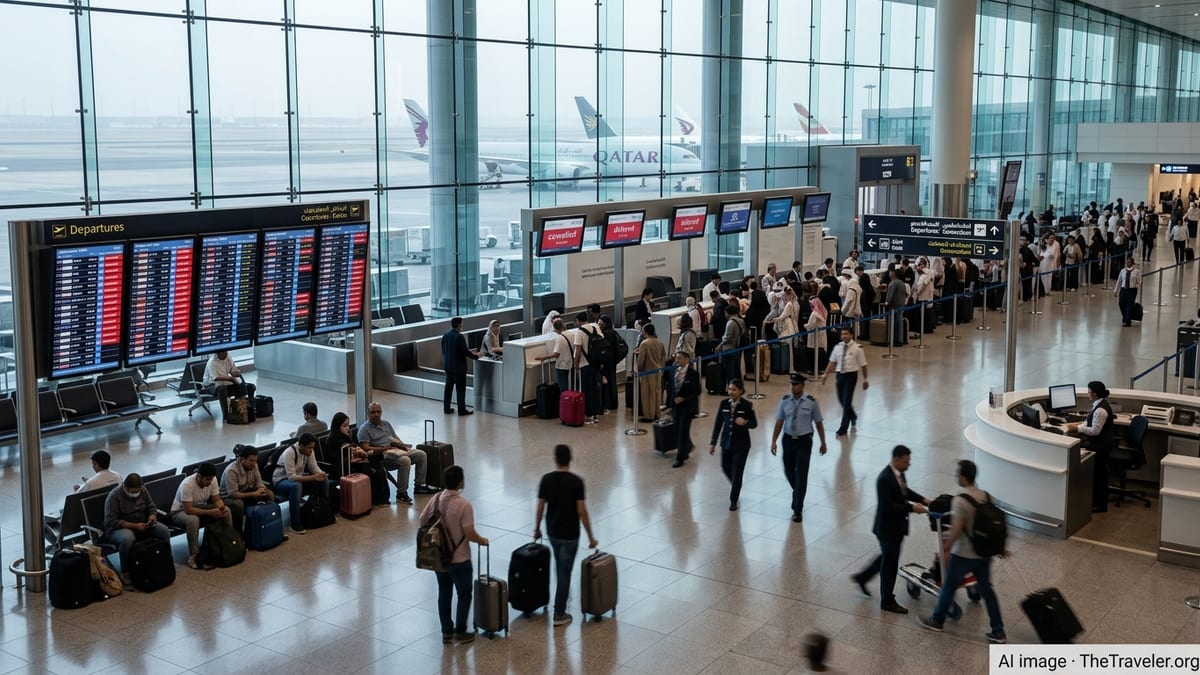
Airspace Closures Ripple Across Gulf Hubs
Publicly available advisories and news coverage show that a patchwork of airspace restrictions and airport suspensions across the Gulf has evolved into a sustained regional aviation crisis. Since late February, Iranian missile and drone strikes targeting Qatar, the United Arab Emirates, Saudi Arabia, Bahrain and Oman have prompted governments and aviation regulators to curb or temporarily halt commercial operations at several major hubs. Hamad International Airport in Doha, Bahrain International Airport and King Khalid International Airport in Riyadh have all operated with sharply reduced schedules at various points, with Bahrain and Qatar among the hardest hit.
Industry bulletins issued in early March described airspace across Qatar, Bahrain, the United Arab Emirates, Iran and Iraq as restricted, with commercial traffic curtailed and some hubs limited to evacuation, cargo or specially authorized flights. At the same time, Dubai and Abu Dhabi faced intermittent suspensions and capacity cuts after missile and drone activity near key aviation and fuel infrastructure. The result has been rolling cancellations and delays across national carriers and foreign airlines that rely on Gulf hubs for long-haul connectivity between Europe, Asia and Africa.
According to regional travel and security advisories current through late March, commercial operations at Hamad International remain constrained, Bahrain International is described as mostly halted, and Riyadh continues to manage a backlog of disrupted services on routes to and from neighboring Gulf states. These overlapping constraints underpin the current tally of roughly 140 cancellations and around 45 delayed services across the main hubs on peak days, as carriers repeatedly adjust schedules in response to security assessments and available air corridors.
Bahrain, Doha and Riyadh Bear the Brunt
Bahrain’s aviation sector has suffered particularly severe disruption. Coverage of the conflict and airline statements reviewed by TheTraveler.org indicate that Gulf Air, the kingdom’s flag carrier, has relocated a significant portion of its fleet to airports in neighboring Saudi Arabia to keep key routes alive, after attacks and airspace concerns curtailed normal activity at Bahrain International Airport. The move has allowed the airline to operate some substitute services via Saudi hubs but has also introduced complex rerouting and connection issues for passengers who expected to travel through Bahrain.
In Qatar, Hamad International Airport, normally one of the world’s busiest transit hubs, has shifted from near-total suspension of regular commercial flights to highly limited operations focused on repatriation and selected long-haul links. Travel advisories dated in early March describe most standard passenger services as suspended, with only specific, authorized flights permitted. While some limited passenger operations have been restored later in the month, continued airspace constraints and operational bottlenecks leave Qatar Airways operating at a fraction of its usual schedule, contributing a substantial share of the cancellations and knock-on delays recorded across the region.
Riyadh’s King Khalid International Airport has emerged as both a pressure point and a partial relief valve. Saudia, the Saudi flag carrier, paused or reduced flights on a number of routes to neighboring states when their airspace was restricted, even as the kingdom’s own airports remained technically open. That combination has produced waves of cancellations on international sectors and heavy rebooking activity on domestic and alternative international services, particularly for travelers attempting to bypass closed or degraded hubs in Bahrain and Qatar. On days when missiles and drones have targeted Saudi infrastructure, inbound and outbound flights through Riyadh have also been thinned, adding to the region-wide tally of disrupted services.
Dubai, Muscat and Secondary Gateways Struggle to Absorb Demand
Dubai International Airport, usually celebrated for its resilience and capacity, has also come under direct operational pressure. Reports from mid-March describe a drone strike near Dubai International that triggered a brief suspension of flights and diversions to Al Maktoum International, underscoring how quickly volumes can swing between the emirate’s two airports. Although Emirates has gradually moved from a complete halt of scheduled operations to a pattern of repatriation flights and then to more regular but still reduced services, its network remains constrained, forcing continuing cancellations and time-consuming re-accommodations for passengers.
Muscat International Airport in Oman has emerged as one of the few relatively stable gateways, even as Oman itself has been drawn into the wider security crisis. Advisory notes from early March characterize Omani airspace as open but affected by selective route cancellations and adjusted flight paths. With Bahrain and Doha heavily restricted and Dubai subject to intermittent suspensions, Muscat has attracted passengers and airlines looking for alternative routings between South Asia, East Africa and Europe. However, the surge in demand has strained available capacity and contributed to longer connection times, fare volatility and periodic delays as ground and air operations adjust.
Outside these headline hubs, secondary airports around the Gulf and in neighboring countries have taken on unexpected importance. Carriers have routed aircraft to Saudi regional airports and to less congested fields in Oman and the United Arab Emirates to stage repatriation services and relief flights. While this strategy has helped reduce the number of travelers stranded for extended periods in shuttered terminals, it has also distributed disruption more widely, creating localized bottlenecks and complicating ground transport for those forced to reroute.
Passenger Experience: Rolling Cancellations and Long Rebooking Queues
For travelers, the operational statistics translate into a highly unpredictable journey. Public forums and social media posts over the past three weeks describe repeated last-minute cancellations, sometimes affecting the same booking multiple times, as airlines revise timetables in line with evolving security guidance. Some passengers detail itineraries that were scrapped three or four times in succession, with each cancellation triggering fresh battles for rebooking or refunds amid heavily overloaded customer service channels.
Reports indicate that the heaviest disruption has affected passengers transiting through Doha and Bahrain, where entire segments of the schedule have vanished from booking systems for days at a time. Many travelers attempting to reach Asia or Europe from the Middle East have been rebooked through Dubai, Riyadh or Muscat, only to face additional delays there as inbound flights arrive out of sequence and aircraft and crews are repositioned. Others have abandoned trips altogether after spending days in airport hotels waiting for confirmation that a rescheduled flight would actually operate.
Carriers across the region have introduced temporary flexible policies, including fee-free date changes and, in some cases, vouchers or refunds for those unwilling to travel while airspace restrictions remain in place. However, high call volumes and the complexity of re-planning global networks through a shrinking number of usable corridors have limited how quickly those measures can be implemented in practice. For many passengers, the immediate experience remains one of uncertainty, long waits for information and a constant risk that even confirmed flights may be altered or removed at short notice.
Uncertain Outlook as Security Situation Evolves
The short-term outlook for Middle East air travel remains fragile. Security analyses suggest that while some airspace corridors are reopening under tighter controls, the pattern of missile and drone activity across the Gulf continues to pose risks to aviation infrastructure and flight paths. Under these conditions, airlines are likely to continue operating reduced schedules, with rolling waves of cancellations and delays as they balance safety, regulatory constraints and commercial demand.
Travel and risk consultancies currently recommend that passengers with near-term bookings into or through Doha, Bahrain, Riyadh, Dubai and Muscat maintain flexible plans and monitor flight status closely. Rebooking via multiple hubs, allowing extended connection times and remaining prepared for sudden changes are presented as practical strategies for reducing the chance of becoming stranded. At the same time, observers caution that capacity on alternative routes may tighten quickly whenever a new incident forces a major hub to curtail operations.
For the aviation industry, the evolving crisis underscores the vulnerability of global connectivity to regional security shocks, particularly when they affect tightly clustered mega-hubs like those of the Gulf. With more than 140 cancellations and dozens of delays recorded across key airports on some recent days, the region’s role as a crossroads between continents has been sharply constrained. How quickly normality can return will depend not only on infrastructure repairs and regulatory decisions, but on whether the underlying conflict eases sufficiently to allow airlines and passengers to trust that the skies over the Gulf are reliably open again.