

More news on this day
Flight disruptions across the Middle East are intensifying as KLM cancels all services to Dubai through late March and Qatar Airways keeps most operations suspended amid an ongoing airspace closure, leaving tens of thousands of travelers scrambling to rebook or find alternative routes between Europe, Asia and the Gulf.
Get the latest news straight to your inbox!
What Is Behind the Latest Wave of Disruptions?
The latest cancellations are rooted in the rapidly escalating conflict involving Iran, the United States and Israel, which has triggered missile and drone attacks across the Gulf and prompted aviation authorities to shut or sharply restrict key air corridors. Airspace over parts of Iran, Iraq, Israel and the Arabian Gulf has been partially or fully closed since late February, forcing airlines either to cancel flights outright or to operate long detours that add hours to journey times.
Dubai, one of the world’s busiest long haul hubs, was hit particularly hard after strikes in late February damaged infrastructure at Dubai International Airport and led the United Arab Emirates to temporarily close its airspace. While local carriers such as Emirates have started to restore a reduced schedule, foreign airlines are taking a more cautious stance. European and Asian carriers remain wary of routing aircraft near conflict zones and are reacting to frequently changing advisories from national regulators and international aviation bodies.
Qatar has also been drawn into the turmoil. Doha’s Hamad International Airport, home base for Qatar Airways, suspended scheduled commercial operations on March 1 after Qatari authorities closed the country’s airspace because of security concerns. The closure effectively removed one of the region’s most important connection points between Europe, Africa, Asia and Oceania, amplifying the disruption felt worldwide.
With airspace and airport statuses changing at short notice, airlines are updating timetables day by day. Analysts say the pattern now resembles a rolling shutdown of the Gulf’s traditional hub system, with carriers making tactical decisions on which routes to preserve, which to cancel and which to reroute via secondary airports outside the immediate conflict zone.
KLM Cancels Dubai Flights and Cuts Gulf Capacity
Dutch carrier KLM has emerged as one of the latest major European airlines to significantly reduce its presence in the Gulf. In a statement updated this week, the airline said it has cancelled all flights between Amsterdam and Dubai through March 28, citing the “ongoing unrest” and security risks in regional airspace. The move extends earlier suspensions that had already affected other destinations including Tel Aviv, Riyadh and Dammam.
The cancellation of Dubai services effectively cuts one of the most popular one-stop options between Northern Europe and destinations in Asia, Africa and Australasia. Passengers who had booked KLM services into or through Dubai are being offered rebooking on alternative dates or rerouting via other hubs, subject to availability and any applicable fare differences. Travel agencies report that many customers are instead being shifted to partner airlines in Europe or to routes that bypass the Gulf entirely, such as connections via Istanbul or Central Asia.
The timing is especially damaging for business and leisure travelers who rely on consistent connectivity for end-of-winter and early spring trips. Many had already faced disruption from earlier rounds of cancellations affecting Tel Aviv and Iranian destinations; the Dubai decision now removes another key link in KLM’s long haul network. Industry observers note that the airline, already under pressure from higher operating costs due to circuitous routings around closed airspace, is likely choosing to prioritize crew safety and operational predictability over maintaining market share in the region in the short term.
KLM has indicated that it will continue to review the situation in coordination with Dutch and international aviation authorities. Any resumption of Dubai flights after March 28 will depend on an improvement in the security outlook and a clearer picture of which air corridors can be used safely without excessive detours.
Qatar Airways Remains Largely Grounded as Airspace Stays Shut
Qatar Airways, one of the world’s largest long haul carriers, remains in a far more constrained position. Since Qatari authorities closed national airspace on March 1, the airline has suspended almost all regular passenger operations, operating only a small number of special services on temporary corridors approved by the civil aviation regulator. The carrier has begun running limited relief and repatriation flights on select dates from cities such as London, Paris, Frankfurt, Madrid, Rome and Bangkok, but these services remain the exception rather than the rule.
Travelers holding Qatar Airways tickets for March report widespread cancellations and repeated last minute schedule changes. The airline is offering affected passengers options to rebook for later dates, reroute via partner carriers where possible or request refunds. However, with Doha functioning at only a fraction of its normal capacity and many partner airlines also steering clear of the Gulf, alternatives are often limited and involve multi-stop itineraries or long layovers.
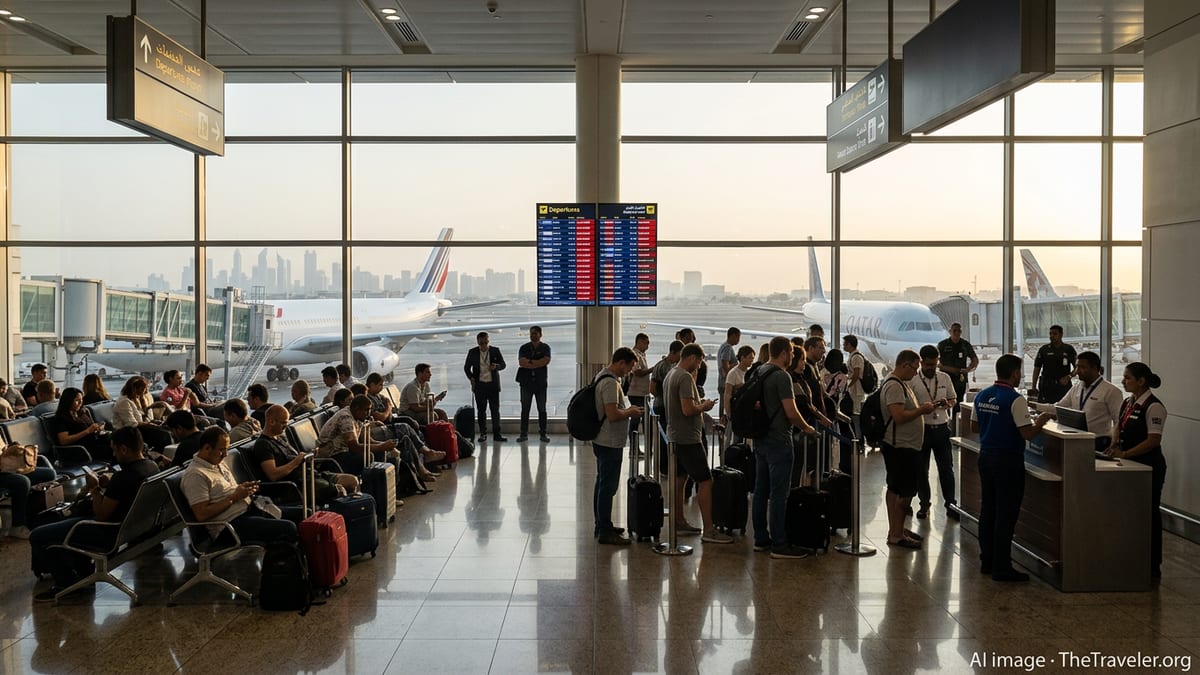
Hamad International Airport has handled thousands of stranded passengers in recent days, as some travelers who were already in transit when the closure took effect found themselves stuck in Doha with little clarity on when onward flights would depart. Airport authorities have opened additional seating, extended hotel and lounge arrangements where possible and reinforced customer support teams, but anecdotal reports describe long queues at service desks and difficulty obtaining firm rebooking dates.
Qatar Airways has emphasized that it will not fully resume its global network until the Qatar Civil Aviation Authority deems it safe to reopen airspace on a normal basis. For now, the carrier’s strategy focuses on ad hoc relief operations and maintaining a skeletal presence on certain strategic routes, while warning customers that all plans remain subject to abrupt change based on military and regulatory developments in the wider region.
Impact on Travelers and the Wider Aviation Network
The combined effect of KLM’s Dubai cancellations and Qatar Airways’ suspended operations is being felt far beyond the Middle East. With two of the most important Europe to Asia transit hubs severely constrained, the usual web of one stop connections has been partially dismantled. Travelers seeking to fly between Europe and destinations in South and Southeast Asia, Australia or East Africa are encountering higher fares, longer journey times and reduced choice as capacity through the Gulf shrinks.
Other carriers are trying to capture displaced demand, but they face their own challenges. Many European and Asian airlines are rerouting around Iranian and Iraqi airspace, which lengthens flight times and increases fuel burn, eroding profitability on long haul routes. Some have temporarily suspended services to Gulf cities altogether, while others are operating with reduced frequencies or daytime-only schedules to align with available safe corridors.
Travel industry analysts estimate that more than 20,000 flights across the region have been cancelled since the conflict intensified in late February, with Dubai and Doha accounting for a significant share of the disruption. This has immediate consequences for tourism-dependent economies and for global trade flows that rely on bellyhold cargo capacity in passenger jets. Freight forwarders report tight space, longer transit times and surcharges on key lanes linking Asia, the Middle East and Europe, as airlines prioritize core markets and high-yield shipments.
For individual travelers, the disruption is translating into missed holidays, rescheduled business meetings and complex refund negotiations. Consumer groups are advising passengers to document all communications with airlines, review fare conditions carefully and consider the use of travel insurance policies that cover war-related disruptions, which are often subject to strict exclusions and may not apply in all cases.
What Passengers Should Do Now
Passengers booked on KLM services to or from Dubai through at least March 28 are being urged to check their booking status directly with the airline or their travel agent and to avoid heading to the airport without a confirmed new itinerary. In many cases, customers can rebook onto later dates or alternative routes, though popular spring travel periods are already filling up on remaining services via non-Gulf hubs.
Those holding Qatar Airways tickets for travel in March should assume that schedules will remain highly unstable for the rest of the month. Travelers are advised to monitor updates from the airline closely, as limited relief flights continue to be announced at short notice on specific dates and routes. Where journeys are time sensitive, it may be prudent to explore completely different routings via Europe, Turkiye or South Asia, even if this involves extra stops or overnight stays.
Experts also recommend that anyone planning new trips involving the Middle East in the coming weeks build in additional buffer time, opt for fully flexible tickets where budgets permit and pay particular attention to connecting times when itineraries combine multiple carriers. Given the scale of the disruption, a single cancellation can ripple through an entire multi segment journey, and reaccommodation options may be scarcer than usual.
With the security situation evolving day by day, there is no clear timeline for a full restoration of normal flight patterns across the Gulf. Until airspace restrictions ease and airlines such as KLM and Qatar Airways can reliably operate to major hubs including Dubai and Doha, travelers should be prepared for a prolonged period of volatility in schedules, routes and fares across one of the world’s most important aviation crossroads.