

More news on this day
Passengers across the Middle East are facing a new wave of travel disruption as Emirates, flydubai and EgyptAir suspend around 60 flights and defer nearly 100 more, following rolling airspace restrictions and security concerns that continue to upend operations at key hubs including Dubai, Abu Dhabi and Cairo.
Get the latest news straight to your inbox!
Wave of Suspensions Hits Gulf and Egypt Hubs
According to recent airline advisories and industry bulletins, Emirates, flydubai and EgyptAir have collectively withdrawn or rescheduled more than 150 flights over recent days, focusing on high-traffic routes in and out of Dubai, Abu Dhabi and Cairo. Operational data shared in travel alerts indicates that roughly 60 flights have been fully suspended, while about 95 have been pushed back, consolidated or rerouted as carriers navigate ongoing airspace closures across parts of the Middle East.
The latest adjustments build on a period of heightened turbulence for regional aviation that began in late February 2026, when escalating military tensions triggered widespread closures of airspace over Iran, Iraq, Kuwait and sections of the Gulf. Client advisories issued in early March describe major airports such as Dubai International, Zayed International in Abu Dhabi and Cairo International as among the most heavily affected, with knock-on disruption spreading into Europe, Asia and Africa as long-haul flights lost access to key corridors.
Publicly available information shows that Emirates initially halted nearly all passenger operations to and from Dubai before cautiously restoring a skeleton schedule, while flydubai and EgyptAir have trimmed regional networks and temporarily pulled flights to several Middle Eastern cities. Even as some services resume, day-to-day timetables remain fluid, leaving passengers uncertain whether planned departures will operate.
Emirates Scales Back, Then Restarts Limited Operations
Operational updates circulated to corporate travel clients and reposted by passengers on public forums describe how Emirates moved from a near-total standstill to a tightly controlled restart of flights from Dubai. Advisories dated in the first week of March outline an initial suspension of all services, followed by a limited resumption centered on select long-haul and repatriation flights once a partial reopening of Emirati airspace was authorized.
In practice, this has meant that dozens of Emirates departures and arrivals were removed from the schedule outright, particularly on routes crossing the most affected airspace. A further tranche of flights has been deferred or combined, with passengers shifted onto fewer services operating at different times or on alternative routings. Industry notices point to Europe, North America and key Asian gateways among the regions experiencing the most significant retiming.
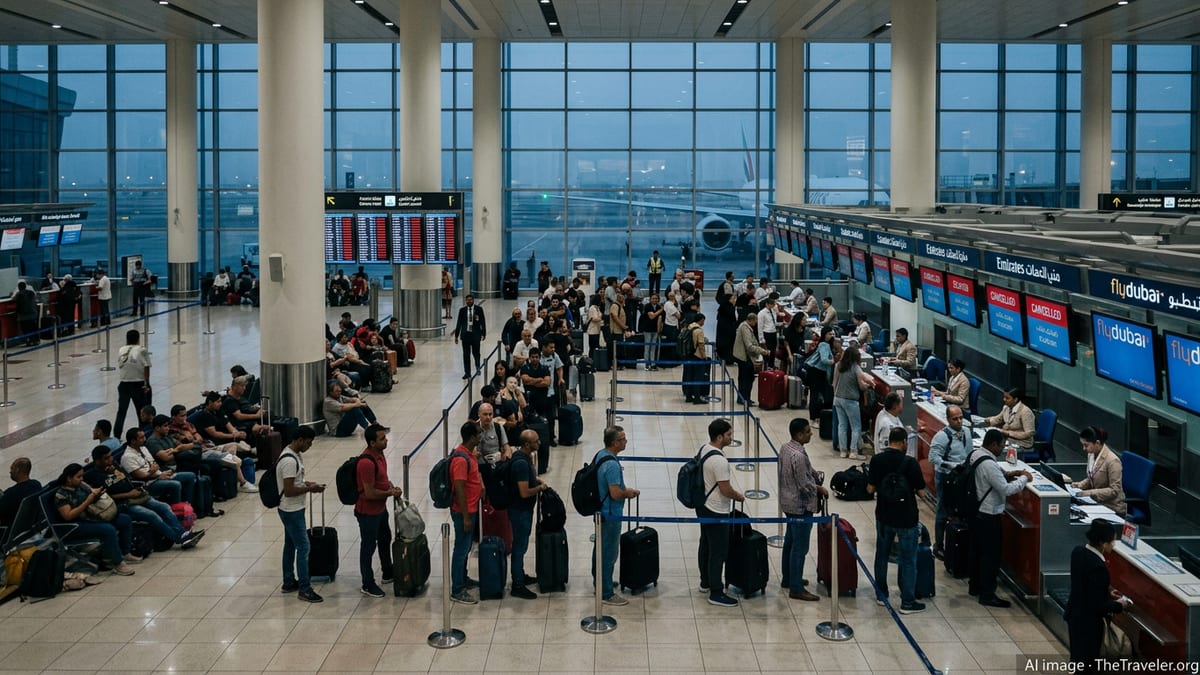
Emirates has publicly indicated that customers with earlier bookings are being prioritized for seats on the limited flights now operating, while warning that all other flights remain subject to change at short notice. The carrier’s call centers and ticket desks have been heavily congested, with reports of travelers spending hours in queues at Dubai International as they seek rebooking options, refunds or entirely new itineraries that avoid the disrupted corridors.
Flydubai and EgyptAir Cut Regional Links and Reroute Traffic
Low-cost carrier flydubai, which relies heavily on point-to-point traffic across the Gulf, Levant and wider Middle East, has also pared back its schedule. Airport updates and local media coverage indicate that the airline moved to a limited-operation model, focusing on a reduced number of departures from Dubai, while suspending or deferring dozens of services to destinations most directly affected by airspace restrictions and security concerns.
For EgyptAir, the impact has centered on its Middle East network rather than on domestic Egyptian airspace, which remains technically open. Corporate advisories summarizing the situation state that the Cairo-based carrier has suspended flights to more than a dozen cities around the region, while maintaining operations on other trunk routes where overflight permissions allow. Many EgyptAir departures to Gulf hubs have been rescheduled, consolidated or rerouted, contributing to the tally of deferred services reported in recent days.
These cutbacks have strained capacity between major Arab capitals at a time when demand for alternative routings is spiking. With some Gulf and Levantine airports still operating under restrictions, EgyptAir has increasingly become a fallback option for passengers trying to bridge Europe, Africa and the Middle East, even as its own timetables shift repeatedly in response to the evolving airspace map.
Passengers Face Cancellations, Diversions and Marathon Journeys
The ripple effects for travelers have been severe. Airline notices and airport statements describe passengers stranded in transit hubs, with some flights departing nearly empty toward affected cities in order to operate return sectors focused on repatriation. Others have been diverted to secondary airports such as Dubai World Central or have taken circuitous routings that skirt closed airspace, significantly extending flight times.
Reports from major regional airports describe crowded terminals, long queues at airline counters and a sharp rise in missed connections as carefully timed itineraries unravel. Travelers who had planned straightforward one-stop journeys through Dubai or Abu Dhabi have in many cases been rebooked onto multi-stop alternatives through Istanbul, European capitals or North African hubs, turning what were once eight-hour trips into journeys stretching well beyond 20 hours.
Travel insurance has emerged as a further point of tension. Policy documents shared in public forums show that many standard products exclude cover for disruptions linked to war, military action and airspace closures, leaving some passengers to absorb hotel costs and last-minute replacement tickets themselves. Consumer advocates in the region are urging travelers to scrutinize policy wording and keep detailed records of expenses while disruption continues.
Uncertain Timeline for Full Restoration of Schedules
Despite cautious signs of recovery, a fully stable schedule remains elusive. Business travel consultancies and global mobility advisories issued in early to mid March note that while hundreds of flights across the wider region have already been cancelled, carriers are still adjusting their operations daily, reacting to shifting assessments of risk and evolving overflight permissions.
Some industry commentary suggests that Emirates, flydubai and EgyptAir aim to rebuild their networks in phases, first restoring core long-haul links and the most commercially critical regional routes, while secondary destinations remain on reduced frequencies or temporary suspension. However, publicly available assessments from aviation analysts stress that any forecast is contingent on a sustained easing of regional tensions and a clear, coordinated reopening of multiple airspace zones.
For now, passengers planning to travel through Dubai, Abu Dhabi or Cairo in the coming days and weeks are being advised by airlines and travel-management firms to monitor flight status repeatedly, keep contact details updated with carriers, and consider flexible itineraries that allow for short-notice changes. With around 60 flights removed from schedules and nearly 100 more reshuffled by Emirates, flydubai and EgyptAir alone, the Middle East’s role as a reliable global transit crossroads remains under unprecedented pressure.