

More news on this day
Flight disruption across the Middle East intensified this week as regional airspace restrictions and security concerns resulted in 133 flight cancellations and 239 delays, affecting services operated by Gulf Air, Saudia, Emirates, IndiGo and other major carriers on routes connecting Dubai, Riyadh, Paris, New York and additional global hubs.
Get the latest news straight to your inbox!
Regional Airspace Restrictions Keep Hubs Under Pressure
Publicly available aviation data and recent travel industry coverage show that airspace constraints across Bahrain, the United Arab Emirates, Qatar, Jordan and Kuwait continue to play a central role in widespread schedule disruption. Authorities in several states have maintained partial or full restrictions on overflights and arrivals following a series of regional security incidents earlier in the year, leaving airlines with fewer routing options and tighter operational windows.
Reports from route-tracking platforms and travel advisories indicate that Bahrain and Kuwait have faced some of the steepest cuts, with a significant share of scheduled services either grounded or rerouted on short notice. Qatar and the UAE, home to major hubs in Doha and Dubai, have also seen extended periods of limited operations as carriers adjust to evolving airspace availability and longer diversion paths around restricted zones.
The cumulative impact is reflected in the latest figures from aviation analytics providers, which attribute at least 133 cancellations and 239 delays to the current wave of Middle East disruptions. While these numbers represent a snapshot within a broader crisis that has produced thousands of affected flights over recent weeks, they highlight how even incremental restrictions reverberate quickly through already congested schedules.
Industry observers note that the region’s role as a crossroads between Europe, Asia and North America amplifies the effect of each cancellation. When a key hub such as Dubai, Doha or Riyadh is forced to slow or suspend operations, connecting itineraries spanning multiple continents can unravel in a matter of hours.
Major Gulf Carriers Cut and Reroute Services
Gulf-based airlines remain at the center of the disruption. Public data and airline updates compiled by travel outlets show that Gulf Air, Saudia and Emirates have all reduced or reshaped schedules as they work around restricted airspace and fluctuating demand. On certain days, regional reports have recorded cancellation rates for some Middle Eastern carriers far above normal levels, with Bahrain and Qatar in particular posting large proportions of grounded flights.
Emirates, headquartered in Dubai, has progressively rebuilt its network after an initial wave of large-scale cancellations, but continues to operate below pre-crisis capacity. Travel coverage notes that the airline is prioritizing core long-haul routes while trimming frequencies on secondary destinations, a strategy intended to preserve connectivity between Dubai and major cities such as Paris and New York even as regional links remain fragile.
Saudia and other Saudi-based operators have focused on stabilizing operations from Riyadh and Jeddah, yet services to and from neighboring states including Jordan and Kuwait remain vulnerable to last-minute changes. Bahrain’s flag carrier, Gulf Air, has repeatedly adjusted schedules at its Manama hub as neighboring airspace openings and closures shift from week to week.
Low-cost and regional carriers are also heavily affected. IndiGo, FlyDubai and various Middle Eastern and South Asian airlines have reported disrupted rotations through Dubai and other Gulf airports, with some short-haul sectors to the subcontinent cancelled or delayed by several hours due to knock-on effects from earlier diversions and airport congestion.
Global Ripple Effects from Dubai, Riyadh, Paris and New York
The disruption is not confined to the Middle East. Because Gulf hubs act as transfer points between Europe, Asia, Africa and the Americas, cancellations in Bahrain, Qatar or the UAE are quickly felt in distant cities. Airline schedule data reviewed by travel analysts shows irregular operations on routes linking Dubai and Riyadh with major intercontinental gateways such as Paris Charles de Gaulle, London Heathrow and New York.
Passengers flying between Europe and Asia on one-stop itineraries via hubs in Dubai or Doha have faced missed connections and unplanned overnight stays when feeder flights from regional points are delayed. In some cases, aircraft and crew stranded in the Middle East have forced carriers to cancel or downgrade services on long-haul sectors, including flights to North American and European destinations.
Transatlantic and Europe–Asia corridors are particularly exposed to these disruptions because many itineraries rely on carefully timed connections through the Gulf. When a cluster of 133 cancellations and 239 delays is concentrated around a handful of regional hubs, schedules on entirely different continents can experience secondary delays as airlines reposition aircraft and crew.
Travel experts note that this interconnectedness makes it difficult for airlines to isolate problems. Even when airports such as Paris and New York are operating normally, passengers may still face disruption if their journey depends on a Middle Eastern connection that becomes untenable due to airspace or security constraints.
Passengers Confront Long Queues, Complex Rebookings
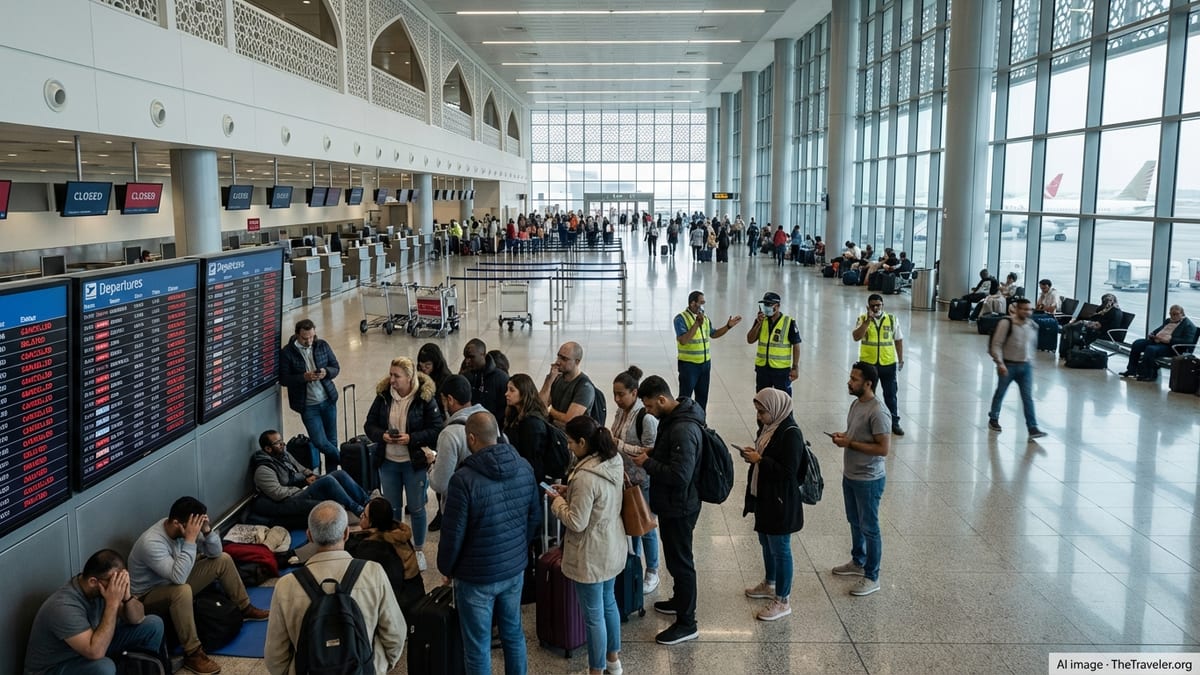
For travelers, the operational statistics translate into crowded terminals and challenging rebooking experiences. Coverage from travel media and consumer advocacy groups describes long queues at check-in and customer service desks in Dubai, Doha, Manama and Kuwait City as passengers seek alternative routes or new departure dates after cancellations are announced.
With multiple Gulf carriers trimming schedules at the same time, inventory on remaining flights has tightened, especially on popular corridors between South Asia, the Middle East and Europe. Some passengers have reported being rebooked via indirect routings that add many hours and additional stops to journeys that normally involve a single connection.
Industry guidance encourages affected travelers to rely on digital tools where possible, using airline apps and websites to track the latest status and submit rebooking or refund requests. However, surges in demand during major disruption periods have at times overwhelmed call centers and digital platforms, leading to slower response times and heightened frustration.
Consumer groups also emphasize the importance of understanding fare rules and regional regulations on compensation and care, which can differ depending on the carrier and the point of departure. In some jurisdictions, travelers may be entitled to meals, accommodation or partial refunds in the event of long delays or cancellations, while in others support is more limited when disruption is linked to security or airspace decisions.
Outlook: Gradual Recovery Amid Persistent Volatility
Looking ahead, publicly available airline schedules suggest a tentative recovery in Middle East operations, but with significant caveats. Some carriers have begun to restore frequencies to key destinations, and capacity at major hubs such as Dubai is slowly edging upward from the sharp declines recorded immediately after the latest escalation in regional tensions.
At the same time, travel industry briefings consistently describe the environment as volatile. Airspace permissions, security assessments and operational constraints are being updated on short notice, leaving airlines with limited visibility beyond the near term. As a result, schedules for the coming weeks are subject to change, and further clusters of cancellations and delays cannot be ruled out.
Analysts point out that the concentration of global traffic through a small number of Gulf hubs remains both a strength and a vulnerability for the aviation system. These airports enable efficient long-haul connections, but they also represent single points of failure when geopolitical or security shocks affect the region.
For passengers planning trips that involve Bahrain, the UAE, Qatar, Jordan or Kuwait, travel advisories continue to recommend close monitoring of itineraries and a willingness to adjust plans. Until regional conditions stabilize more fully, episodes of mass disruption on the scale of 133 cancellations and 239 delays are likely to remain a recurring feature of Middle East air travel.