

More news on this day
Hundreds of passengers across the Middle East are facing fresh disruption as flight tracking data shows 29 cancellations and more than 500 delays affecting services in Saudi Arabia, Egypt, the United Arab Emirates, Türkiye and Kuwait, snarling operations for Emirates, Saudia, Etihad, Pegasus Airlines and other carriers at major hubs in Dubai, Riyadh, Cairo and Istanbul.
Get the latest news straight to your inbox!
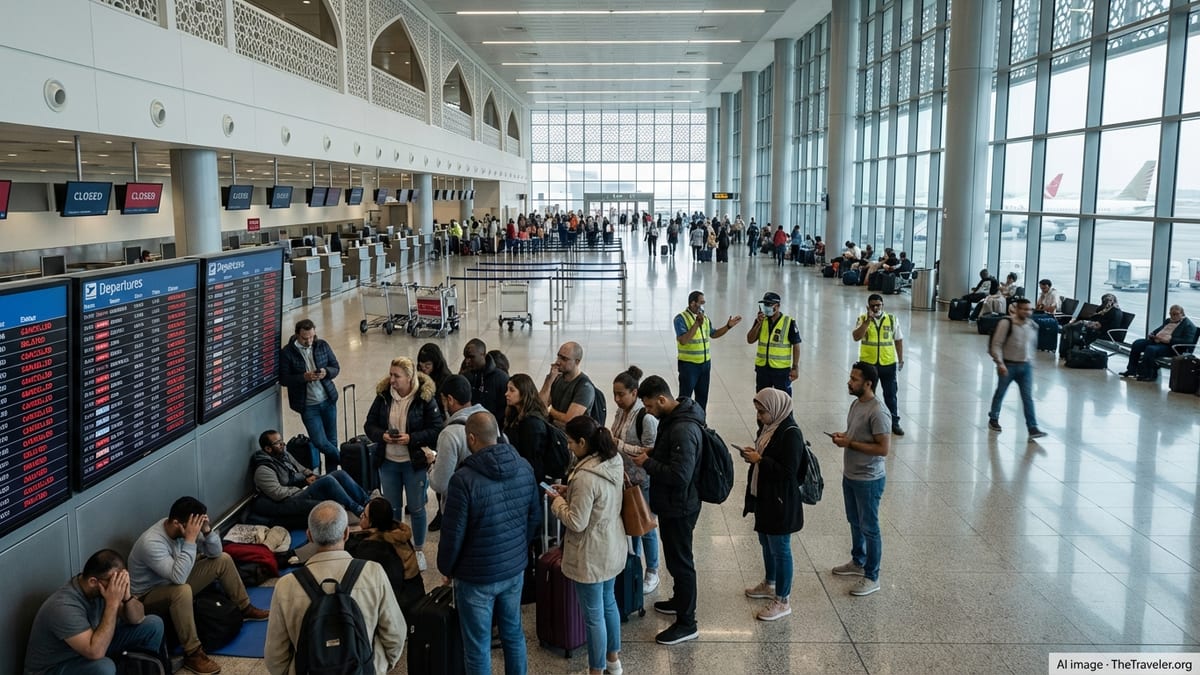
New Wave of Disruptions Across Gulf and Levant Hubs
The latest figures, compiled from publicly available flight status boards and monitoring platforms, indicate that 29 flights were cancelled and 517 delayed in a single operating period at airports across the region, highlighting how fragile airline schedules remain more than a month into the current security crisis. The tally covers movements at major hubs in the United Arab Emirates, Saudi Arabia, Egypt, Türkiye and Kuwait, with knock-on effects rippling into Europe, Asia and Africa.
Reports indicate that Dubai International Airport, Riyadh’s King Khalid International, Cairo International, Istanbul Airport and Kuwait International were among the hardest hit, with waves of late-running departures and extended ground holds as airlines adjusted routings around restricted airspace. Even where airports technically remained open, intensified traffic management and slot constraints contributed to rolling delays through the day.
Data reviewed by travel and aviation analysts shows that the pattern of disruption tracks closely with earlier shockwaves seen in early March, when coordinated airspace closures following the escalation of conflict involving Iran and several Gulf states forced carriers to suspend or sharply curtail operations through key hubs. While some restrictions have since eased, the latest cancellation and delay count underscores that schedules remain highly volatile.
Industry updates from travel management companies and logistics providers describe a patchwork operating environment, with certain corridors intermittently reopening while others stay shut or heavily restricted. As a result, even modest adjustments to airspace availability or local security postures can quickly cascade into widespread timing disruptions, as seen in the latest 29 cancellations and 517 delays.
Emirates, Saudia, Etihad and Pegasus Struggle to Rebuild Networks
Flag carriers and leading regional airlines are bearing the brunt of the ongoing instability. Public advisories and schedule updates show that Emirates and Etihad in the United Arab Emirates, Saudia in Saudi Arabia, and Pegasus Airlines and other Turkish operators have all been forced to repeatedly recalibrate their networks as airspace over segments of the Gulf, Iraq and the Levant opens and closes with little warning.
Published coverage on the wider conflict’s aviation impact notes that Emirates has been cautiously rebuilding capacity after an initial near-total suspension of regular services through Dubai, while still operating below its pre-crisis frequency on many long haul routes. Etihad has adopted a similar approach from Abu Dhabi, running a limited but gradually expanding schedule and prioritizing high-demand trunk routes where overflight permissions are stable enough to support reliable operations.
For Saudia, the challenge has been compounded by the need to maintain domestic connectivity between key Saudi cities while navigating regional closures that affect popular international links to Kuwait, Qatar and other Gulf markets. Reports on recent days at Riyadh’s King Khalid International point to heavy delays concentrated on domestic sectors to and from Dammam and southern gateways closer to conflict-adjacent airspace, alongside scattered long haul disruption.
In Türkiye, Pegasus Airlines and other carriers have been contending with intermittent suspensions on services to Lebanon, Syria, Iraq, Iran and Jordan, alongside restrictions on flights to Gulf destinations including the United Arab Emirates and Kuwait. Operational summaries for Istanbul Airport in early March highlighted triple digit delay counts and double digit cancellations in a single day, a pattern that has re-emerged in softer form with the latest wave of 517 delays across the wider region.
Dubai, Riyadh, Cairo and Istanbul Feel the Strain
Dubai International, one of the world’s busiest international hubs, remains at the center of the disruption. Earlier in the crisis, publicly available airline and airport notices indicated periods when all scheduled commercial flights to and from Dubai were suspended, followed by carefully managed reopenings via designated safe corridors. Although the airport is now handling a growing volume of traffic, the latest statistics demonstrate that timing reliability remains fragile, particularly on connections that rely on overflights of constrained airspace.
Riyadh’s main airport has played a dual role as both an affected hub and a relative safe harbor. Analysis of regional operations suggests that while Saudi Arabia’s airspace has largely stayed open compared with some neighbors, recurring security alerts and routing changes have forced waves of delays and occasional clusters of cancellations. Domestic Saudi routes and high demand links to Egypt and the wider Gulf have been especially sensitive to schedule shocks.
Cairo International Airport continues to see secondary effects from closures and restrictions east of Egypt. Travel advisories highlight Egypt as a critical alternative gateway for travelers rerouting around the Gulf, particularly those seeking to connect between Europe, East Africa and South or Southeast Asia without transiting the most affected airspace. That shift in demand has added to congestion and contributed to the elevated counts of delayed departures and arrivals recorded in the latest monitoring period.
Istanbul Airport, which emerged in recent years as a heavyweight connector between Europe, Asia and Africa, has repeatedly faced ripple effects from Middle East airspace constraints. Operational data from early March documented more than a hundred delays and a cluster of cancellations in a single day linked to regional closures, and the renewed disruption this week indicates that Istanbul’s role as a detour hub also carries exposure to timing instability when nearby air routes tighten.
Kuwait City and Secondary Airports Remain Vulnerable
Kuwait has been among the worst affected states in the current aviation crisis, with published travel advisories describing extended airport closures and severe schedule disruption following security incidents near Kuwait City. International carriers have cancelled or suspended many services into and out of the country, and even as some operations tentatively resume, overall capacity remains sharply reduced.
The latest set of 29 cancellations and 517 delays includes services linked to Kuwait International as well as flights in neighboring states that ordinarily rely on Kuwait’s airspace as part of standard routings. Cargo-focused updates from logistics firms emphasize that Kuwait’s constrained operations are still weighing on both passenger and freight connectivity, limiting options for travelers seeking alternative routings through the northern Gulf.
Secondary airports in the wider region, including some in the United Arab Emirates and Saudi Arabia, have at times absorbed additional traffic as carriers seek to maintain partial connectivity while avoiding the most sensitive air corridors. However, these facilities often lack the spare gate capacity and ground handling resources to seamlessly accommodate sudden surges in diverted or rescheduled flights, contributing to extended turnaround times and late running departures.
Industry observers note that while the headline figure of 29 cancellations may appear modest compared with earlier peaks in the crisis, the accompanying 517 delays highlight a deeper operational strain. In many cases, flights are operating but with extended block times, longer routings and compressed connection windows, all of which increase the risk of missed onward journeys and overnight strandees.
Passengers Face Prolonged Uncertainty as Summer Season Looms
For travelers, the latest wave of cancellations and delays confirms that Middle East air travel remains subject to abrupt change, even as some airlines talk publicly about cautiously restoring capacity. Consumer advocacy groups and compensation specialists tracking the disruption report that passengers are encountering a mix of last minute cancellations, rolling departure time changes and lengthy airport stays while carriers adjust to evolving restrictions.
Guidance from travel management companies continues to stress the importance of checking flight status repeatedly in the 24 hours before departure and avoiding unnecessary early arrivals at heavily affected hubs unless airlines have confirmed that a service is operating. With many carriers still using wide ranging rebooking waivers and flexible change policies introduced earlier in the crisis, passengers holding tickets through Dubai, Abu Dhabi, Doha, Riyadh, Jeddah, Cairo, Istanbul, Kuwait City and other regional gateways are being urged to consider alternative routings where possible.
Aviation analysts warn that the operational turbulence could extend into the peak northern summer travel period if regional security tensions remain unresolved. Industry data collated since late February has already shown tens of thousands of cancellations across the broader Middle East, combined with significant frequency reductions by several global network carriers. Against that backdrop, the specific snapshot of 29 cancelled and 517 delayed flights across Saudi Arabia, Egypt, the United Arab Emirates, Türkiye and Kuwait illustrates how even a single day of disruption can affect hundreds of passengers and reverberate across multiple continents.
With no clear timeline for a full normalization of airspace access, airlines are expected to continue relying on dynamic schedule planning and conservative capacity deployment in and around the Gulf and Levant. For travelers planning itineraries that touch Dubai, Riyadh, Cairo, Istanbul, Kuwait City or nearby hubs, the current environment points to a season of heightened uncertainty, where flexibility and vigilance remain as essential as passports and boarding passes.