

More news on this day
Thousands of travelers across the Middle East are facing severe disruption as airlines including Gulf Air, Qatar Airways, Malaysia Airlines, EgyptAir and FlyDubai suspend or delay hundreds of flights, with major hubs in Manama, Doha, Dubai, Abu Dhabi and Fujairah experiencing widespread cancellations and rolling delays.
Get the latest news straight to your inbox!
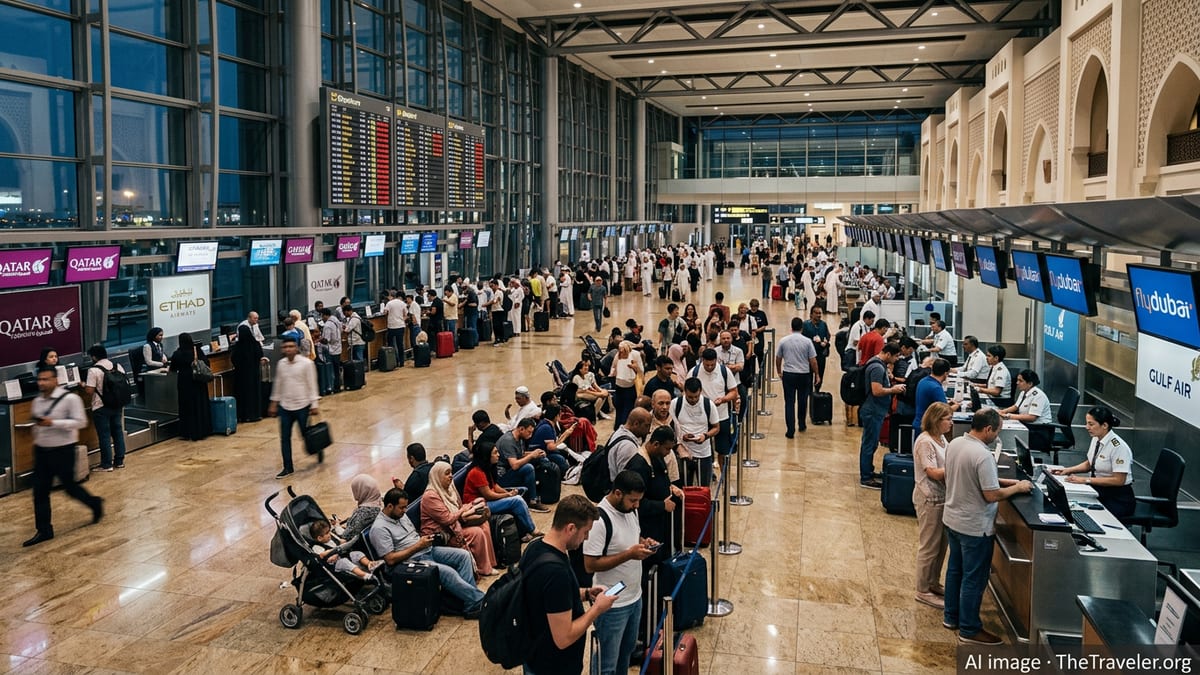
Network Shock as 272 Flights Are Pulled From Schedules
Publicly available operational data and local media coverage indicate that at least 272 flights have been suspended across key Middle Eastern routes in recent days, alongside more than 200 additional delays. The disruption is concentrated at regional hubs linking Europe, Asia and Africa, where tight connection windows and dense schedules have quickly magnified the impact.
The most heavily affected services include those operated by Gulf Air from Manama, Qatar Airways via Doha, EgyptAir from Cairo, FlyDubai out of Dubai and Malaysia Airlines on selected services transiting Gulf hubs. Other regional and international carriers have adjusted schedules, re‑timed departures or rerouted around closed or restricted airspace, adding further pressure on already stressed networks.
Reports indicate that suspensions span a mix of short‑haul regional routes and long‑haul intercontinental services, with many aircraft and crew now out of position. This imbalance is complicating recovery plans, as airlines work to realign fleets, secure new overflight permissions and rebuild reliable timetables in a volatile operating environment.
Travel planners describe the current situation as one of the most complex operational challenges in the region since the pandemic, with cascading effects on passenger itineraries, cargo flows and airport ground operations.
Gulf Hubs Struggle Under Passenger Backlogs
Major airports in Bahrain, Qatar and the United Arab Emirates are managing significant passenger backlogs as cancellations and rolling delays accumulate. Published accounts from airport operators and travel industry briefings point to thousands of travelers stranded or facing extended layovers at Bahrain International Airport in Manama, Hamad International Airport in Doha, Dubai International Airport, Abu Dhabi’s Zayed International Airport and Fujairah International Airport.
In Dubai and Abu Dhabi, curbs on regional airspace and temporary infrastructure constraints have reduced movements well below normal levels, forcing airlines to prioritize limited slots for essential repatriation and key long‑haul trunk routes. Similar pressure is being reported in Doha, where Qatar Airways has adjusted operations while working within evolving overflight and routing limitations.
Smaller but strategically important facilities such as Fujairah are playing an outsized role as carriers and local authorities redirect some operations away from the busiest hubs. Charter and relief flights using secondary airports along the Gulf coast are helping to move stranded travelers, but capacity remains far below demand.
Terminal congestion, long queues at service desks and heavy reliance on digital rebooking tools are now common features across multiple Gulf airports, as airlines try to handle high volumes of schedule changes while maintaining basic passenger services.
Airlines Adjust Strategies Amid Ongoing Airspace Constraints
According to published airline notices and industry analyses, the latest wave of suspensions and delays is closely tied to a patchwork of airspace closures and restrictions across parts of the Middle East. Carriers have been forced to cancel point‑to‑point flights that directly traverse affected corridors and to reconfigure multi‑stop itineraries that depend on tight turnaround times at Gulf hubs.
Gulf Air and other Bahrain‑based operations have been particularly exposed where Bahrain airspace restrictions have limited departures and arrivals, significantly reducing connectivity for passengers using Manama as a regional transfer point. In parallel, Qatar Airways has scaled back some Doha services while rerouting others along longer flight paths that avoid sensitive airspace, increasing flying times and fuel costs.
EgyptAir’s network has also felt the impact, with suspensions on selected routes into the Gulf and onward to Asian destinations. Malaysia Airlines and other Asian carriers using Gulf hubs as key transit points have reported disruption to itineraries, highlighting the global reach of what appears, on the surface, to be a regional issue.
FlyDubai, which relies on dense short‑ and medium‑haul schedules from Dubai to cities across the Middle East, North Africa and South Asia, has faced particular challenges realigning its timetable. Publicly available updates show that many departures have been consolidated, retimed or temporarily pulled while the carrier assesses the stability of available routes.
Knock‑On Effects for Global Routes and Travel Plans
The Gulf’s central role in global aviation means that the impact of 272 suspended flights and extensive delays extends far beyond the immediate region. Industry trackers highlight disrupted itineraries linking major cities from London, Paris and Frankfurt to Mumbai, Kuala Lumpur, Sydney and Johannesburg, as passengers find their carefully planned one‑stop connections via Manama, Doha, Dubai or Abu Dhabi suddenly unworkable.
With aircraft and crews displaced around the network, airlines are having to cancel or heavily delay flights from distant points such as Southeast Asia and Europe, even when local conditions at those origin airports remain normal. This imbalance is generating additional cancellations unrelated to immediate airspace constraints, prolonging the disruption for travelers who never expected to transit the Middle East.
Travel agents and corporate travel managers are reporting a surge in demand for alternative routings that bypass the Gulf entirely, often via Istanbul, major European hubs or South Asian gateways. These alternatives typically involve longer journeys, reduced flexibility and higher fares, especially on short notice, further complicating travel planning for business and leisure passengers alike.
For many travelers already en route, real‑time itinerary changes have become the norm, as airlines rebook passengers on different carriers, reroute via new hubs or offer extended hotel stays while waiting for limited seats to become available.
Advice for Affected Travelers and Outlook for Recovery
Publicly shared travel advisories and airline statements emphasize that passengers should avoid heading to the airport without confirmed rebookings, as walk‑up assistance capacity is limited and departure boards are changing rapidly. Travelers are instead being encouraged to monitor official airline channels, mobile apps and airport notices for the latest status on specific flights.
Flexible ticket policies have become a key tool in managing the disruption, with many carriers offering fee waivers for date changes, rerouting options where space allows and, in some cases, refunds for passengers who choose to postpone or cancel their trips. Travel industry analysts recommend documenting all communications and keeping receipts for incidental expenses, in case partial reimbursement or insurance claims are possible at a later stage.
The pace of recovery will largely depend on how quickly airspace restrictions ease and how reliably airlines can rebuild their schedules once corridors reopen. Even as limited services resume, publicly available information from recent disruption events in the region suggests that it can take several days, and sometimes longer, for flight networks to normalize and for stranded passengers to reach their final destinations.
For now, travelers planning to transit Manama, Doha, Dubai, Abu Dhabi, Fujairah and other nearby hubs in the coming days are being advised to prepare for potential changes, build in additional buffer time and remain ready to adjust itineraries as airlines continue to refine their operations in a shifting regional environment.