

More news on this day
Thousands of travellers across the Middle East are facing mounting disruption as Gulf Air, Saudia, FlyDubai, IndiGo, EgyptAir and Royal Jordanian collectively suspend 141 flights and register more than 100 delays across Bahrain, Saudi Arabia, the United Arab Emirates, Qatar and Egypt, according to emerging operational data and published industry coverage.
Get the latest news straight to your inbox!
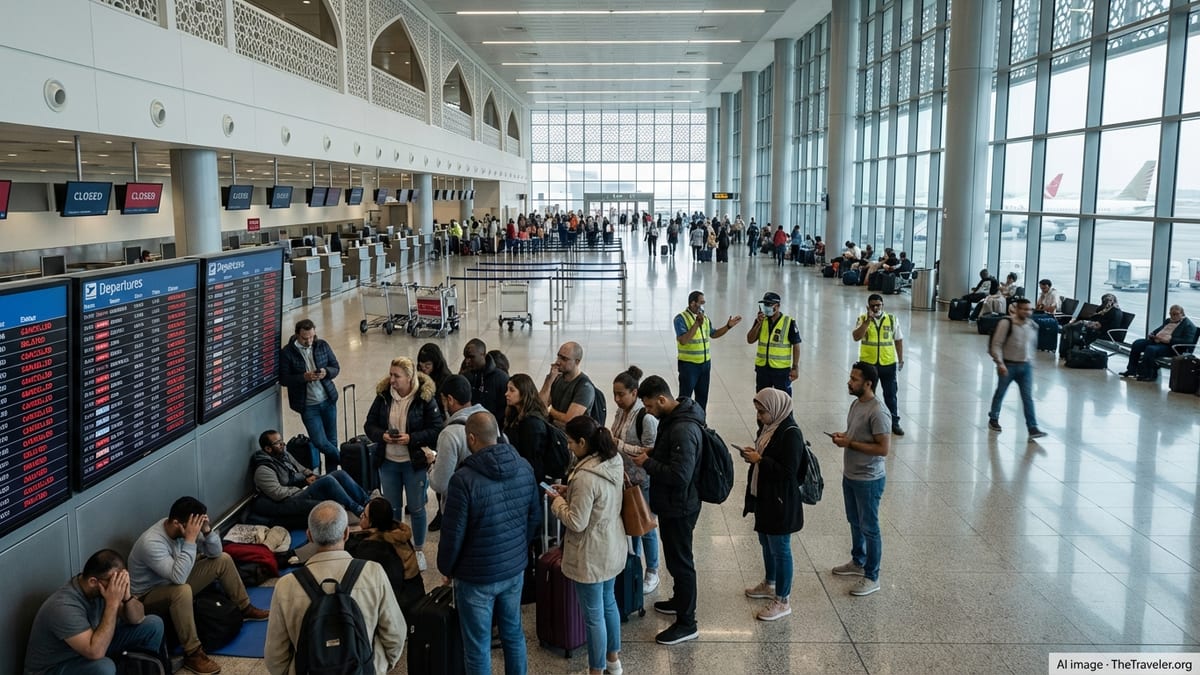
Airspace Restrictions Keep Hubs Under Strain
The latest wave of suspensions is unfolding against a backdrop of ongoing airspace restrictions and intermittent closures affecting key corridors across West Asia. Since late February, a series of security developments and retaliatory strikes in the region have prompted authorities in multiple states to curtail or tightly manage overflights, pushing airlines into rapid schedule revisions and reactive network planning.
Publicly available aviation advisories and travel-industry analyses indicate that operators serving Bahrain, Saudi Arabia, the UAE, Qatar and Egypt have been particularly exposed. Long-haul routes that typically cross Iranian, Iraqi, Jordanian and Gulf airspace have required diversions or temporary withdrawal, while shorter regional links have been cut outright when alternate routings are commercially or operationally unviable.
These restrictions are magnified at major hubs such as Dubai, Abu Dhabi, Doha, Manama and Riyadh, which normally function as high-frequency connection points between Europe, Asia and Africa. As corridors close or narrow, capacity at these airports drops quickly, forcing carriers to consolidate flights, extend ground times and reassign aircraft and crews on short notice.
Travel intelligence platforms tracking cancellations and delays across the region show that the cumulative effect is a patchwork of disrupted schedules that changes by the hour, rather than a single, clearly defined shutdown window. For passengers, that means uncertainty persists even when individual airports appear open and operating.
Gulf Air and Saudia Bear the Brunt at Core Bases
Gulf Air, the flag carrier of Bahrain, has emerged as one of the most affected airlines as Bahrain International Airport continues to experience sharply reduced operations. Flight-status summaries for Manama indicate that a significant share of the 141 suspended services are clustered around Gulf Air’s regional network, particularly short- and medium-haul rotations into Saudi Arabia, Qatar and the UAE that rely on now-constrained airspace.
Schedule data suggests that Gulf Air has concentrated remaining capacity on select trunk routes and essential connections, while an above-average number of flights are either cancelled outright or retimed by several hours. Reports from travel platforms note that the carrier is also using nearby Saudi gateways as alternative points of departure and arrival for some passengers, reflecting a wider regional trend toward creative re-routing.
In Saudi Arabia, Saudia is confronting similar pressures. Airports in Riyadh and Jeddah are seeing elevated volumes of both cancellations and late departures as the airline adjusts to shifting overflight permissions and downstream congestion at foreign hubs. Industry coverage of daily operations shows Saudia trimming frequencies on certain regional routes and prioritising widebody services on higher-yield intercontinental sectors.
Operational summaries from major Saudi airports highlight that knock-on delays often ripple outwards: when an inbound aircraft arrives late due to a diversion or longer routing, subsequent departures from Riyadh or Jeddah are pushed back, adding to the tally of delays even when flights are not formally cancelled.
FlyDubai, IndiGo, EgyptAir and Royal Jordanian Cut and Reroute
Low-cost and hybrid carriers are also at the centre of the disruption. FlyDubai, which normally operates a dense web of short-haul services from Dubai to destinations across the Gulf, Levant and South Asia, has suspended a portion of its schedule where routings intersect with the most restricted airspace. Aviation trackers show that affected flights include services to nearby regional capitals and secondary cities that typically depend on high frequency rather than long-haul demand.
Indian carrier IndiGo, already contending with significant constraints on India–West Asia traffic since late February, has scaled back additional flights into Bahrain, Saudi Arabia, Qatar and the UAE. Trade publications focusing on Indian aviation report that thousands of IndiGo passengers have been shifted onto alternative dates or rerouted through less affected corridors, with some itineraries now requiring longer travel times and overnight layovers at non-Gulf hubs.
EgyptAir and Royal Jordanian, both heavily integrated into the region’s network structure, are likewise making targeted cuts. Flight monitoring data for Cairo and Amman shows selected departures to Gulf destinations temporarily removed from timetables or listed with extended delays. Carriers are leaning on their remaining European and African links to offer detours, but seat availability has become tight on popular dates as displaced Gulf-bound travellers search for alternatives.
Collectively, these schedule reductions from FlyDubai, IndiGo, EgyptAir and Royal Jordanian contribute to the tally of 141 suspended services, while more than 100 flights remain technically operating but significantly delayed, often by several hours.
Travellers Face Missed Connections, Visa Complications and Longer Journeys
The immediate impact for travellers across Bahrain, Saudi Arabia, the UAE, Qatar and Egypt is a maze of missed connections, unplanned stopovers and re-issued tickets. Because many of the affected routes function as feeder legs into long-haul journeys, a single cancellation on a short regional hop can disrupt itineraries spanning three continents.
Reports compiled by passenger-rights organisations and travel platforms indicate that transit passengers are especially vulnerable. A delayed outbound flight from a Gulf hub can mean a missed onward connection to Europe or Asia, with limited same-day alternatives once airlines have trimmed frequencies. In some cases, travellers are being rebooked via entirely different hubs in Turkey, North Africa or Southern Europe.
There are also bureaucratic challenges. When carriers shift passengers to alternative gateways, some travellers suddenly require transit visas or meet different entry rules than originally planned. Public information from consular services and airline advisories stresses the importance of checking visa and documentation requirements for any newly assigned routing, particularly when last-minute changes involve an unexpected overnight stay.
Travel search engines and booking sites show surging demand for flexible tickets and itineraries that avoid the most disrupted airports where possible. However, with airspace restrictions affecting a wide swathe of the region, even seemingly indirect routings can be subject to last-minute time changes, making advance planning difficult.
What Passengers Should Monitor in the Coming Days
As of 9 April 2026, industry observers describe the situation as fluid rather than stabilised. While some airspace corridors have seen intermittent reopening, the overall environment remains unpredictable, and airlines are updating schedules day by day. Travel-analytics firms caution that published timetables may not reflect real-time operational decisions until a few hours before departure.
Publicly available guidance from airlines and airports across Bahrain, Saudi Arabia, the UAE, Qatar and Egypt encourages passengers to monitor their booking status repeatedly in the 24 hours before travel. Same-day checks are especially critical for those relying on connecting services operated by Gulf Air, Saudia, FlyDubai, IndiGo, EgyptAir or Royal Jordanian, as these carriers adjust rotations to accommodate crew-duty limits and aircraft positioning.
Travel-industry coverage also highlights the importance of understanding ticket conditions. Flexible or rebookable fares are proving far easier to adjust than heavily discounted non-changeable tickets, though many carriers are temporarily relaxing some rules for journeys that traverse the most affected airspace. Passengers are being advised to retain boarding passes, booking confirmations and any written disruption notices for potential use in refund or compensation claims where local regulations permit.
With 141 flights already suspended and more than 100 delayed across the five key markets, the Middle East’s aviation network remains under extraordinary strain. For now, travellers planning to transit through Bahrain, Saudi Arabia, the UAE, Qatar or Egypt are likely to face longer journeys, limited routing options and a heightened need for up-to-the-minute information.