

More news on this day
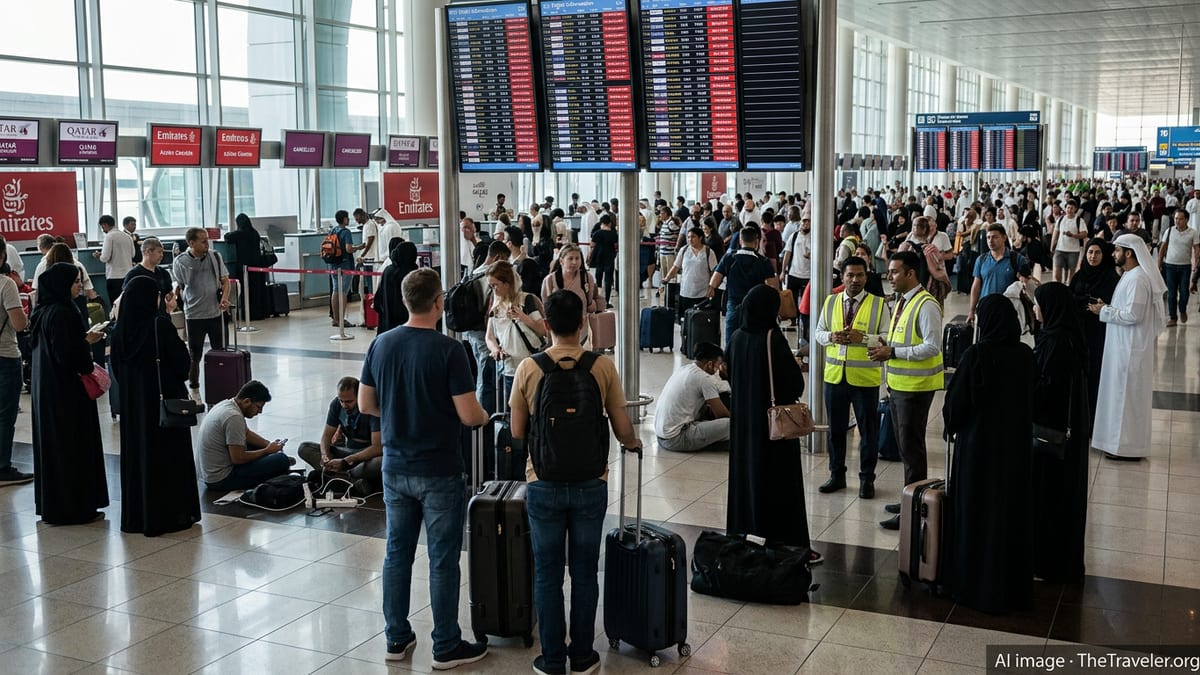
Airspace closures and missile strikes linked to the Iran war have plunged flights across the United Arab Emirates, Qatar and Saudi Arabia into turmoil, leaving thousands of travelers stranded in transit hubs from Dubai to Doha and scrambling to secure refunds, rebookings and safe passage home.
Airspace Closures Turn Gulf Hubs into Global Bottlenecks
The United Arab Emirates, Qatar and Saudi Arabia sit on one of the world’s busiest aviation crossroads, carrying a huge share of traffic between Europe, Asia, Africa and Australasia. That system has been thrown badly off balance since U.S. and Israeli strikes on Iran on February 28 triggered retaliatory missile attacks and sweeping airspace restrictions across the Gulf.
Flights through Iran, Iraq, Israel, Qatar, Bahrain, Kuwait and parts of Syria have been suspended or heavily curtailed, forcing carriers to cancel services outright or divert along longer southern or northern corridors. Dubai, Abu Dhabi and Doha, normally among the most efficient hubs, have faced rolling shutdowns, skeleton schedules and packed departure halls as airlines work through grounded aircraft and displaced crews.
Emirates and Etihad have begun operating limited services from Dubai and Abu Dhabi, using alternative routes that add several hours to long haul journeys. Qatar Airways remains subject to tight constraints from Doha as Qatari airspace reopens only for restricted evacuation and cargo flights, keeping standard commercial schedules largely on hold.
Saudi Arabia, whose airspace remains open, has turned into a crucial overflight corridor and diversion point. Saudia and other carriers are accommodating rerouted international traffic even as they trim some routes for operational and safety reasons, creating further pressure on an already strained system.
What Airlines Are Offering: Rebooking and Refund Rules
The patchwork of cancellations and diversions has prompted Gulf and global airlines to publish special disruption policies for passengers ticketed to or through the region. Broadly, carriers in the UAE, Qatar and Saudi Arabia are allowing customers to change travel dates without penalty, and in many cases to request refunds, for journeys scheduled over the coming days and weeks.
Emirates, Etihad and Qatar Airways are all offering free rebooking for affected travelers, typically within a defined window from the original departure date, subject to seat availability in the same cabin. Some carriers are also allowing itinerary changes to alternative destinations in the same region or on the same continent where operationally feasible, reflecting the scarcity of direct options in and out of the Gulf.
Refunds are generally available if a flight is cancelled, significantly delayed, or if an airline cannot provide a reasonable alternative route. However, industry analysts caution that compensation beyond a refund of the unused ticket, such as for hotels or missed events, is likely to be limited. Because the chaos stems from armed conflict and government-imposed airspace closures, carriers will typically cite force majeure clauses in their contracts of carriage.
Major international airlines serving the Gulf, including European and Asian flag carriers, have released their own waivers that mirror these policies. Many are allowing one free change or full refunds for itineraries touching affected airports through at least late March, and some Middle Eastern and Turkish operators have extended flexible change options through the end of the month.
How to Secure Your Rebooking Without Getting Stranded
With airport terminals in Dubai, Abu Dhabi and Doha still under strain, airlines and aviation authorities are urging passengers not to go to the airport unless they have a confirmed, operating flight and have been contacted directly. Travelers who simply turn up hoping to be placed on standby risk long waits in crowded departure halls and limited on-the-spot assistance from overwhelmed staff.
Instead, stranded customers are being told to manage their bookings via official airline apps, websites or call centers. Digital channels are generally updated first with new schedules, and many carriers now allow rebooking, destination changes and refund requests to be processed online. Keeping contact details current in the booking record is critical so that airlines can push notifications about last minute timing changes.
Travel agents and online booking platforms remain key intermediaries, especially for complex itineraries combining multiple airlines. Agents can sometimes access alternative routings through Saudi hubs or via Africa and Europe that may not appear in simple self-service tools. For travelers whose tickets were purchased through third parties, airlines may insist that changes and refunds be handled by the original point of sale.
Patience remains essential. With hundreds of thousands of passengers needing to be reprotected on a reduced number of flights, priority is usually given to those closest to their original travel dates, as well as vulnerable travelers. Experts recommend confirming updated travel plans at least twice, including on the day of departure, as timetables are still changing frequently in response to shifting security assessments.
Know Your Rights in the UAE, Qatar and Saudi Arabia
Passenger rights in the Gulf differ from the detailed compensation regimes in regions such as the European Union, and the current crisis is shaped by the fact that the disruption is rooted in war and state security decisions. Regulators and consumer advocates in the UAE and Saudi Arabia provide for care obligations when flights are delayed or cancelled, but airlines are not generally required to pay cash compensation when events are outside their control.
In practice, that means carriers will usually offer meal vouchers, hotel accommodation and ground transport when disruptions force extended waits or overnight stays, provided that immigration and safety rules allow passengers to leave secure areas. During the current crisis, the sheer number of stranded travelers has at times outstripped available hotel rooms near major hubs, prompting some airlines to prioritize families with children, elderly passengers and those with medical needs.
For journeys that start or end in Europe, or involve European carriers, passengers may benefit from stronger protections. However, even those rules contain exemptions for extraordinary circumstances related to security and conflict. Consumer lawyers say that while refunds should be honored where flights are cancelled, claims for additional compensation tied directly to the war are unlikely to succeed.
Travel insurance is emerging as an important backstop. Policies that explicitly cover trip interruption due to war or civil unrest remain relatively rare, but some comprehensive plans include benefits for missed connections, emergency accommodation and alternative transport that can help soften the blow of extended disruption in the Gulf.
Strategies to Avoid Future Travel Nightmares in the Region
As the conflict evolves, aviation analysts expect a prolonged period of instability in Middle Eastern skies, even if the most intense fighting eases. Airlines will need time to reposition aircraft and crews, reestablish routine overflight permissions and rebuild passenger confidence. For would-be travelers, that calls for more cautious planning for trips that rely on Gulf transit hubs.
Specialists advise booking on a single ticket when connecting through the region, rather than stitching together separate legs, so that one airline or alliance is responsible for getting the traveler to the final destination if disruption strikes. Choosing slightly longer itineraries that avoid the tightest connection times can also provide a buffer in case of rolling delays at hubs still catching up from earlier shutdowns.
Flexible, refundable fares and add-on services that allow same day changes have gained fresh appeal as war-related risks rise. While more expensive upfront, these options can make it far easier to adjust or abandon trips without incurring substantial penalties. Travelers are also being encouraged to pay close attention to government advisories, including those issued by the United States and European states, which can foreshadow further restrictions on flights in and out of the Middle East.
For now, the message from airlines and regulators across the UAE, Qatar and Saudi Arabia is clear. Do not assume business as usual, even if some flights are running again. Check, double check and, where possible, build flexibility into your plans as the region’s aviation lifeline is gradually rebuilt under the shadow of an unpredictable conflict.