

More news on this day
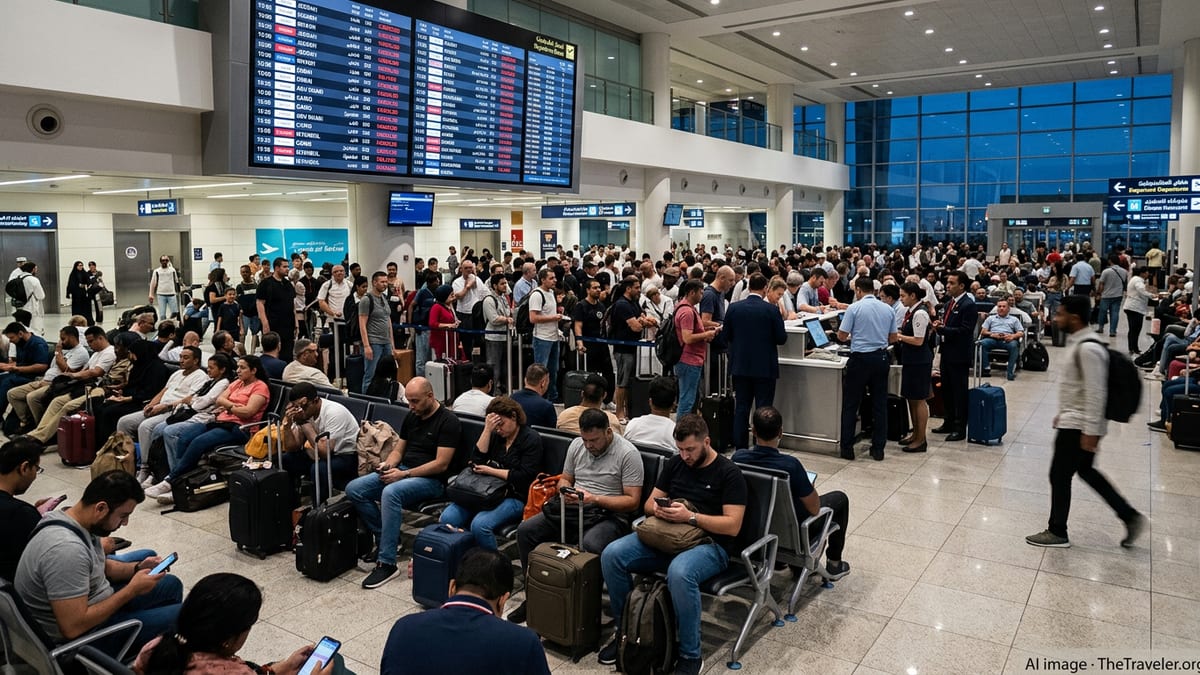
Middle Eastern air travel was thrown into further turmoil this week as fresh data showed at least 197 flight cancellations and 252 delays affecting carriers including Saudia, Etihad Airways, EgyptAir and Pegasus Airlines, with passengers in Saudi Arabia, the United Arab Emirates, Egypt and Turkey enduring long queues, scarce information and overnight waits in crowded terminals.
Conflict-Linked Airspace Closures Ripple Across the Region
The latest wave of disruption follows the closure and partial reopening of key Middle East airspaces after US and Israeli strikes on Iran triggered a cascade of security restrictions beginning on February 28. Countries including Iran, Iraq, Israel, Kuwait, Bahrain, Qatar and the UAE have enforced full or partial closures, forcing airlines to reroute or ground aircraft and suspend services through some of the world’s busiest transit hubs.
Dubai, Abu Dhabi and Doha have all seen large parts of their operations halted or severely constrained, according to aviation analytics and industry advisories, with thousands of flights cancelled since the crisis began. Saudi Arabia, Egypt and Turkey have remained relatively more open but are now absorbing a surge of diverted and disrupted traffic, pushing their infrastructure and airline operations to the limit.
While some safe corridors have reopened on a limited basis, schedules remain highly fluid, and carriers stress that services may be altered or cancelled at short notice as the military and security picture shifts. For travelers, that has translated into an unpredictable mix of last minute gate changes, rolling delays and sudden cancellations with little time to rebook.
Industry estimates suggest that more than 10,000 flights across the wider region have now been cancelled since the end of February, with hundreds of thousands of passengers either stranded or forced into lengthy detours via alternative hubs in Europe and Asia.
Saudia and Etihad Under Pressure as Hub Airports Strain
In Saudi Arabia, where airspace has remained open but under heightened control, disruption levels spiked again on March 3. Operational data compiled by regional travel monitors indicated more than 250 cancellations and nearly 200 delays in a single day across the country’s main airports, with Saudia and fellow Gulf carriers among those hardest hit.
At Jeddah’s King Abdulaziz International Airport and Riyadh’s King Khalid International Airport, passengers reported hours-long queues at check in and security, with departure boards showing waves of red as services to the UAE, Qatar and other nearby states were scrubbed or pushed back repeatedly. Staff have been juggling disrupted rotations for both aircraft and crew as flights that would normally pass through the UAE or Qatar are forced onto longer, more complex routings.
Etihad Airways, based in Abu Dhabi, remains constrained by the knock-on effects of the UAE’s airspace controls, even as it operates a small number of carefully approved services. Travelers connecting between Asia, Europe and North America via Abu Dhabi have seen itineraries broken into multiple legs or held for days while the airline repositions planes and crews stranded outside the country.
The combined impact is particularly acute for religious travelers and migrant workers relying on Saudi gateways to reach South and Southeast Asia, many of whom travel on tight budgets and short visas. With hotel space near major airports rapidly filling, some families have been sleeping in terminal seating areas while they wait for scarce seats to open up.
EgyptAir, Pegasus and Turkish Carriers Face Tight Capacity
As Gulf hubs falter, airports in Egypt and Turkey have become vital pressure valves, but they too are feeling the strain. Cairo, one of Africa’s largest aviation hubs, has seen a rising tally of cancellations and delays as EgyptAir works around restrictions in neighboring airspaces and absorbs rerouted traffic, especially on routes linking Europe, the Gulf and East Africa.
Turkey, whose carriers including Turkish Airlines, Pegasus Airlines and others serve a dense network of Middle Eastern destinations, has extended suspensions on flights to several conflict-adjacent countries into early March. Services to Iran, Iraq, Syria, Lebanon and Jordan remain halted for now, while flights to Qatar, Kuwait, Bahrain and the UAE have faced intermittent cancellations, narrowing connection options for travelers seeking an alternative bridge between Europe and Asia.
Pegasus, which relies heavily on point to point leisure and migrant flows, has had to trim schedules and reposition aircraft to maintain connectivity on core domestic and European routes. For passengers in Istanbul, Izmir and Antalya, that has meant a higher risk of last minute changes, even on flights not directly touching the Gulf or Iran, as the carrier juggles aircraft utilization in a fast changing environment.
Turkish authorities have emphasized that flights to key Saudi and Omani cities remain possible, providing an important lifeline for those trying to move in and out of the Gulf without transiting fully closed or heavily restricted hubs. However, available seats are tight and fares have climbed as travelers scramble for any viable route.
What Passengers Need to Know Before They Fly
For travelers booked on Saudia, Etihad, EgyptAir, Pegasus or other regional operators over the coming days, patience and preparation are essential. Airlines are generally allowing free rebooking or voucher options on affected routes, but policy details differ by carrier, fare type and origin country. Many schedules are being adjusted several times a day, and not all changes are reflected immediately in online booking engines.
Passengers are being urged to monitor their booking reference directly through airline apps or websites, and to enable push notifications where possible. Travel agents and corporate travel departments can sometimes see schedule changes earlier through global distribution systems, making them a useful first point of contact for those on complex itineraries spanning multiple carriers.
Experts recommend avoiding self connecting itineraries that rely on separate tickets, especially through hubs in the Gulf, Saudi Arabia, Egypt and Turkey. If one leg is canceled or delayed, airlines are under no obligation to protect onward travel booked on a different ticket, leaving travelers exposed to additional costs. Booking through a single carrier or alliance, even at a higher upfront price, can provide greater protection in the current environment.
Travel insurance can help in certain cases, covering hotel and meal expenses during long delays, but many standard policies limit or exclude coverage when disruptions are attributed to war or acts of state. Travelers should check policy wording carefully and retain all receipts for any additional expenses incurred while stranded.
Planning Alternatives and Managing Long Airport Waits
With the situation changing by the hour, flexibility is now one of the most valuable assets for anyone flying into, out of or over the Middle East. Where possible, travelers are being encouraged to consider alternative routings that avoid currently stressed hubs, such as connecting through major European or Asian gateways rather than relying on a single Gulf hub for long haul transfers.
Some regional airports that remain fully operational, including Jeddah, Riyadh and Cairo, are emerging as temporary substitute hubs. However, these facilities are not designed to absorb the full volume of traffic displaced from Dubai, Abu Dhabi and Doha, and crowding has become a common feature in departure halls. Early arrival is advisable, but heading to the airport without a confirmed seat is not, as many airlines are restricting access to check in counters to confirmed passengers only.
For those already stuck in terminals, simple strategies can help mitigate the discomfort of long waits, from carrying essential medications and chargers in hand luggage to saving offline copies of travel documents and booking confirmations. Staying close to staffed transfer desks can also be beneficial, as occasional last minute opportunities arise when airlines consolidate lightly booked services or swap aircraft types.
While there are tentative signs of gradual stabilization as some airspaces reopen on a restricted basis, airline executives and aviation analysts warn that schedules in and around the Middle East are likely to remain volatile in the coming days. For now, anyone planning to travel through Saudi Arabia, the UAE, Egypt or Turkey should assume possible disruption, build extra time into their plans and remain ready to adjust at short notice.