

More news on this day
Thousands of passengers across the Middle East are facing severe disruption after regional carriers including Gulf Air, Saudia, Royal Jordanian and EgyptAir scrapped 154 flights and delayed 23 more, snarling operations at key hubs in Bahrain, Saudi Arabia, Jordan and Egypt amid widespread airspace closures linked to escalating regional tensions.
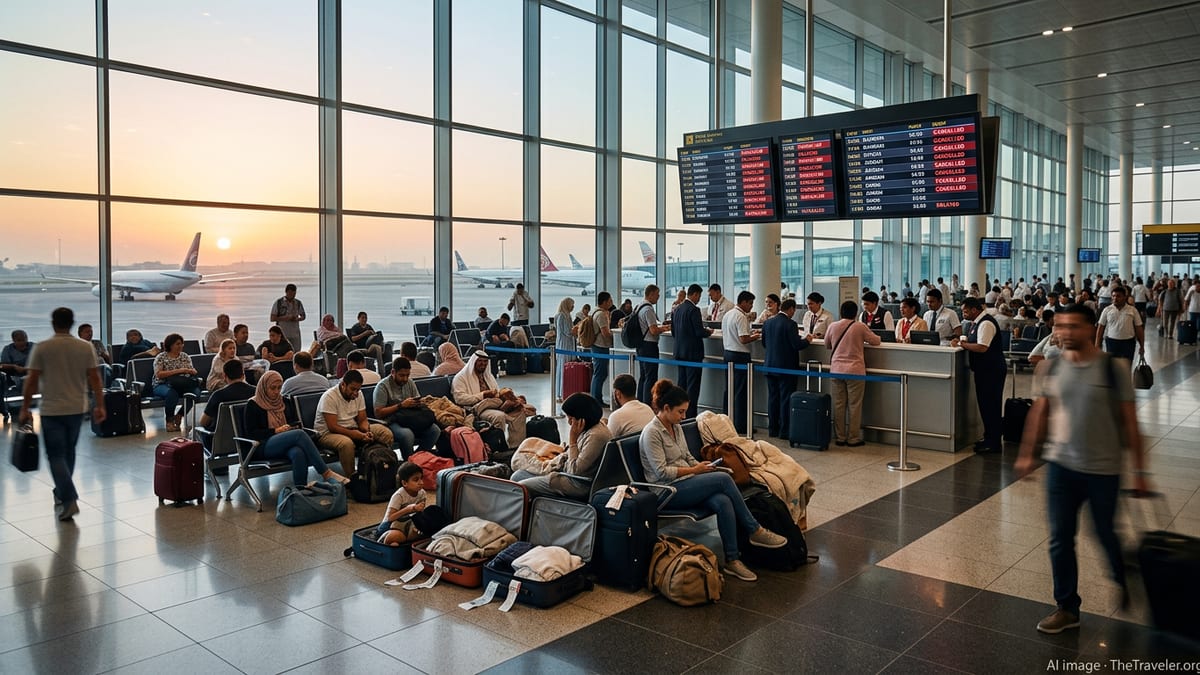
Airspace Closures Trigger Wave of Cancellations
The latest disruption follows a cascade of airspace closures across parts of the Middle East after United States and Israeli strikes on Iran over the weekend, prompting aviation authorities in several countries to restrict or partially suspend traffic. Iran, Iraq, Israel, Syria, Kuwait and the United Arab Emirates have all confirmed some level of airspace shutdown, forcing airlines to cancel or reroute services and adding pressure to already congested regional hubs.
According to data from aviation analytics firms and regional media, more than 1,500 flights across nine Middle Eastern countries were cancelled on Sunday alone, with Bahrain, Saudi Arabia, Jordan and Egypt among the worst affected. Within that broader total, Gulf Air, Saudia, Royal Jordanian and EgyptAir together have now axed 154 flights and delayed a further 23, leaving passengers stranded or scrambling for alternative connections at short notice.
The cancellations are concentrated on short and medium haul routes linking major Gulf hubs with cities across the Levant, North Africa, South Asia and Europe. Airlines have cited airspace safety concerns, rapidly shifting regulatory directives and the need to replan flight paths around newly restricted corridors as the main reasons for grounding operations.
Industry analysts warn that while some routes may gradually resume as authorities reassess risk, the rolling impact of diversions, crew repositioning and aircraft out of place could continue to disrupt schedules for several days, especially for carriers dependent on tightly banked hub operations.
Which Airlines and Routes Are Most Affected
Among regional carriers, Gulf Air, the flag carrier of Bahrain, has suffered a particularly sharp impact. Operating from a hub that sits at the heart of the Gulf’s north-south and east-west traffic flows, the airline has cancelled dozens of services touching Bahrain International Airport, including flights to Riyadh, Jeddah, Dammam, Cairo, Amman and several South Asian cities. Additional flights have been delayed as the carrier works through a backlog of aircraft and crew displaced by sudden airspace changes.
Saudia has also enacted sweeping cancellations across its regional network. The Saudi national airline has suspended services to and from Amman, Kuwait, Dubai, Abu Dhabi, Doha and Bahrain for set periods, while trimming frequencies on select longer haul routes to accommodate detours around closed skies. Flights linking Riyadh, Jeddah, Dammam and Madinah with neighboring capitals have been especially hit, compounding bottlenecks at Saudi Arabia’s main international gateways.
In Jordan, Royal Jordanian has reported multiple cancellations and delays centered on Queen Alia International Airport in Amman. Regional flights to Gulf destinations such as Dubai, Doha, Bahrain, Kuwait and Abu Dhabi have been most affected, alongside some services to Iraq and Syria where overflight restrictions are tightest. While long haul services to Europe and North America are broadly operating, passengers are being advised to expect knock on delays as aircraft navigate longer routings.
EgyptAir, based at Cairo International Airport, has cancelled and delayed a cluster of flights across the Gulf and Levant, including services to Riyadh, Jeddah, Dammam, Kuwait City and Amman. Routes connecting Egypt’s Red Sea and Mediterranean resorts to regional hubs have also come under pressure, raising concerns among tourism operators already facing booking uncertainties at the start of the spring travel season.
Airports Under Strain in Bahrain, Saudi Arabia, Jordan and Egypt
Bahrain International Airport has emerged as one of the focal points of the current disruption. With Gulf Air at the center of the cancellations tally, departure boards in Manama have shown waves of scrapped services to Gulf neighbors, while arriving flights are being retimed or diverted. Passengers report long queues at airline desks and transit counters as staff attempt to rebook travellers or arrange hotel accommodation for those unable to depart.
In Saudi Arabia, major hubs in Riyadh, Jeddah, Dammam and Madinah are dealing with a combination of cancellations, delays and aircraft reassignments. These airports handle significant connecting traffic between Asia, Africa and Europe, so each grounded or late-running flight can disrupt multiple onward journeys. Ground handlers and airport authorities are urging passengers to arrive early and to check flight status repeatedly, noting that schedules can change within hours as new airspace directives are issued.
Amman’s Queen Alia International Airport has experienced a high concentration of stranded passengers due to Royal Jordanian’s regional cancellations, as well as schedule adjustments by other foreign carriers. Airport officials have been coordinating with airlines to open additional customer service points and to bolster information screens in both arrivals and departures halls. Travellers transiting through Amman are seeing minimum connection times lengthen as crews and aircraft rotate more slowly through the network.
Cairo International Airport, one of Africa’s busiest hubs, is contending with knock on effects from regional cancellations layered on top of already heavy local demand. EgyptAir and other carriers operating to and from the Gulf are juggling limited take off and landing slots with new routing requirements that add time to each sector. Domestic flights are so far less affected, but passengers connecting from cancelled regional services are filling up rebooked sectors, constraining seat availability.
Guidance for Travelers Holding Tickets on Affected Carriers
For passengers booked on Gulf Air, Saudia, Royal Jordanian or EgyptAir over the coming days, aviation authorities and airline representatives are emphasizing the importance of verifying flight status before leaving for the airport. With timetables being updated frequently, information provided at the time of booking may no longer be accurate, and some flights originally marked as delayed are now moving into cancelled status as operational constraints mount.
Most carriers in the region are offering a mix of free date changes, routing modifications and refunds, with specific conditions varying by airline and fare type. Travelers whose flights fall within the 154 cancellations and 23 delays reported so far are generally being contacted via the email addresses or phone numbers linked to their reservations. However, passengers who booked through third party agents or online platforms may experience slower notifications and are advised to proactively reach out to their point of sale.
Airports in Bahrain, Saudi Arabia, Jordan and Egypt recommend that travelers allow extra time for security checks and check in, given longer lines at rebooking counters and customer service desks. Those with tight onward connections should ask airlines in advance about protection on later flights, as same day options may be limited on heavily used regional routes. Travel insurance policies that include disruption coverage may help recover some out of pocket expenses, such as unexpected hotel stays or missed tours, but policyholders should retain receipts and records of airline communications.
Officials stress that safety remains the overriding priority, and suggest that travelers monitor official announcements from civil aviation regulators and national carriers for the latest updates. While the situation is fluid, aviation analysts note that airlines are steadily refining new routings and may be able to restore a portion of suspended capacity once regional security assessments stabilize, though the timing and extent of that recovery remain uncertain.