

More news on this day
Thousands of air passengers across the Middle East are facing disrupted journeys as widespread cancellations and delays ripple through major hubs including Riyadh, Istanbul, Dubai and Muscat, with regional carriers such as Gulf Air, Saudia, Etihad Airways and EgyptAir adjusting schedules in response to ongoing airspace restrictions and operational challenges.
Get the latest news straight to your inbox!
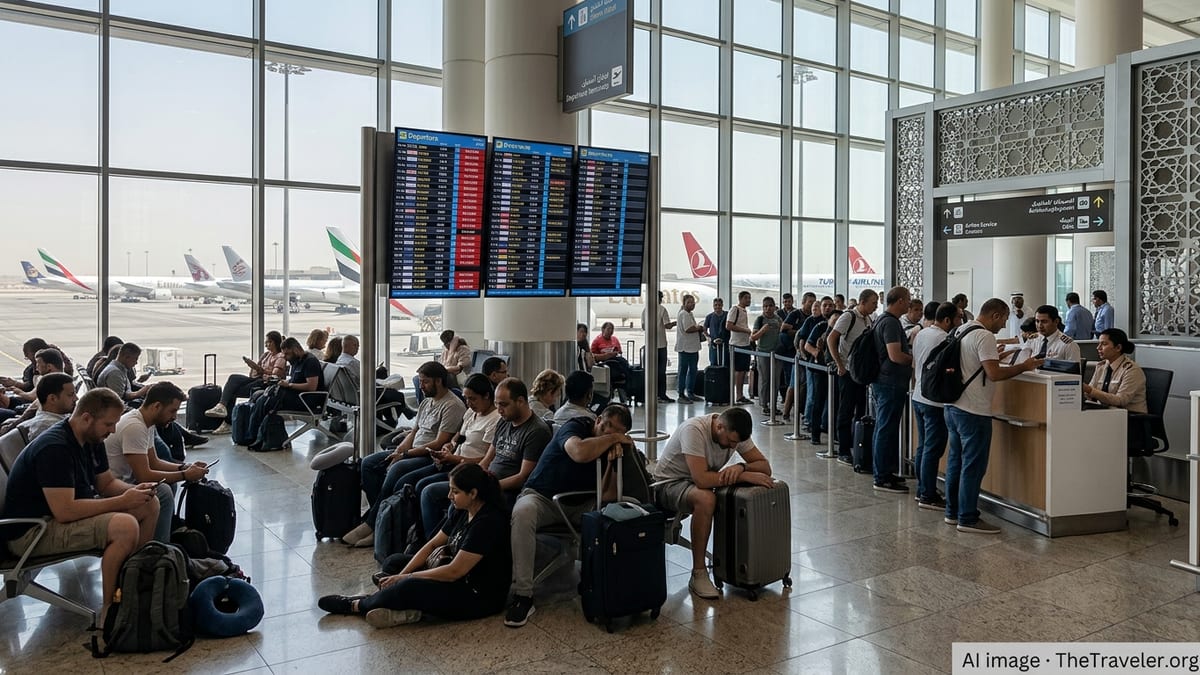
Hundreds of Flights Disrupted Across Gulf and Regional Hubs
Publicly available aviation tracking data and regional advisories indicate that at least 249 flights have been cancelled and close to 1,900 delayed in recent days across the Middle East, sharply affecting travel through Saudi Arabia, the United Arab Emirates, Qatar, Bahrain and Turkey. The disruption has concentrated around key international gateways such as Riyadh’s King Khalid International Airport, Dubai International Airport, Abu Dhabi’s Zayed International Airport, Istanbul Airport and Muscat International Airport.
Reports from airport departure boards and airline customer updates describe a pattern of rolling delays that often stretch for several hours, followed by last minute cancellations as airspace corridors open and close or become too congested to handle scheduled traffic. Many services are departing significantly behind schedule, while others disappear from boards altogether as carriers consolidate capacity or reroute aircraft to alternative airports.
Travel advisories issued in early and mid March highlighted ongoing airspace restrictions and intermittent closures across segments of the Gulf region, creating knock-on effects for long haul flights connecting Asia, Europe, Africa and North America. These constraints have limited the number of available routings, forcing airlines to operate fewer frequencies and lengthier detours that strain crews, fleets and airport infrastructure.
The result is a wave of disruption that has left passengers stuck in transit cities, unable to reach onward connections or return home as scheduled. Crowded terminals, rapidly changing information and stretched customer service channels have compounded the difficulty of rebooking or securing alternative routes.
Regional Carriers Curtail and Reroute Operations
Flag carriers and regional airlines are at the center of the upheaval as they attempt to balance safety, operational feasibility and passenger demand. Saudia has adjusted schedules at Riyadh and Jeddah, where advisories describe limited flights, cancellations and extended delays linked to regional airspace closures. Gulf Air has shifted some operations through Dammam in Saudi Arabia, using the airport as a temporary alternative to ease pressure on Bahrain-bound services.
In the United Arab Emirates, Emirates and Etihad Airways have faced repeated schedule changes out of Dubai and Abu Dhabi. Earlier in March, operations at Dubai International Airport were temporarily suspended before services resumed on a partial basis, and subsequent days have seen a mix of cancellations and delayed departures as airlines navigate evolving restrictions and congested corridors.
Qatar Airways has been heavily affected as well, with passengers reporting cancellations on flights linking Dubai and Doha and onward long haul connections toward Europe and South America. Some travelers stranded in Dubai have described last-minute cancellations followed by the need to purchase new tickets at significantly higher prices on alternative carriers or on later dates when capacity becomes available.
EgyptAir and other regional operators have also reduced or suspended selected services to Gulf destinations, particularly when outbound or inbound routes require passage through restricted airspace. Advisories from Egypt and Gulf states point to suspended flights on certain high-risk or logistically challenging routes, adding further layers of complexity to the regional flight map.
Riyadh, Istanbul, Dubai and Muscat Struggle With Knock-On Effects
The impact of these disruptions has been especially visible in hub airports that normally rely on dense banks of connecting flights. In Riyadh, King Khalid International Airport has been operating with limited flights and sporadic cancellations, with advisories warning of ongoing delays and reduced connectivity to neighboring Gulf capitals and beyond.
In Turkey, Istanbul’s role as a bridge between Europe, the Middle East and Asia has made it particularly vulnerable to changes in regional routing. Delays on flights between Riyadh and Istanbul, in some cases flagged days in advance, show how carriers are preemptively building extra time into schedules to cope with potential reroutes and slot congestion.
Dubai and Abu Dhabi continue to see some of the longest queues and most complex rebooking challenges. As major transit hubs, any reduction in outbound capacity quickly multiplies through the network, leaving transfer passengers with missed connections and limited same-day alternatives. Though some long haul flights are operating close to schedule, others have been cancelled outright or shifted to later dates, leading to an uneven and unpredictable experience for travelers.
Muscat International Airport in Oman has remained more stable, with advisories indicating normal operations for most flights. Even so, selective cancellations and route suspensions have been reported where services intersect affected airspace, illustrating how even relatively unaffected hubs are not entirely insulated from the broader regional turmoil.
Passengers Face Long Waits, Extra Costs and Limited Options
For travelers caught in the middle of the disruption, the immediate consequences have included unexpectedly long layovers, nights spent in terminals or nearby hotels, and the financial strain of purchasing new tickets, food and accommodation. Social media posts and online travel forums are filled with accounts of passengers stranded in Dubai, Doha and other regional hubs after last-minute cancellations erased carefully planned itineraries.
Some travelers have reported being offered rebooking several days later, while others have turned to alternative routes via less affected airports such as Muscat or Dammam, or via southern corridors that avoid the most restricted sections of Middle Eastern airspace. In many cases, these alternatives involve lengthy backtracking or additional stops and can be significantly more expensive than the original booking.
Insurance coverage has become a critical issue, with travel advisories noting that some policies may reimburse costs related to cancellations or major delays when they stem from airspace closures or security-related disruptions. However, passengers often face complex claims processes and may not receive immediate relief while still abroad and incurring expenses.
As airlines continue to adjust their networks, publicly available guidance urges travelers with upcoming flights through Riyadh, Istanbul, Dubai, Muscat and other regional hubs to monitor their bookings closely, use airline apps and airport information services to check live status, and prepare contingency plans in case of further cancellations or extended delays.
Uncertain Outlook as Airspace Restrictions Evolve
The outlook for a full return to normal operations across the Middle East remains uncertain. Travel risk assessments and airline advisories emphasize that airspace restrictions and route suspensions may be imposed or lifted at short notice, depending on security evaluations and regional developments. This volatility makes it challenging for carriers to publish reliable schedules far in advance and complicates planning for both business and leisure travelers.
Some airports and airlines are gradually restoring capacity along designated safe corridors, which has helped reduce backlogs for certain destinations. Nevertheless, continued congestion in these limited pathways and the need for longer routing around restricted zones have kept pressure on fleets and crew availability, leaving little margin for additional disruptions.
Industry observers note that the Middle East’s role as a global transit crossroads magnifies the effects of any regional constraint, sending ripples through flight networks linking Europe, Asia, Africa and the Americas. Even travelers whose journeys do not originate or end in the Gulf can be affected when their itineraries rely on connections through hubs such as Dubai, Doha, Abu Dhabi, Riyadh or Istanbul.
With thousands of passengers still working to reach their destinations amid 249 cancellations and nearly 1,900 delays, the situation underscores the importance of flexible travel planning, careful monitoring of flight status and a readiness to adapt routes as the regional aviation picture continues to shift.