

More news on this day
Thousands of travelers across the Middle East are facing hours-long queues, missed connections, and overnight airport stays as 1,738 flight delays and 460 cancellations ripple through major hubs in Turkey, Oman, the United Arab Emirates, Saudi Arabia, Kuwait, and Egypt, disrupting operations at airports including Dubai, Riyadh, Doha, Muscat, Cairo, and Abu Dhabi.
Get the latest news straight to your inbox!
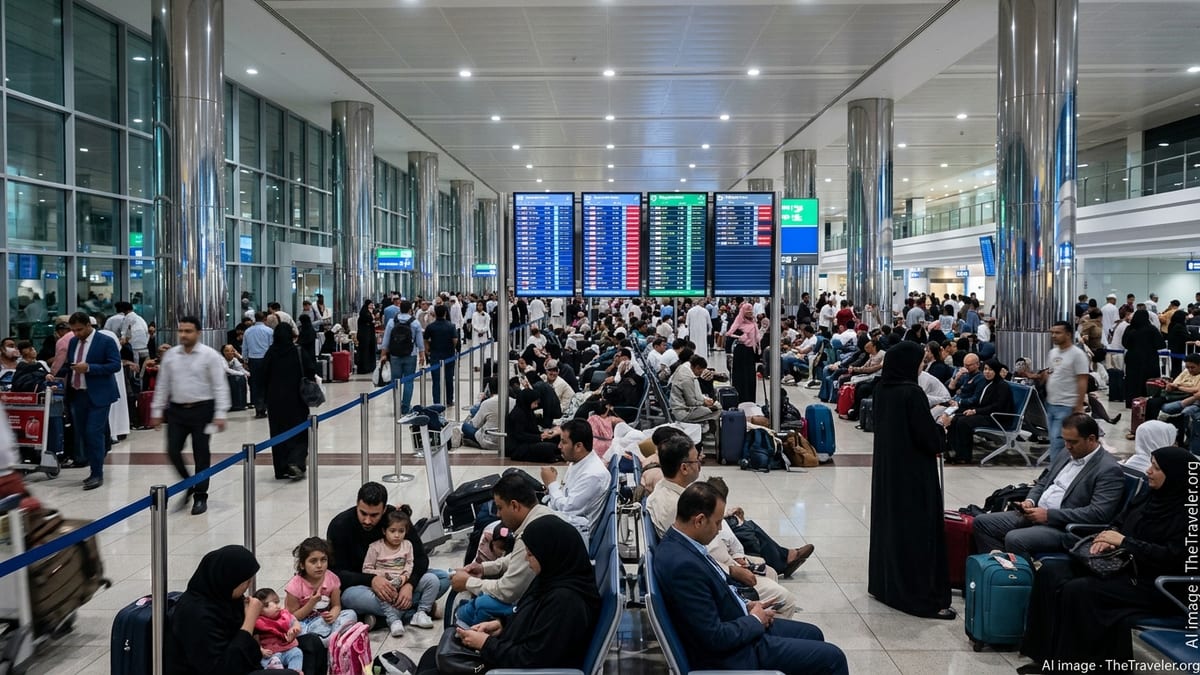
Regional Conflict Turns Airports Into Bottlenecks
Air travel across the Middle East has been thrown into turmoil in recent weeks, with conflict-related airspace restrictions forcing carriers to thin out schedules, reroute aircraft, and cancel services altogether. Publicly available data and aviation tracking platforms indicate that airports in the Gulf and wider region, long relied on as global transit crossroads, are now contending with surging congestion and a mounting backlog of disrupted passengers.
Restrictions and intermittent closures of airspace around the Gulf have compelled airlines to adopt longer routings or suspend certain corridors entirely, reducing capacity and increasing block times on many international routes. Industry analysis notes that several major Middle Eastern airports, which ordinarily handle a significant share of global transfer traffic, have experienced waves of cancellations and delays as carriers adapt operations on short notice.
According to passenger-rights portals and disruption trackers, cumulative figures in recent days show at least 1,738 delays and 460 cancellations across airports in Turkey, Oman, the UAE, Saudi Arabia, Kuwait, and Egypt. These disruptions are concentrated at marquee hubs such as Dubai International, Abu Dhabi, Doha Hamad International, Riyadh, Muscat, and Cairo, where the combination of diverted flights and reduced airspace options is turning normal transit flows into bottlenecks.
Reports from regional travel media describe scenes of packed departure halls, extended check-in and security lines, and passengers sleeping in terminal seating as they wait for rebooked departures. With security conditions evolving rapidly, airlines and airports are frequently updating schedules, leaving travelers dependent on apps and social channels for near-real-time information on whether their flights will operate.
Major Gulf Carriers Cut and Rebuild Schedules
The disruption has hit the region’s largest airlines particularly hard. Publicly accessible advisories and timetable updates show that Emirates in Dubai, Qatar Airways in Doha, and Saudia in Saudi Arabia have all significantly adjusted services as conflict-related risks have intensified and airspace corridors narrowed.
Analysts tracking the situation note that Emirates was among the first Gulf carriers to begin reintroducing limited scheduled services after initial suspensions, gradually rebuilding its network from Dubai and coordinating with UAE authorities on exceptional operations to move stranded passengers. Nevertheless, numerous flights across its long-haul network have continued to experience substantial delays as aircraft and crew rotations are rebalanced.
Qatar Airways, heavily dependent on its Doha hub for global connectivity, has faced extended periods of curtailed operations, with several days of widespread cancellations followed by what route trackers describe as a patchwork of limited services. Passenger feedback on public forums highlights uncertainty around rolling cancellation windows and schedule updates, reflecting how quickly operational plans have been changing.
Saudia and other regional carriers, including flydubai, Air Arabia, and Etihad Airways, have also cut or reshaped frequencies on routes touching affected airspace. Flight-status portals and travel advisories show that these reductions have contributed to the high number of delays and cancellations recorded in Saudi Arabia, the UAE, and neighboring states, especially on popular East–West trunk routes linking Asia, Europe, and North America.
Knock-on Disruptions From Cairo to Istanbul
The current wave of disruption is not confined to the Gulf itself. Airports in Egypt and Turkey, which serve as key regional connectors, are also experiencing significant operational strain as rerouted flights and displaced passengers are funneled through alternative hubs.
Recent coverage from regional travel news outlets highlights Cairo International Airport as a major pressure point, with dozens of cancellations and delays affecting carriers such as EgyptAir, Emirates, Saudia, Qatar Airways, and several low-cost operators. These irregularities at Cairo have in turn disrupted itineraries onward to Doha, Dubai, Kuwait City, Riyadh, and Beirut, contributing to the overall tally of delayed and canceled services in the wider region.
In Turkey, Istanbul’s airports and other major gateways have absorbed additional traffic as airlines adjust routings to avoid higher-risk airspace. Monitoring by disruption-analysis firms suggests that Turkish operations have registered spikes in both delays and cancellations on select days, as carriers juggle altered flight paths, crew duty limits, and aircraft positioning challenges.
The result is a complex, multi-node disruption pattern, where a cancellation in one hub can cascade across multiple countries within hours. For passengers, that means a relatively routine regional flight can now involve multiple rebookings, extended layovers, or last-minute diversions to secondary airports as carriers search for viable routings.
Passenger Experience: Long Queues, Limited Clarity
Travelers caught in the middle of this turbulence are reporting long waits and limited clarity around rebooking options. Passenger accounts shared on public platforms describe hours spent in airport queues or on customer-service hotlines as they seek alternative flights with Emirates, Qatar Airways, Saudia, Israir, and other affected carriers.
Israir and additional regional and European airlines serving Turkey and Gulf destinations have reported schedule changes and cancellations, adding to the strain on already crowded hubs. With many flights fully booked or operating at reduced frequency, some travelers have turned to neighboring airports in Saudi Arabia or Oman that retain more consistent operations, though these alternatives often require lengthy overland journeys.
Public information from consumer-advocacy and passenger-rights organizations emphasizes that, despite the complexity of the situation, many travelers affected by long delays or cancellations may be eligible for compensation or refunds, depending on the carrier, route, and underlying cause of disruption. Guidance typically encourages passengers to keep documentation of boarding passes, receipts, and written airline communications to support future claims.
However, in a fast-moving security environment, many carriers have framed schedule changes as the result of extraordinary circumstances, which can limit compensation obligations under certain legal regimes. This has left some passengers facing additional accommodation and meal costs out of pocket while waiting for onward travel.
Uncertain Outlook as Carriers Balance Safety and Connectivity
The near-term outlook for travelers through Dubai, Riyadh, Doha, Muscat, Cairo, Abu Dhabi, and other regional hubs remains uncertain. Industry observers note that as long as airspace warnings and conflict-related constraints remain in place, airlines will likely continue to operate with conservative schedules, leaving little slack to absorb new disruptions.
Some Gulf carriers have begun publishing limited forward schedules and waiving change fees on select tickets, signaling an attempt to offer more predictability to travelers while retaining flexibility to cancel or reroute if security conditions deteriorate again. Business-travel advisories recommend that companies with staff traveling through the Gulf build in additional buffer time, consider alternative routings via Europe or South Asia, and closely monitor airline waiver policies.
Aviation analysts caution that even as certain routes are restored, residual disruptions from aircraft and crew dislocation may persist for days or weeks. Backlogs of stranded passengers, maintenance checks delayed by irregular rotations, and congestion at key air-traffic corridors all contribute to an extended recovery timeline.
For now, the figures tell the story: with at least 1,738 delays and 460 cancellations recorded across affected countries in a short span, the Middle East’s role as a highly efficient global aviation bridge has been temporarily undermined. Travelers passing through the region in the coming days are being urged, through publicly available advisories and airline communications, to check flight status frequently, remain flexible with itineraries, and prepare for the possibility that plans may change at the last minute.