

More news on this day
Escalating US and Israeli military action against Iran has plunged air travel across the Middle East into crisis, with Australian authorities issuing sweeping "do not travel" warnings and airlines abruptly cancelling or diverting flights through key Gulf hubs.
Sharp Escalation Triggers Regional Airspace Shutdowns
The latest round of US-Israel strikes on Iranian targets, followed by retaliatory missile and drone attacks across the Gulf, has prompted multiple Middle Eastern nations to close or severely restrict their airspace. Iran, Iraq, Israel, Syria, Kuwait and the United Arab Emirates are among those announcing at least partial shutdowns, disrupting one of the world’s most heavily trafficked aviation corridors.
Australia’s Department of Foreign Affairs and Trade (DFAT) updated its Smartraveller advisories overnight, now explicitly warning Australians not to travel to Iran and urging those already there to leave as soon as it is safe to do so. Travel advice for Israel and Lebanon has also been raised to the highest level, with authorities cautioning that further reprisals by Iran and its proxies are likely and that airports may close with little or no notice.
Officials in Canberra say the abrupt airspace closures and the risk of new attacks make it difficult to guarantee any evacuation effort. Foreign Minister Penny Wong has warned of “difficult days ahead” for Australians in the region, stressing that the government’s capacity to mount repatriation flights would be tightly constrained while military operations continue and skies remain restricted.
Security analysts note that the air campaign, coupled with Iran’s retaliation on US facilities in Qatar, Bahrain, Jordan and Kuwait, has widened the risk zone far beyond the initial targets. The European Union’s aviation regulator has advised its carriers to avoid affected skies, adding further pressure to an already strained global network.
Australian Travellers Caught in Sudden Airline Cancellations
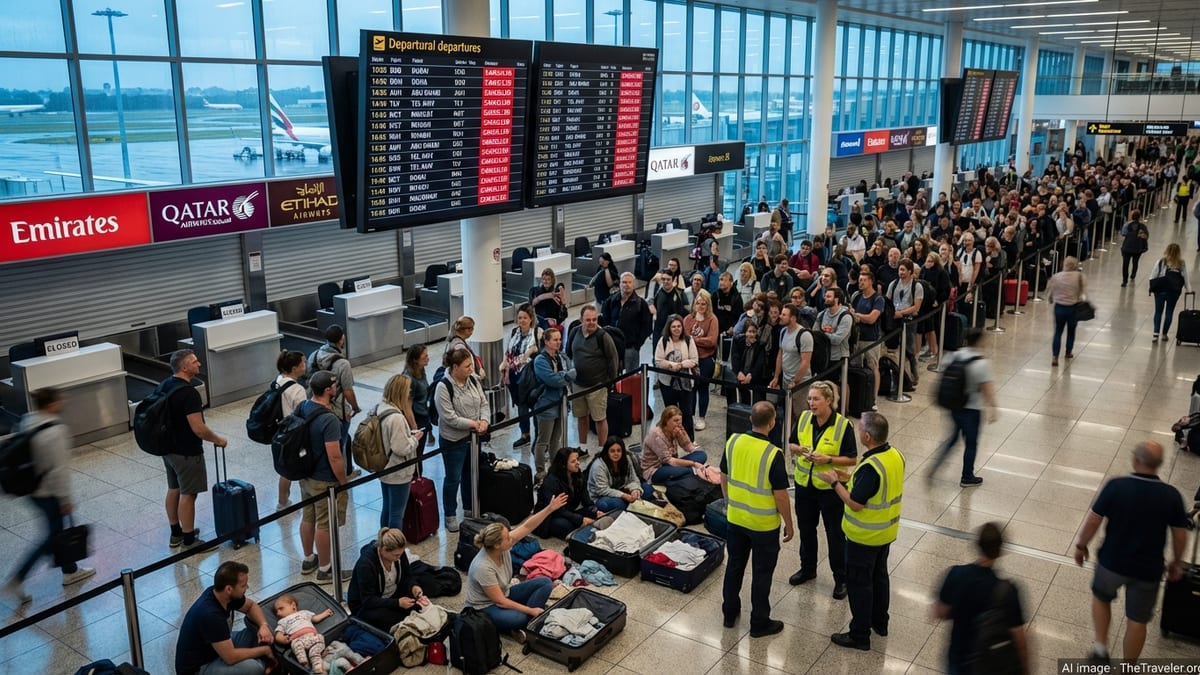
The impact for Australian travellers has been immediate and chaotic. Flights from Sydney, Melbourne, Brisbane and Perth bound for Doha and Dubai were forced to turn back after Gulf states briefly closed their airspace, leaving passengers stranded in terminals or diverted back to their departure cities.
Virgin Australia confirmed that multiple Qatar Airways services it codeshares to Doha were cancelled or turned around, urging customers to closely monitor flight information rather than heading straight to the airport. Emirates has temporarily suspended operations to and from Dubai, while other Gulf carriers have imposed rolling ground stops as missile alerts and interceptions continue above major hubs.
Qantas, which relies less heavily on Gulf hubs than some competitors, has so far avoided outright cancellations on its Europe network but is rerouting flights to skirt conflict zones. Travellers are being pushed onto longer paths through Singapore or Perth, adding hours to journey times and constraining available seats for those hoping to rebook disrupted itineraries.
Scenes at Australian airports have reflected the sudden nature of the shutdown. Passengers describe boarding long-haul services to the Middle East only to be told at the last minute that their flights were cancelled, with limited accommodation or meal support and few immediate alternatives. With hotels in Sydney and other gateway cities still busy from peak events and holidays, many travellers report struggling to find somewhere to stay while they wait for new flights.
Do Not Travel: Smartraveller’s Toughest Advice for Key Hubs
The Australian government has now issued a “do not travel” directive for a growing list of Middle Eastern states central to long-haul aviation. Qatar, Iraq, Yemen, Syria, the United Arab Emirates, Bahrain and Kuwait have all moved to the highest warning level, joining Iran, where Australians are told our ability to provide consular help is extremely limited.
Australians already in Israel and Lebanon are being urged to leave as soon as they can do so safely, while those planning trips to Jordan are told to reconsider the need to travel. For Turkey, Saudi Arabia, Oman, Egypt and Armenia, advice has been raised to “exercise a high degree of caution,” reflecting fears that the conflict could spill over or trigger opportunistic attacks by armed groups.
Authorities stress that travel warnings are being driven not only by the direct threat of missile and drone strikes, but also by the possibility that civilian airports and airlines could be caught up in rapidly changing military calculations. Recent incidents in Dubai and Abu Dhabi, where debris from intercepted projectiles caused casualties and minor damage at airports, have reinforced concerns about flying through the region.
DFAT has activated its crisis centre to support Australians overseas, but officials caution that consular assistance cannot circumvent local security measures or reopen closed skies. Travellers are being urged to register their whereabouts, follow local guidance, monitor reputable news outlets and stay in close contact with airlines and travel agents.
Knock-On Effects for Europe Routes and Global Networks
For Australian travellers, the disruption is particularly acute because around one in ten international trips typically route through Gulf hubs such as Doha, Dubai and Abu Dhabi. These cities form key links on the so-called Kangaroo Route between Australia and Europe, as well as for journeys to Africa and parts of the Middle East.
With Middle Eastern corridors constricted, airlines worldwide are redrawing their route maps in real time. European carriers including British Airways, Lufthansa and Air France have suspended services to Tel Aviv, Bahrain, Beirut and Oman, and in some cases to Dubai, while they assess the evolving security picture. Asian airlines such as Turkish Airlines, Air India and Cathay Pacific have also paused or limited operations to parts of the region.
Alternative paths, particularly via Southeast Asia, are quickly filling as displaced travellers seek new ways to reach Europe, North Africa and beyond. Longer routings around closed airspace are pushing up fuel burn and operating costs, and aviation experts warn that schedule reliability on some long-haul routes could remain volatile for weeks, even if tensions ease.
Australian travel industry figures advise passengers not to cancel bookings pre-emptively, noting that voluntary cancellations can complicate eligibility for refunds, credits or complimentary rebookings. Instead, they recommend waiting for airlines to formally alter or cancel services, documenting all communication and keeping receipts for any emergency accommodation or transport.
War Risk Leaves Insurance Gaps and Difficult Choices
Beyond the immediate scramble to rebook flights, many Australians are discovering that standard travel insurance offers limited protection in an active conflict zone. Policies commonly exclude disruptions caused by war, invasion or insurrection, leaving travellers potentially out of pocket for new tickets, extended hotel stays or missed tours if their itineraries are derailed by missile strikes or airspace closures.
Industry bodies have long argued that insuring against full-scale military conflict would be prohibitively expensive and could encourage risky behaviour. For policyholders, that means the safety-first decision to abandon or reroute a trip might have significant financial consequences, particularly where airlines provide only basic support or insist that customers wait for capacity to open up.
For those still holding tickets to or through the region, travel advisers say the first priority should be safety: heed government warnings, avoid non-essential journeys and, where possible, delay departures until the outlook becomes clearer. Australians currently based in affected countries are being urged to keep emergency plans updated, identify alternative exit routes and maintain stocked essentials in case they are asked to shelter in place.
With airspace restrictions changing at short notice and the political situation highly volatile, experts expect ongoing turbulence across international aviation. For now, the message from Canberra is unequivocal: avoid travel to the Middle East’s highest-risk hotspots, and if you are already there, be prepared for sudden changes, long delays and an uncertain path home.