

More news on this day
Hundreds of travelers have been left stranded across the Middle East after a fresh wave of flight delays and cancellations rippled through major hubs in Saudi Arabia, the United Arab Emirates, Egypt, Qatar, Syria, and Jordan, disrupting operations at flagship carriers including Emirates, Qatar Airways, Saudia, Flynas, and Royal Jordanian.
Get the latest news straight to your inbox!
834 Delays and 32 Cancellations Snarl Major Airports
Publicly available operational data compiled by travel industry outlets shows a dense cluster of disruption across eight key airports, with 834 flights delayed and 32 cancelled in a single day. The worst congestion has been concentrated at Riyadh’s King Khalid International Airport, Dubai International, and Cairo International, but knock‑on effects have stretched from Doha and Damascus to Amman and secondary airports in the Gulf.
Reports indicate that King Khalid International in Riyadh has recorded more than 230 delays and several cancellations as carriers battle to reconfigure schedules and crews. In Dubai, the region’s busiest long‑haul hub, over 100 delays and a number of scrapped services have been logged at Dubai International, while nearby Al Maktoum International has also reported schedule disruptions despite handling a much smaller passenger volume.
In Egypt, Cairo International has seen nearly 200 delayed flights alongside a smaller number of outright cancellations, leaving long lines at check‑in counters and transit desks. Queen Alia International Airport in Amman has reported dozens of delayed movements and several cancellations, while Damascus International and Doha’s Hamad International have each recorded multiple cancelled departures amid tighter operational windows.
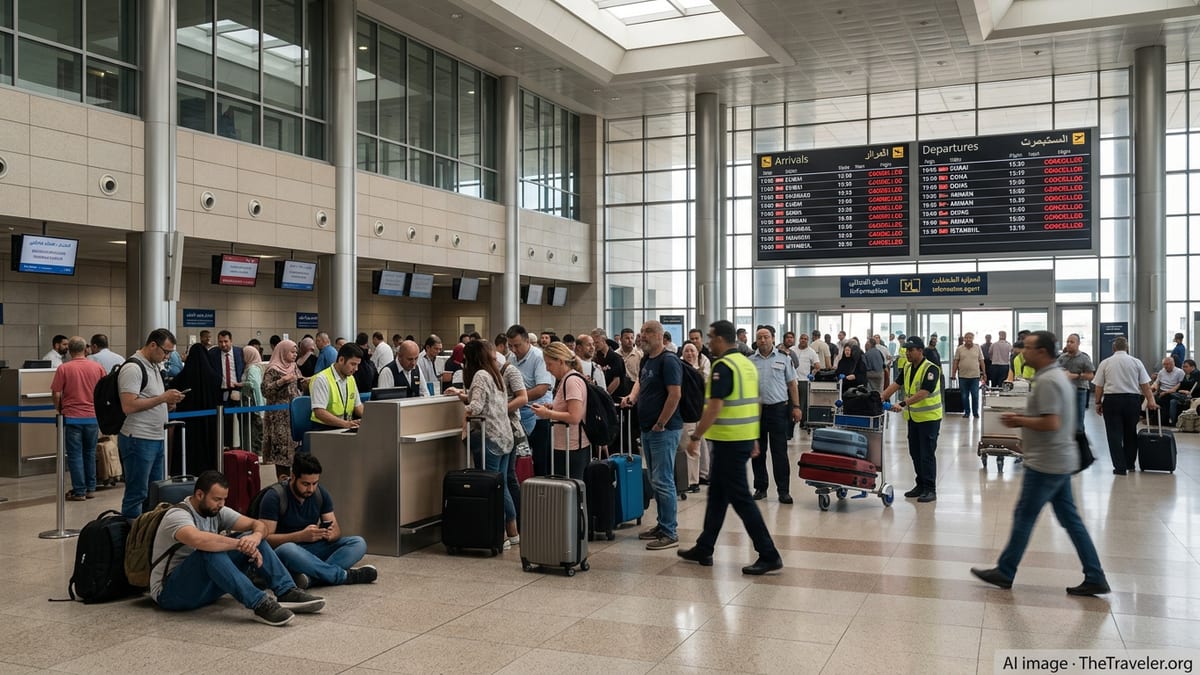
Travel industry coverage describes crowded terminal halls and passengers bedding down in seating areas as rolling delays turn into overnight waits. With limited spare capacity across the region, rerouting options have become more complicated, particularly for travelers with tight onward connections to Europe, Asia, and Africa.
Flagship Carriers Under Strain as Schedules Fray
The disruption has put intense pressure on the region’s best‑known airlines. Emirates and Qatar Airways, normally among the most reliable long‑haul operators, have been forced to juggle aircraft rotations and crew availability as delays cascade across their networks. Recent weeks have already seen both carriers trim frequencies and adjust routings in response to regional airspace constraints, and the latest figures suggest a renewed squeeze on their hub‑and‑spoke models.
Saudi Arabia’s Saudia and low‑cost carrier Flynas have faced similar challenges at home bases in Riyadh and Jeddah, where banks of departures connect domestic routes with long‑haul services to Asia and Europe. Any disturbance in departure waves quickly ripples outward, either delaying inbound connections to Riyadh and Jeddah or forcing last‑minute rebookings through alternative hubs such as Bahrain or Muscat.
Royal Jordanian, based in Amman, has also seen a measurable share of its daily schedule disrupted, with a mix of delayed flights and a smaller number of cancellations. Aviation analysts quoted in regional media suggest that even modest schedule reductions can be difficult to absorb when neighboring hubs are simultaneously under strain, narrowing the options for onward re‑accommodation.
Smaller and secondary carriers serving routes into Riyadh, Dubai, Cairo, and Doha have not been spared. Available timetable and tracking data shows scattered cancellations among regional operators, including services from South and Southeast Asia that rely heavily on Middle Eastern connections to reach Europe and North America.
Security Tensions and Weather Amplify Operational Risks
The latest wave of disruption is unfolding against the backdrop of an already fragile operating environment. In recent weeks, escalating regional tensions and missile and drone incidents have periodically impacted airspace availability over parts of the Gulf and Levant. Aviation and security briefings have documented temporary closures and restrictions affecting corridors over or near Iran, Iraq, Syria, and adjacent coastal areas, forcing carriers to reroute or suspend certain services.
In Qatar and the United Arab Emirates, earlier airspace closures and limited operating windows at key hubs have already contributed to large backlogs of stranded passengers. While most airports have since reopened, operations remain vulnerable to renewed security alerts and last‑minute altitude or routing changes, increasing flight times and stretching aircraft utilization close to its limits.
Weather has added another layer of complexity. In Egypt, Cairo and other cities have recently grappled with severe storms and reduced visibility, prompting local carriers to issue travel alerts and instruct passengers to arrive significantly earlier than usual. Such conditions slow airport throughput and compound delays that originate from airspace constraints further afield, especially when combined with busy holiday travel periods.
Industry observers note that the cumulative effect of these factors is to erode the buffers that airlines typically use to recover from routine disruptions. With contingency slots and spare aircraft already committed, any additional shock quickly cascades through multiple hubs, leaving passengers with fewer alternatives and longer waits.
Passengers Face Long Waits, Complex Rebookings
The human impact of the disruption is visible across terminals in Riyadh, Dubai, Cairo, Doha, Amman, and Damascus, where passengers have reported missed connections, lost hotel bookings, and uncertainty about when they will be able to travel. Social media posts and traveler forums describe crowded service desks, long telephone hold times, and difficulty securing confirmed seats on the next available flights.
Some airlines have been operating limited relief or repatriation services to move stranded travelers out of the most congested hubs. These flights, often departing at short notice as operational windows open, are typically oversubscribed and prioritized for passengers who have already experienced multiple cancellations or who are transiting onward to distant destinations.
Travel advisories from governments and carriers continue to emphasize the importance of monitoring flight status in real time and maintaining flexible itineraries. Passengers booked on routes that transit affected hubs are being encouraged to allow extended connection times and to consider alternative routings where available, particularly if their journeys involve long‑haul sectors and time‑sensitive commitments.
Consumer advocates in the region suggest that travelers carefully review fare rules and conditions of carriage before requesting refunds or changes, as eligibility for compensation or complimentary rebooking can vary widely depending on the airline, route, and cause of disruption. In several jurisdictions, protections may be more limited for flights disrupted by security incidents or airspace closures than for those affected by routine operational delays.
Regional Hubs Test Resilience Amid Prolonged Turbulence
The latest figures on delays and cancellations underscore the degree to which Middle Eastern hubs remain exposed to external shocks. Over the past month, Dubai, Doha, Riyadh, Cairo, and Amman have all been forced to adjust quickly to shifting security dynamics and weather‑related disruptions while attempting to preserve their roles as key connectors between Europe, Asia, and Africa.
Aviation data providers and regional media coverage indicate that overall flight volumes at some Gulf hubs remain below pre‑crisis levels, even as airlines gradually restore selected services. At the same time, a number of international carriers have temporarily suspended or reduced flights into the region’s hotspots, concentrating remaining capacity on routes where operational certainty is higher.
Industry analysts caution that further waves of disruption are possible if regional tensions escalate or if infrastructure near major airports suffers additional damage. For now, the combination of heightened security risks, intermittent airspace restrictions, and episodic severe weather continues to test the resilience of airline networks and airport operations across Saudi Arabia, the UAE, Egypt, Qatar, Syria, and Jordan.
For passengers, the situation translates into a travel environment where planning ahead, staying informed, and building in generous margins for disruption are increasingly essential when flying through the Middle East’s main gateways.