

More news on this day
Hundreds of passengers were left stranded across the Middle East on Tuesday as El Al, Emirates and FlyDubai canceled at least 66 flights and delayed more than 100 others, severely disrupting travel through Tel Aviv, Dubai and other major transit hubs amid ongoing regional instability and lingering airspace restrictions.
Major Hubs Hit as Airlines Slash Schedules
The latest wave of disruption comes as carriers continue to grapple with airspace closures and security restrictions linked to the escalating conflict involving Iran and Israel, which has periodically shut down or constrained key corridors across the region. Airport operations at Dubai International, Tel Aviv’s Ben Gurion and several Gulf gateways have been repeatedly throttled in recent days, forcing airlines to pare back schedules and reroute traffic.
Data compiled from airport departure boards and flight-tracking services on March 10 showed 66 outright cancellations and 107 delays affecting services operated by El Al, Emirates and FlyDubai alone, primarily on routes linking Europe and Asia via Dubai, as well as transatlantic and regional flights to and from Tel Aviv. Industry analysts say the figures understate the broader impact, as knock-on delays continue to cascade through global networks.
Dubai International, normally among the world’s busiest hubs, has been operating with a patchwork of limited and ad hoc services since a near-total airspace shutdown earlier this month. Emirates and FlyDubai have focused on maintaining a skeleton schedule to priority destinations and operating repatriation flights, gradually restoring capacity but still far from normal levels. Tel Aviv has seen a similar pattern, with Israel’s flag carrier El Al forced to consolidate frequencies and cancel rotations as airspace restrictions ebb and flow.
Airports across Bahrain, Qatar, Kuwait and Saudi Arabia have also reported persistent disruption, as carriers either avoid affected airspace or wait for regulatory clearance to resume routine operations. Even where airports remain technically open, tight slot controls, crew duty-time limits and the need to reposition aircraft are constraining what airlines can realistically operate.
Passengers Sleep in Terminals as Rebooking Lags
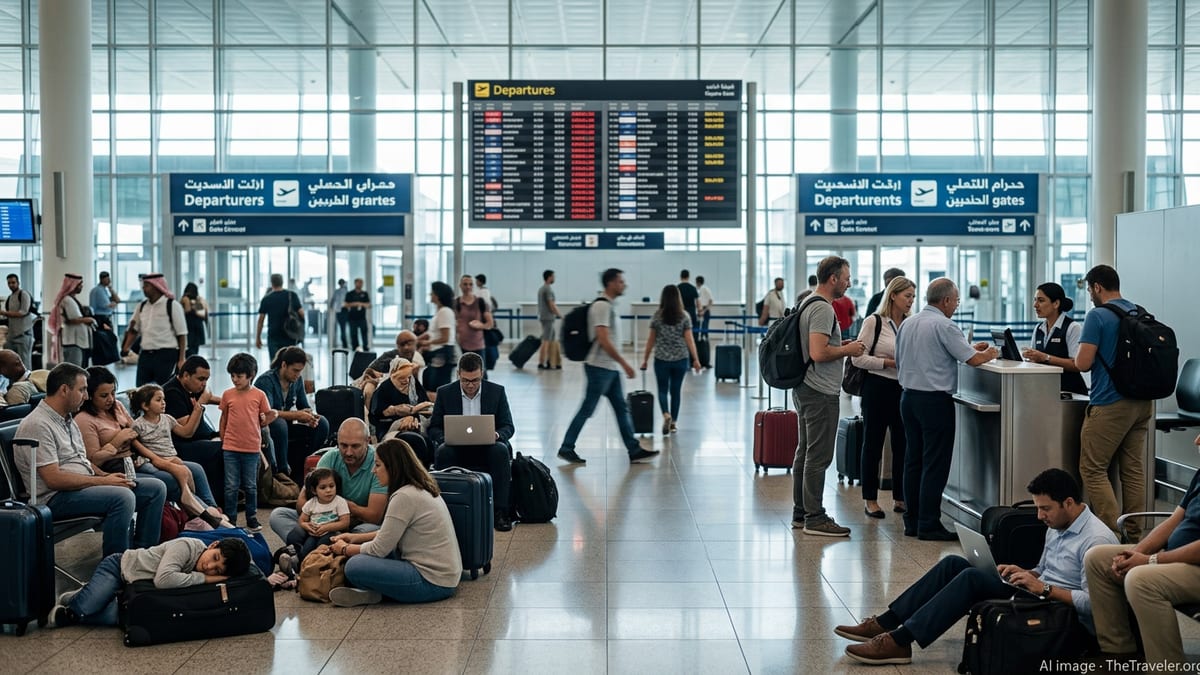
For travelers, the operational complexity is translating into long queues, cramped terminals and days-long waits for alternative flights. At Dubai International, passengers described rows of people sleeping on the floor near departure gates, while others clustered around customer-service desks in the hope of securing scarce seats on newly announced services.
Emirates has been prioritizing travelers who were already stranded in Dubai when the airspace closures first came into effect, adding additional services and upgrading aircraft on select routes to clear the backlog. However, the combination of rolling cancellations and limited rebooking options has left many still in limbo, particularly those bound for secondary cities or traveling on separate tickets that complicate re-accommodation.
FlyDubai, which operates an extensive regional network to smaller destinations in the Middle East, South Asia and Eastern Europe, has also been running a restricted schedule, forcing some passengers to route through alternative hubs or wait for the resumption of direct flights. Travel agents in the Gulf report that families attempting to return home at the end of school holidays have been hit especially hard, with some splitting across different flights and dates to secure seats.
In Tel Aviv, El Al’s trimmed schedule has produced similarly fraught scenes. With several international carriers still suspending or limiting flights to Israel, many travelers have little choice but to wait for space on the national airline’s departures. Incoming passengers, meanwhile, have seen planned itineraries upended with little warning, as security developments prompt last-minute adjustments.
Airlines Walk Tightrope Between Safety and Connectivity
Airlines operating in and around the Gulf and Eastern Mediterranean are attempting to balance passenger safety, regulatory compliance and commercial viability in an environment that can shift from stable to volatile within hours. Carriers have had to build in additional contingency for potential missile or drone activity, rapidly changing no-fly zones and military operations that can close vital corridors with little notice.
Route planners across the region are re-evaluating overflight paths to avoid the most sensitive areas, which can add hours to certain journeys and increase fuel burn. In some cases, that makes previously marginal routes uneconomic to operate on a reduced passenger load, contributing to the wave of cancellations. Airlines are also wary of stranding aircraft at airports where they may subsequently face restrictions that complicate retrieval.
Emirates and FlyDubai, both based in Dubai, have announced gradual ramp-ups in operations as segments of regional airspace reopen, but warn that schedules will remain fluid for at least several more days. El Al has communicated similar caution, indicating that while core routes will be maintained wherever possible, frequencies and timings are subject to rapid revision as security assessments evolve.
Aviation safety experts note that while commercial airlines have sophisticated tools to track risks in real time, the pace and unpredictability of the current conflict complicate decision-making. Some carriers have opted to suspend service entirely to specific destinations, while others continue operating limited flights under strict risk-mitigation protocols.
Travelers Face Uncertain Journeys and Patchwork Waivers
For international travelers with upcoming trips through Tel Aviv, Dubai or other regional hubs, the environment remains highly uncertain. Airlines have issued a series of travel waivers allowing passengers to rebook or reroute without change fees, but the terms vary by carrier and route, and available alternative flights are often scarce.
Many travelers are being advised to avoid non-essential journeys through the region in the short term, or to build in additional buffer time in case of missed connections and overnight delays. Those who must travel are urged to monitor airline notifications closely, reconfirm flights before leaving for the airport and keep contingency funds available for unexpected hotel stays or last-minute ground transport.
Travel insurers are also fielding a spike in claims and inquiries, as customers seek clarity on whether conflict-related disruptions are covered under their policies. Coverage often hinges on whether a government has issued a formal travel warning for a destination and when the policy was purchased relative to the start of the crisis, leaving some passengers exposed to out-of-pocket costs.
In the meantime, scenes of crowded departure halls and weary travelers highlight the vulnerability of global air connectivity to regional shocks. With El Al, Emirates and FlyDubai still operating below normal capacity and dozens of flights each day affected, the Middle East’s key hubs remain in recovery mode, and passengers transiting the region should be prepared for continued turbulence in the days ahead.