

More news on this day
Passengers across the Middle East faced fresh travel chaos as a wave of disruptions left travelers stranded at airports in Dubai, Cairo and Riyadh, with 549 flights delayed and 9 canceled on a single day, affecting major carriers including Emirates, Flydubai, Saudia, Air India and IndiGo and rippling across routes to London, Frankfurt and other global destinations.
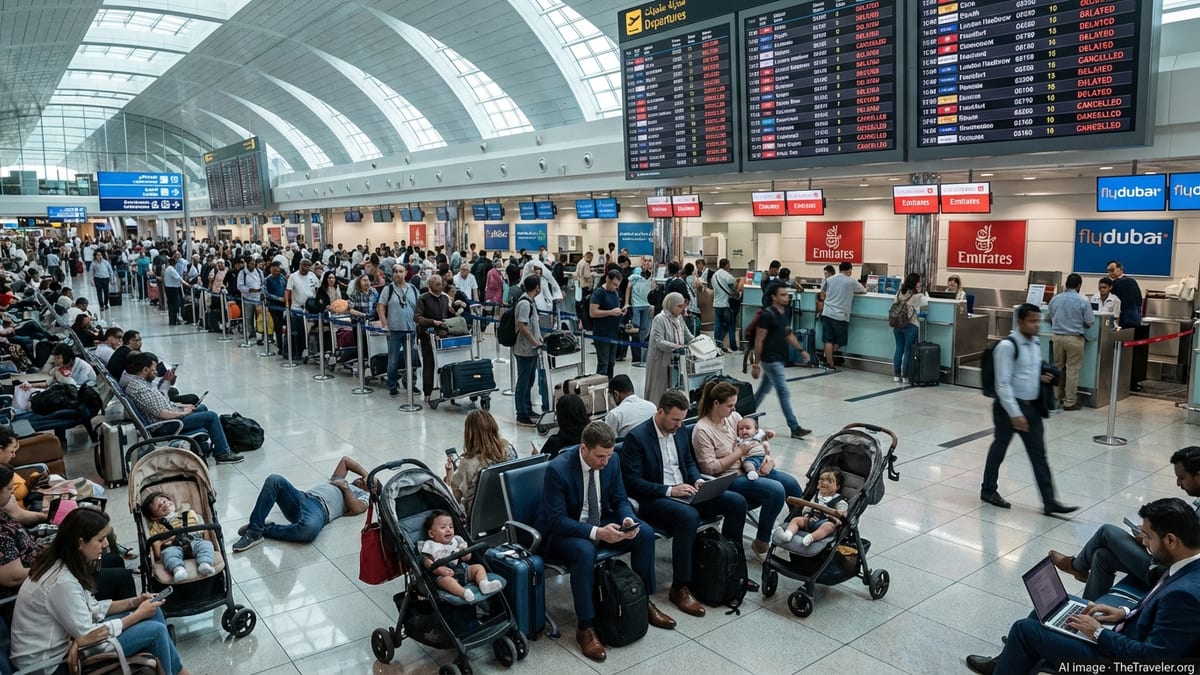
Mass Disruptions Hit Dubai, Cairo and Riyadh on Busy Travel Day
Operational data compiled from airport information screens, airline advisories and independent tracking platforms on February 16 indicated that a total of 549 flights were delayed and 9 canceled across Dubai International, Cairo International and Riyadh’s King Khalid International Airport, three of the region’s most important hubs for long-haul connectivity. The figures reflect departures and arrivals across a 24 hour period, underscoring the scale of the disruption for both origin and transit passengers.
At Dubai International, the world’s busiest airport for international traffic, prolonged delays gradually backed up through the day, with departure banks in particular suffering from tight turnaround times and crew rotation pressures. Cairo International, a critical gateway between Africa, the Middle East and Europe, reported congested departure halls as airlines struggled to reassign aircraft and seating to accommodate displaced travelers. In Riyadh, Saudi Arabia’s King Khalid International Airport saw departure boards peppered with orange and red status alerts as delays stretched into the evening peak.
Airport officials and airline representatives said that while safety was never compromised, the knock on effect of cascading delays was felt far beyond the three hubs themselves. Transit passengers connecting through Dubai, Cairo or Riyadh on their way to Europe, Asia and North America faced missed connections, unplanned overnight stays and extensive rebooking queues, compounding an already demanding winter travel period.
Weather, Congested Airspace and Operational Strain Combine
Industry sources in the United Arab Emirates, Egypt and Saudi Arabia pointed to a familiar but potent mix of factors behind the latest disruption. Unsettled winter weather over sections of the Gulf and Eastern Mediterranean, including periods of reduced visibility and strong winds, forced air traffic controllers to increase separation between aircraft and temporarily cap runway movements at several points during the day. Even short-lived restrictions quickly translated into schedule slippage at tightly banked hubs such as Dubai and Riyadh.
Beyond the weather, ongoing airspace constraints related to regional security tensions continue to funnel traffic into narrower corridors above the Arabian Peninsula and the Eastern Mediterranean. Airlines have been forced to file longer routings or accept departure slot restrictions, stretching both crew and aircraft utilization. Aviation analysts say that while such constraints have become an unwelcome feature of Middle East operations in recent years, the region’s rapid growth in traffic has left little slack in the system when unexpected slowdowns occur.
Operational strain within individual airlines also played a part. Carriers juggling complex crew rosters, maintenance schedules and high demand have less buffer to absorb disruptions on peak days. Recent regulatory changes affecting pilot duty times in key markets, along with higher-than-usual rates of aircraft undergoing heavy maintenance during the winter shoulder season, have further eroded resilience. The result was a day in which relatively modest meteorological and airspace challenges cascaded into hundreds of delayed movements.
Major Carriers Feel the Impact Across Global Networks
The disruption was most visible at the check in counters and departure gates of some of the region’s largest airlines. Flights operated by Emirates and Flydubai in and out of Dubai, Saudia services in and out of Riyadh, and Air India and IndiGo flights serving Dubai and Cairo all featured prominently among the affected services, according to tracking data and passenger reports. Delays ranged from minor schedule slippages of 30 to 45 minutes to extensive hold ups exceeding four hours on some long-haul routes.
Emirates, which relies on tightly timed banks of arrivals and departures at Dubai to feed its global network, was forced to reshuffle connections and rebook passengers onto later flights where possible. Travellers booked onward to European hubs such as London and Frankfurt reported being moved to alternative services departing several hours later, while some were provided with hotel accommodation when same day connections became unworkable. The airline reiterated that safety and regulatory compliance governed all operational decisions, even when that meant extended delays.
Flydubai, Saudia, Air India and IndiGo all grappled with similar challenges. For Flydubai, which operates a dense schedule of short and medium haul routes from Dubai to the Middle East, Africa, Central Asia and the Indian subcontinent, congested stands and extended ground times in the morning quickly rippled into afternoon and evening services. Saudia’s operations at King Khalid International were affected not only on outbound flights to Europe and Asia but also on heavily trafficked regional services within the Gulf and to the Levant. Air India and IndiGo, both key players on the busy India Middle East corridor, saw multiple flights to and from Dubai and Cairo operating behind schedule, feeding additional disruption into their domestic networks.
Passengers Stranded as Queues Grow and Tempers Fray
For passengers on the ground, the operational statistics translated into long lines, missed commitments and exhausted families camping out in terminal seating areas. At Dubai International, travellers arriving to check in for evening flights found densely packed departure halls, with airline staff struggling to process a backlog of rebookings while still handling new departures. Some passengers reported queueing for several hours at transfer desks to confirm new itineraries after misconnecting from delayed inbound flights.
In Cairo, passengers described boarding gates that opened and closed repeatedly as estimated departure times were revised, while public address announcements alternated between calls for patience and updates on revised boarding procedures. Travellers bound for London, Frankfurt and other European destinations reported being offered reroutings via alternative hubs, extended layovers, or next day departures as airlines tried to match limited spare capacity with stranded demand. For families traveling with small children or elderly relatives, even moderate delays quickly turned into a test of endurance.
Riyadh’s King Khalid International saw similar scenes. With multiple Saudia and partner airline services running behind schedule, seating areas near popular departure gates overflowed, and airport staff distributed water and snacks to help ease mounting frustration. While many passengers acknowledged that weather and airspace issues were beyond anyone’s control, some expressed dissatisfaction over perceived gaps in communication, particularly when boarding times repeatedly slipped without clear explanations.
Knock On Effects for London, Frankfurt and Other Long Haul Routes
The impact of the day’s disruption was not confined to the Middle East. Flight-tracking data and passenger accounts indicated delays and occasional aircraft swaps on services linking Dubai, Cairo and Riyadh with major European gateways, including London and Frankfurt, as well as onward connections to North America and Asia. Long-haul flights that rely on precise arrival times to feed morning or evening banks at European hubs were forced to contend with late departures from the Middle East, compressing ground handling windows and complicating crew planning.
Airlines operating multi leg itineraries, such as Dubai London New York or Riyadh Frankfurt North America, sometimes opted to prioritize maintaining the integrity of their transatlantic or intra European schedules, even if that meant accepting a delayed departure from the Middle East sector. In practice, this meant that some passengers originating in Dubai, Cairo or Riyadh who missed their planned connection in Europe had to be rebooked onto later services, while their checked baggage followed on subsequent flights.
Aviation analysts noted that high load factors on many winter long-haul routes left airlines with little spare seating to accommodate disrupted travellers. Premium cabins on Sunday and Monday departures in particular were described as “effectively sold out,” limiting the ability of carriers to upgrade economy passengers in order to free up space lower in the cabin. The result was a complex logistical puzzle, as revenue management priorities, crew duty limitations and aircraft maintenance requirements all intersected with the immediate need to get stranded passengers moving again.
Airports and Airlines Roll Out Emergency Support Measures
Facing packed terminals and mounting social media criticism, airport operators and airlines moved to activate contingency plans designed for irregular operations. At Dubai International, additional staff were deployed to information counters and key junctions in the terminal to assist passengers with wayfinding, rebooking and basic customer service queries. Airport management coordinated with police and ground transport providers to manage curbside congestion, while encouraging passengers with later departures to delay their arrival at the airport where possible.
In Cairo, airport authorities opened supplementary seating areas and coordinated with concessionaires to extend operating hours for food and beverage outlets, providing some relief for passengers facing overnight waits. Airlines issued meal vouchers to eligible travellers and, in cases of lengthy delays or cancellations, arranged hotel accommodation in line with their respective policies. At King Khalid International, Saudia and other carriers set up dedicated disruption desks to centralize rebooking and customer care, attempting to reduce pressure on regular check in counters.
Across all three airports, carriers urged travellers to use mobile apps and call centres to verify flight status before heading to the terminal. While such advisories are now standard in times of disruption, aviation experts emphasized that widespread adoption of real time digital tools can meaningfully reduce crowding in terminal buildings by discouraging early arrivals for significantly delayed flights. However, limited internet access and language barriers still pose challenges for some passenger segments.
Regulators and Industry Watch for Signs of Systemic Strain
The scale and frequency of recent disruptions across Middle East hubs have drawn the attention of regional regulators and international industry bodies. Safety agencies in the United Arab Emirates, Egypt and Saudi Arabia have reiterated that air traffic management decisions related to weather or airspace closures are taken purely on safety grounds, regardless of commercial pressures. At the same time, there is growing recognition that the accumulation of such events, combined with tight schedules and high load factors, is exposing systemic vulnerabilities in the region’s aviation model.
Experts point out that hubs like Dubai, Cairo and Riyadh handle large volumes of connecting traffic with relatively limited buffers in their daily schedules. Any reduction in runway capacity, airspace availability or fleet flexibility can quickly translate into widespread knock on effects, particularly during holiday peaks or weekends. Some analysts have suggested that airlines may need to build more slack into their networks, even at the expense of short term efficiency, in order to improve resilience to increasingly common weather and security related disruptions.
Questions are also being raised about the ability of ground infrastructure to keep pace with growth. While major investment programs are under way at several airports in the region, including expansion projects and new terminal developments, passenger experience on days of heavy disruption remains a concern. Regulators and consumer protection bodies are watching closely to ensure that airlines fulfill their obligations in terms of care, information and compensation where applicable, particularly for passengers left stranded overnight far from home.
What Travellers Can Do as Disruptions Persist
With regional security tensions unresolved and winter weather patterns still in play, aviation authorities and industry analysts caution that similar days of disruption are likely to recur in the short term. Travellers planning journeys through Dubai, Cairo, Riyadh and other major Middle East hubs are being urged to build additional flexibility into their itineraries, especially when connecting to long haul flights or time sensitive events such as business meetings and cruises.
Passenger advocacy groups recommend booking longer connection windows where possible, registering contact details with airlines for real time alerts, and traveling with essential medication, chargers and a change of clothes in hand luggage in case of unexpected overnight stays. They also advise familiarizing oneself with airline and local regulations on care, refunds and alternative transport, which can vary significantly between carriers and jurisdictions.
For now, airlines including Emirates, Flydubai, Saudia, Air India and IndiGo say they are working to stabilize operations and clear residual backlogs from the latest wave of delays and cancellations. But as aircraft continue to depart late into the night and early morning from Dubai, Cairo and Riyadh, many passengers remain keenly aware that, in the current environment, even a routine itinerary can quickly turn into an unplanned airport marathon.