

More news on this day
Escalating conflict and shifting airspace restrictions across the Middle East are stranding passengers at major transit hubs, as rolling delays and cancellations in early April 2026 ripple across global airline networks.
Get the latest news straight to your inbox!
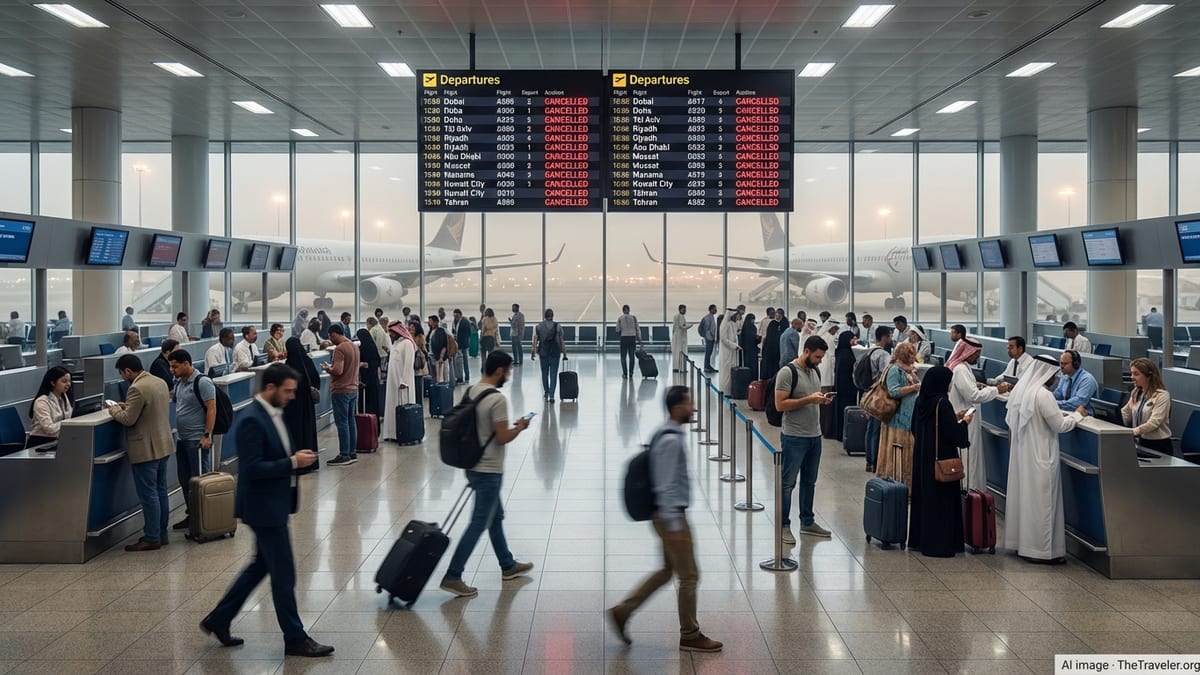
Three Super-Connector Hubs Under Strain
Recent disruption snapshots from aviation data services and travel advisories point to severe operational stress at three of the region’s most important connecting hubs: Dubai, Doha and Cairo. These airports normally serve as vital bridges between Europe, Africa and the Americas on one side and Asia and Australia on the other. With large portions of regional airspace periodically restricted since late February, the pressure on their remaining operating capacity has intensified.
Dubai International, one of the world’s busiest international airports, has faced repeated interruption since missile and drone activity near the United Arab Emirates prompted precautionary slowdowns and temporary closures. Publicly available information cites debris incidents and nearby security events that have forced runway inspections, diversions and capacity cuts, contributing to rolling knock-on delays for Emirates and other international carriers that rely on the hub.
Hamad International Airport in Doha has been at the center of the crisis since airspace constraints and security concerns sharply curtailed normal schedules. Travel-industry reporting describes Qatar Airways focusing on limited special services and repatriation-style flights while large portions of its regular long haul program remain disrupted. That has sharply reduced connection options for travelers booked between Europe, Asia and Australasia who would usually flow through the Doha hub.
Cairo International Airport has emerged as a pressure valve and choke point simultaneously. Operational tallies from April 6 show more than 150 delayed departures and several cancellations in a single day, affecting services to Gulf cities as well as major European gateways. Airlines including EgyptAir, Emirates and other foreign carriers have all seen their schedules reshaped, with delays at Cairo cascading into missed connections and extended layovers across onward networks.
Passengers Stranded Across Three Hubs
The combined effect of curtailed schedules in Dubai, Doha and Cairo has left thousands of passengers stranded or facing extended unplanned stopovers. Reports from regional media and travel trade outlets describe departure halls filled with travelers waiting for rebooked connections, in some cases sleeping in terminal seating as they wait for seats to open on already heavily booked services.
In Dubai, congested transfer zones and long queues at airline service desks have become a recurring feature on peak disruption days, as aircraft arrivals are bunched by evolving airspace windows and ground operations attempt to reset schedules. Travelers connecting from Asia to Europe or North America have been particularly exposed, with some itineraries requiring rerouting via alternative hubs in Istanbul, Muscat or major European cities.
At Doha, the reduction in regular frequencies has translated into fewer options for stranded passengers to continue on their journeys. Publicly available information indicates that Qatar Airways has added select additional sectors and larger aircraft on certain routes, but these measures have not fully offset the loss of capacity produced by earlier cancellations. As a result, passengers headed to destinations such as Sydney, Bangkok, London and Frankfurt are often forced into multi-stop routings that add many hours to travel times.
Cairo, meanwhile, has seen domestic and regional passengers competing with long haul travelers for scarce seats as airlines adjust fleets and crews. Missed banks of connections from Gulf hubs have spilled over into Cairo’s schedule, with delays rippling into North African, European and Middle Eastern routes. For some travelers, particularly those without flexible tickets, rebooking has been complicated by fare differences and limited remaining inventory.
Network Shockwaves Beyond the Middle East
The disruption at these three hubs is reverberating far beyond the immediate region. According to published coverage by global travel and aviation outlets, rerouted flights and extended block times are tightening already busy air corridors over parts of Europe, Central Asia and East Africa, as airlines work around closed or restricted Middle Eastern airspace.
Asia Pacific has felt the strain as well. Operational data from March and early April shows hundreds of cancellations and thousands of delays across key airports from Tokyo and Singapore to Mumbai and Dubai, driven in part by aircraft and crew being out of position due to Middle Eastern diversions. Carriers that typically operate via Gulf or Qatari hubs are being forced to mount longer non-stop services or reconfigure itineraries to transit through cities such as Istanbul, Muscat or Athens.
The squeeze has immediate commercial consequences. Aviation analysts cited in recent reporting warn that the temporary loss or reduction of capacity on popular East–West trunk routes is pushing up fares on alternative direct flights, particularly between Europe and Asia. With aircraft utilization patterns disrupted and some jets tied up on longer detours, available seats remain tight even where demand has not significantly increased.
Longer routings also mean higher fuel burn, adding costs for airlines already contending with elevated fuel prices and insurance premiums in conflict-adjacent regions. While some carriers have introduced targeted travel waivers and flexibility policies for affected itineraries touching the Middle East, travelers booking at short notice often face higher prices and fewer schedule choices.
Airspace Closures and Security Risks Drive Decisions
The underlying cause of the flight chaos is a patchwork of airspace closures, restrictions and security alerts that has developed since late February as the regional conflict deepened. Notices to air missions and public advisories show that multiple countries across the Gulf and Levant have periodically limited or closed portions of their airspace to commercial traffic, compelling airlines to cancel or reroute flights on short notice.
Travel risk consultancies and government advisories describe how missile and drone activity targeting infrastructure and military sites has periodically affected airports or their surrounding areas, including near Dubai and in other Gulf states. Even when no direct damage is reported to runways or terminals, precautionary shutdowns for safety inspections or to avoid overflying conflict zones have been enough to disrupt carefully choreographed hub banks.
The closure of Israeli airspace to most civilian traffic in March, along with subsequent extensions of restrictions on flights to and from Tel Aviv, has further complicated regional traffic flows. Some airlines have suspended services entirely for defined periods, while others continue to operate limited schedules subject to dynamic risk assessments. These decisions, layered on top of broader Gulf and Qatari disruptions, leave fewer viable paths through the region for global travelers.
Industry observers note that Saudi Arabia’s airspace has at times acted as the main remaining East–West corridor, concentrating traffic over a narrower geographic band. That concentration, combined with staffing and capacity limits at alternative hubs, has amplified the impact of any localised disruption into widespread delays and missed connections.
Airlines Seek Workarounds as Disruptions Drag On
Airlines and airports are experimenting with a range of stopgap measures to ease the backlog, though results have been uneven. Some Gulf and European carriers have scheduled repatriation-style flights and extra sections over recent weeks, focused on clearing stranded passengers out of Dubai and other hubs during brief windows of more stable operations.
Other carriers have temporarily shifted connecting traffic to secondary hubs less exposed to the conflict. Muscat in Oman, for example, has been promoted in industry analysis as a relative “resilience hub” thanks to its open airspace and geographic position on the southern flank of the main conflict zone. Istanbul and major European airports have likewise absorbed additional connecting flows that might otherwise have traveled via Doha or Dubai.
Even so, the scale of the disruption and the fluidity of security conditions mean that many passengers continue to face last-minute changes. Airlines are regularly updating schedules, issuing travel waivers and encouraging customers to monitor flight status closely before heading to the airport. For those already in transit, longer layovers, overnight stays and complex reroutings remain common as the Middle East flight chaos stretches into a second month.