

More news on this day
Passengers traveling between Saudi Arabia, India and the wider Gulf region are facing another wave of disruption as Saudia, FlyDubai, Gulf Air and Air Arabia cancel 35 flights and delay at least 83 more, snarling traffic through major hubs including Riyadh, Dubai, Mumbai, Chennai, Bahrain and Kuwait City.
Get the latest news straight to your inbox!
Cross-Border Disruptions Hit Core Gulf–India Corridors
Publicly available aviation tracking data and regional media reports indicate that the latest round of cancellations and delays is concentrated on some of the busiest corridors linking the Gulf with major Indian cities. Services between Riyadh, Dubai and hubs such as Mumbai and Chennai have seen a cluster of grounded and late-running flights, compounding the impact of earlier suspensions linked to regional instability and airspace restrictions.
The 35 flight cancellations attributed to Saudia, FlyDubai, Gulf Air and Air Arabia span departures and arrivals across Saudi Arabia, the United Arab Emirates, Bahrain, Kuwait and India. The 83 registered delays are spread across the same network, with a mix of short and multi-hour hold-ups as airlines adjust schedules, reroute aircraft and navigate changing overflight permissions.
In Riyadh, the disruption is feeding into an already strained operating environment following weeks of on-and-off schedule changes. Dubai International Airport, a critical connecting hub for South Asian traffic, is again feeling pressure as late-arriving aircraft from Saudi Arabia, Bahrain and Kuwait squeeze turnaround times and limit available slots on departures to Indian metros.
On the Indian side, airports in Mumbai and Chennai are among those reporting late inbound services from Gulf carriers, leading to missed connections for onward domestic flights. Local coverage in India notes that some passengers are facing overnight waits while airlines work through a backlog of rebookings created by multiple days of irregular operations.
Saudia, FlyDubai, Gulf Air and Air Arabia Struggle to Stabilize Networks
Operational updates published by the affected airlines show that Saudia, FlyDubai, Gulf Air and Air Arabia are still in recovery mode after earlier large-scale schedule suspensions linked to regional tensions. Recent notices highlight a phased return of certain routes, while also cautioning that individual flights remain subject to last-minute change as airspace access and slot availability evolve.
Saudia has been gradually restoring services between Saudi Arabia and neighboring markets, but selected flights serving Riyadh and other key cities continue to be withdrawn or retimed. Industry-focused coverage points out that aircraft and crew are still out of their original positions after weeks of disruption, making it difficult to operate full schedules even where airspace is technically open.
FlyDubai, which relies heavily on high-frequency regional services through Dubai, has published reduced-operations advisories and is directing travelers to check flight status close to departure. Reports tracking its performance show a pattern of isolated cancellations and multiple delays each day across Gulf and Indian routes, reflecting how even modest operational setbacks can ripple through a point-to-point and connecting network.
Gulf Air and Air Arabia are facing similar challenges. Bahrain-based Gulf Air’s flights into and out of Manama have been affected by shifting regional routings, while Air Arabia’s low-cost model, centered on tight aircraft utilization from hubs in the UAE, leaves relatively little slack to absorb sudden schedule changes. Analysts quoted in regional business media suggest that these carriers, while generally resilient, will likely need several more days of stable conditions before operations normalize.
Riyadh, Dubai, Mumbai and Chennai See Passengers Stranded
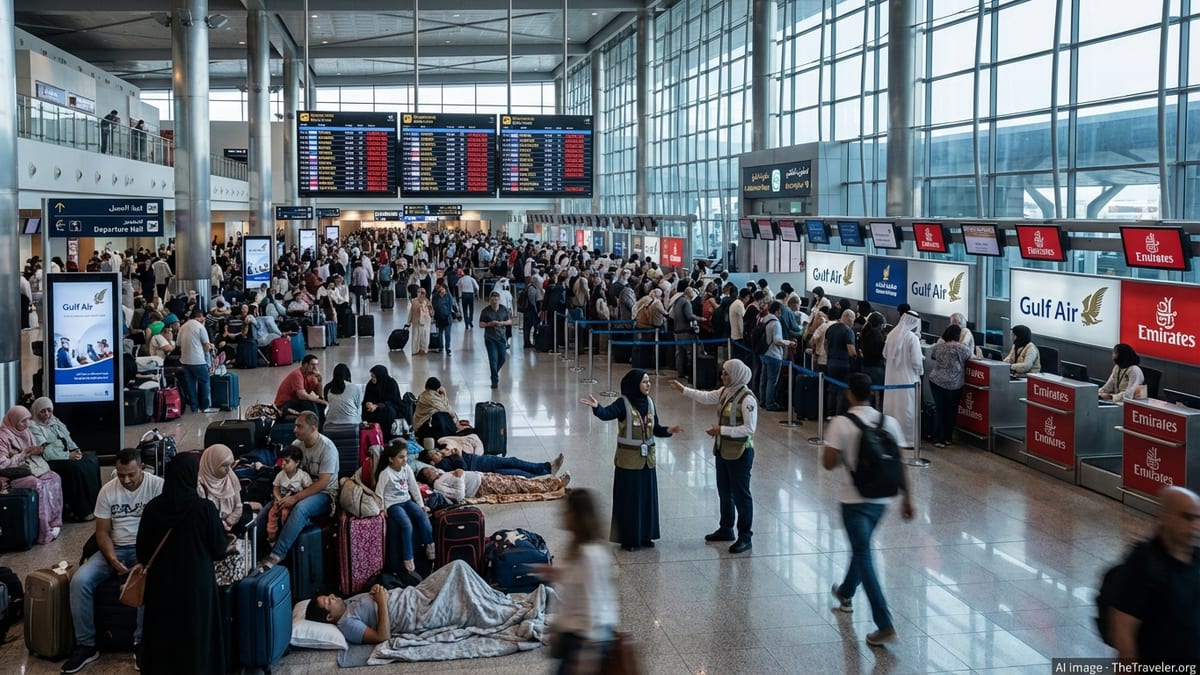
The immediate human impact of the latest cancellations and delays is most visible in terminal congestion and extended waits at key hubs. Visual reports and on-the-ground coverage from Riyadh and Dubai describe long queues at airline counters as passengers seek rebookings, refunds or alternative routings via secondary Gulf airports.
At Dubai International, travelers bound for Indian cities, including Mumbai and Chennai, have reported being moved between flights as airlines prioritize passengers with imminent onward connections. Aviation observers note that constrained capacity on India-bound services, already running near full during peak hours, limits the ability of carriers to quickly clear backlogs created by a single wave of cancellations.
In Mumbai and Chennai, flight-status boards have shown clusters of delayed arrivals from the Gulf, with some services landing several hours behind schedule. Domestic carriers in India, already adjusting to earlier disruptions in West Asia, have been left to manage last-minute no-shows and missed connections as inbound Gulf flights arrive outside their planned banks.
Smaller Gulf gateways such as Bahrain and Kuwait City are also experiencing knock-on effects, with local media coverage highlighting groups of passengers waiting for updated departure times or onward seats after Gulf Air and other regionally focused airlines adjusted schedules. For many travelers, including migrant workers and family visitors, the uncertainty surrounding departure times has added expense for accommodation and ground transport.
Security Tensions and Airspace Constraints Remain a Key Factor
Background reporting from regional outlets links this latest spike in flight disruptions to the broader security situation affecting parts of the Middle East. Recent escalations have led to temporary closures or restrictions in sections of regional airspace, forcing airlines to reroute, lengthen flight paths or suspend certain services altogether.
Industry commentary explains that when multiple air corridors are constrained at once, carriers serving Saudi Arabia, the UAE, Bahrain and Kuwait must compete for limited viable routings, particularly on east–west flows connecting Europe and the Gulf to South Asia. This can result in longer block times, fewer available daily rotations for each aircraft and, ultimately, the need to trim schedules to maintain reliability.
Aviation analysts cited in business and trade publications point out that disruptions of this type have outsized effects on hub airports like Riyadh and Dubai, where connecting traffic depends on tightly timed arrival and departure waves. When arrivals from one direction are delayed by rerouting or holding patterns, entire connection banks can unravel, amplifying the impact of the initial airspace constraint.
While some governments and aviation authorities in the region have signaled a desire to restore normal traffic flows as soon as conditions permit, published guidance stresses that safety and conflict-avoidance remain the primary considerations. Airlines have therefore maintained a cautious stance, cutting or delaying flights where routing or risk assessments are still in flux.
What Passengers Are Being Advised to Do
Travel and aviation advisories across the region emphasize that passengers booked on Saudia, FlyDubai, Gulf Air and Air Arabia should regularly monitor their flight status and avoid heading to the airport before confirming that a service is operating. Airline websites and mobile apps are cited as primary channels for real-time information on cancellations, delays and gate changes.
Consumer guidance from travel agencies and industry commentators suggests that travelers with time-sensitive itineraries between the Gulf and India consider building in additional buffer time, particularly when connecting onward beyond Riyadh, Dubai, Mumbai or Chennai. Some experts recommend selecting earlier departures in the day where possible, on the assumption that later flights are more exposed to cumulative knock-on delays.
Publicly available fare and booking data indicate that alternative options on rival carriers remain limited on short notice, especially during busy weekend and holiday periods. As a result, many stranded travelers have little choice but to accept rebookings offered by the original carrier or wait for seats to become available as airlines gradually restore capacity.
With no firm timeline yet for a complete return to normal operations, regional observers expect intermittent disruption to persist in the short term. Passengers planning travel across Saudi Arabia, the UAE, Bahrain, Kuwait and India in the coming days are being urged by travel media to stay flexible, keep documentation handy for potential schedule changes and monitor airline communications closely right up to departure time.