

More news on this day
Thousands of airline passengers across the Middle East and beyond remain stranded as widespread airspace restrictions and security concerns continue to trigger hundreds of flight cancellations and delays across the Gulf and major international hubs.
Get the latest news straight to your inbox!
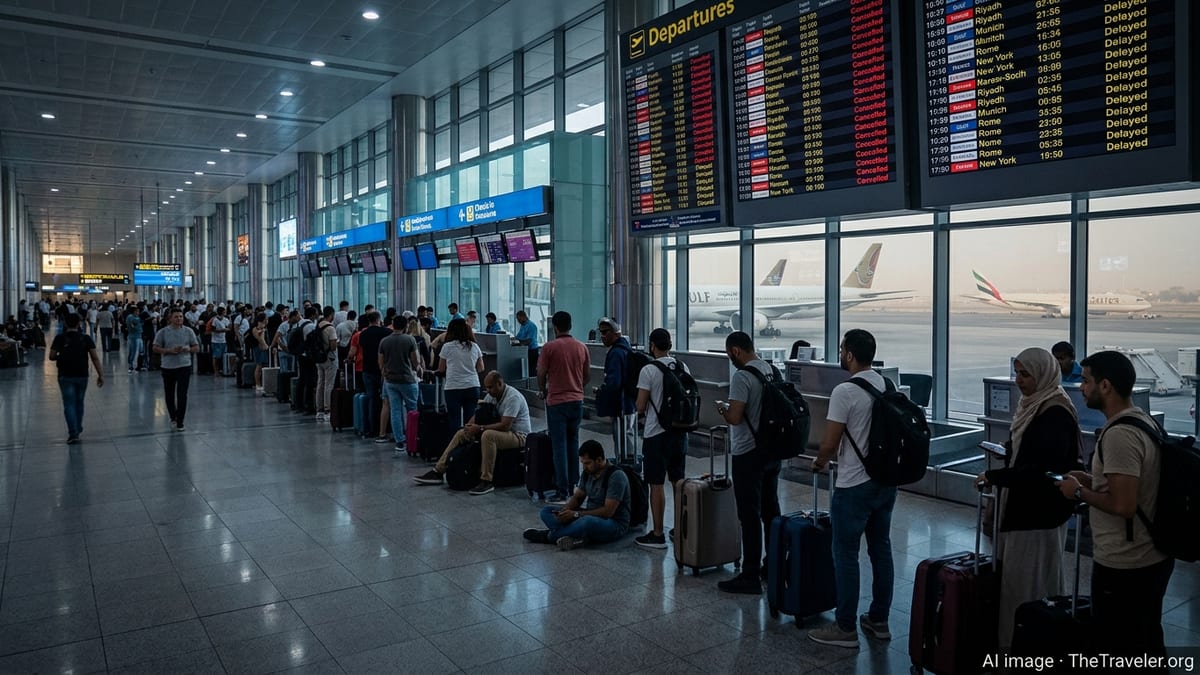
Hundreds of Flights Scrubbed as Gulf Hubs Scale Back Operations
Publicly available aviation data and media reports indicate that at least 219 flights have been cancelled and a further 299 delayed across key Gulf states including the United Arab Emirates, Bahrain, Kuwait and Saudi Arabia in recent days, as carriers react to a rapidly deteriorating regional security environment. The disruption is concentrated at major transit hubs that normally handle a significant share of global connecting traffic between Europe, Asia and Africa.
Flag carriers and low cost airlines alike have been hit. Gulf Air, Emirates and FlyDubai are among the operators that have adjusted or halted selected services as airspace closures and routing restrictions complicate flight planning. International airlines such as Air France and other European and Asian carriers have also trimmed schedules into the region, either cancelling services outright or rerouting around affected areas, extending journey times and straining fleet and crew resources.
While some airports are permitting limited operations, capacity remains far below normal. Industry analyses describe a pattern of rolling cancellations and short-notice schedule changes, with airlines publishing updates only hours before departure as they seek clearance for safe routings. For passengers, the result has been long queues at service desks, uncertainty over rebookings and an acute shortage of available seats on alternative flights.
Aviation analysts note that the current wave of cancellations sits within a broader pattern of disruption that has intensified since late February, when regional tensions began to push governments and airlines toward more conservative risk assessments. With several Gulf states imposing partial or temporary airspace closures, route options through the Middle East’s busiest corridors have narrowed sharply.
Passengers Stranded From Dubai to New York
The ripple effects extend far beyond the Gulf. Disruptions involving Gulf Air, Emirates, FlyDubai, Air France and other carriers are being felt in cities such as Dubai and Riyadh, but also in long-haul destinations including Munich, Rome and New York. These airports serve as critical nodes in global networks that rely heavily on Gulf connections, so cancellations in one region can cascade into missed onward flights on another continent.
Travel forums and social media posts describe passengers stuck in transit lounges in Dubai, waiting days for replacement flights after their original itineraries via Bahrain or Kuwait were cancelled. Others report being held overnight in Riyadh and Jeddah while airlines attempt to consolidate remaining services and find viable routings around restricted airspace. In Europe, travellers in Munich and Rome have posted accounts of last-minute cancellations of flights that would normally route through Gulf hubs to Asia and Australasia.
In North America, New York’s major airports have seen select services disrupted where flights are linked to Middle Eastern legs either as inbound connections or continuing sectors. Some passengers report being rebooked onto indirect routings via alternative hubs in Europe or South Asia, adding many hours of travel time. Others describe being offered travel credits or refunds when airlines are unable to guarantee timely onward connections.
Across these hubs, airport information screens have shown clusters of cancellations and extensive delays on routes tied to the Gulf region, even as purely regional or domestic flights operate more normally. This split highlights the strategic role that Middle Eastern hubs play in long-haul aviation and the sensitivity of global schedules to disruptions along those corridors.
Operational Strain on Airlines as Networks Are Redrawn
For airlines, the wave of cancellations and delays is forcing rapid operational changes. Publicly available airline notices show carriers trimming frequencies, combining flights and, in some cases, operating special services focused on repatriation and essential travel. Crewing patterns have been upended by longer routings, mandatory rest requirements and uncertainties over which airports will remain available at any given time.
Emirates and FlyDubai, both heavily reliant on Dubai as a central connecting hub, have had to balance safety considerations with the imperative to keep at least part of their networks moving. Gulf Air, for its part, has faced particular challenges where routes depend on airspace over or near affected Gulf states, leading to repeated adjustment of schedules. Air France and other European carriers have meanwhile shifted some Middle East services to alternative routings via southern Europe or the eastern Mediterranean when possible.
These cascading schedule changes have knock-on effects that reach beyond the immediate cancellations and delays. Aircraft that would normally complete tightly timed rotations between Europe, the Gulf and Asia are now spending more hours in the air on circuitous paths, leaving fewer frames available for other routes. Maintenance windows and crew rosters are also under pressure, increasing the risk of further disruption if technical issues arise.
Aviation consultants note that the current environment mirrors earlier episodes in which regional crises forced airlines to redraw route maps on short notice. However, with Gulf hubs now handling an even larger share of global connecting traffic than in previous decades, the impact of each cancelled or delayed flight is multiplied across multiple markets and alliances.
Economic Impact and Tourism Setbacks for Gulf States
The Gulf’s role as a crossroads for international travel means the flight disruptions are carrying a heavy economic cost. Airport operators, airlines, hospitality businesses and tourism authorities across the UAE, Bahrain, Kuwait and Saudi Arabia are facing an abrupt slowdown at what is normally a busy period for leisure and business travel. Hotel bookings in major transit cities such as Dubai and Riyadh have reportedly shifted from short stopovers to unplanned, longer stays as stranded passengers wait for new flights.
Retail outlets in duty free zones and airport terminals are also feeling the strain. With passenger volumes sharply reduced and many travellers focused on essential purchases rather than discretionary shopping, revenues have softened. Ground handling companies, catering providers and transport operators that serve airports are being affected by fewer aircraft movements and changing shift patterns.
Tourism boards across the region had been promoting ambitious growth targets in long-haul arrivals, often anchored around the connectivity offered by Gulf carriers. The current wave of cancellations and delays introduces new uncertainty into those plans. Industry observers suggest that some travellers may temporarily opt for routings via alternative hubs in Europe or Asia to avoid potential disruption, at least until airspace restrictions ease and schedules stabilize.
At the same time, the disruption underscores how central the Gulf has become to international tourism flows. Even travellers with no intention of visiting the region are finding their itineraries upended because their flights were scheduled to connect in Dubai, Riyadh or other Gulf cities. This visibility may shape future conversations about risk management, diversification of hubs and the resilience of global air travel networks.
What Travellers Are Being Advised to Do
As cancellations and delays continue, airlines and travel agencies are publishing regular advisories urging passengers to check flight status repeatedly before heading to the airport. Many carriers have introduced flexible rebooking policies for itineraries touching affected Gulf destinations, allowing changes without penalty fees within defined time windows. Some are encouraging customers to consider alternative routings where capacity exists, particularly via secondary hubs less directly affected by current airspace limits.
Travel guidance shared by consumer groups and online travel communities suggests that passengers with upcoming journeys through the Gulf should monitor both airline channels and live flight-tracking tools in the days and hours before departure. Travellers are also being encouraged to keep accommodation and ground transport arrangements flexible at both origin and destination, given the heightened risk of missed connections and unplanned stopovers.
Insurance companies and credit card providers offering trip disruption cover are experiencing a rise in claims inquiries as passengers seek clarity on what costs can be recovered. Policies vary, but some travellers have reported partial compensation for additional hotel nights and rebooking fees where policies explicitly reference disruptions linked to security events or airspace closures.
With no firm timeline yet for a full return to normal operations, industry observers recommend that anyone planning long-haul trips involving Dubai, Riyadh, Munich, Rome, New York or other connected hubs factor in the possibility of changes at short notice. For now, the combination of 219 flight cancellations, 299 delays and ongoing regional uncertainty continues to isolate thousands of passengers across multiple continents.