

More news on this day
Thousands of airline passengers across the Middle East and key long-haul hubs in Europe and North America faced major disruption today as regional airspace restrictions and operational suspensions led to 651 flight cancellations and at least 172 delays, affecting services by Royal Jordanian, Etihad, Ryanair, KLM, Air France and other carriers linking Doha, Riyadh, Dublin, London, Miami and a string of onward destinations.
Get the latest news straight to your inbox!
Widespread Cancellations as Conflict-Linked Restrictions Persist
Publicly available flight tracking data and regional aviation dashboards show that airlines serving Saudi Arabia, Bahrain, Qatar, Kuwait and Jordan have sharply curtailed operations today, reflecting ongoing airspace constraints tied to the wider conflict involving Iran and its neighbors. In total, at least 651 flights touching these countries were canceled, with a further 172 delayed, creating knock-on disruption across Europe and North America.
Published coverage of recent events in the region highlights that several Gulf and Levant states have periodically closed or restricted segments of their airspace since late February, following missile and drone incidents that raised safety concerns around key hubs such as Doha and other Gulf airports. These measures are typically framed as precautionary steps to safeguard civil aviation, but they have had the side effect of forcing carriers to scrub or reroute large volumes of traffic.
Aviation analysts note that when multiple neighboring countries restrict overflight at the same time, point-to-point services and long-haul connections are both hit. Flights that would usually transit the Middle East on Europe–Asia or Europe–Australasia routings have been subject to extended detours, last‑minute schedule changes or outright cancellation, compounding the impact on travelers far beyond the immediate region.
Today’s tallies add to a growing wave of disruption that has built over recent weeks. Industry assessments suggest that thousands of services have already been lost or heavily delayed since the first closures, with airlines repeatedly adjusting winter schedules and contingency plans as conditions shift day by day.
Major Carriers Grounded in Doha and Riyadh
Doha and Riyadh, normally among the busiest transit points in the Middle East, are again at the center of the disruption. Airport information screens and online timetables for Hamad International Airport and Riyadh’s principal gateway show widespread cancellations across regional and long-haul networks, including services operated by or codeshared with Royal Jordanian, Etihad, KLM and Air France.
Qatar’s capital has been particularly affected in recent weeks, with publicly available information indicating that closures of Qatari airspace and intermittent authorizations for narrow “safe corridors” have forced airlines to suspend regular commercial schedules and instead operate a limited number of repatriation or relief flights. Travelers connecting through Doha today report heavily reduced options and longer transfer windows as carriers consolidate operations into fewer departures.
In Saudi Arabia, restrictions affecting both domestic and international routes have cut into Riyadh’s role as a regional connector. Schedules show cancellations on services linking the Saudi capital with neighboring Gulf states and Europe, while some remaining flights are operating with significant delays or altered routings to avoid sensitive airspace. This has placed additional strain on alternative gateways in the region, where capacity is already tight.
Royal Jordanian and Etihad are among the airlines whose networks intersect multiple affected states, increasing their exposure to cascading schedule changes. European partners such as KLM and Air France, which usually rely on stable Middle East corridors for widebody operations, have also had to adapt timetables, aircraft swaps and crew rotations to cope with evolving restrictions.
Ripple Effects in Dublin, London and Miami
The disruption is not confined to the Middle East. According to live schedule boards and airline updates, knock‑on effects are visible at major long-haul gateways including Dublin, London and Miami, where flights operated by or interlined with Middle East and European carriers have been canceled or delayed.
In Dublin, where connections to Gulf hubs are a key link for traffic to Asia and Australasia, passengers have faced a mixture of outright cancellations and late‑running departures. Some services have been rebooked via alternative European hubs, while others await confirmation pending updates on airspace availability along their intended routings.
London’s main airports are seeing similar strain. Long‑haul departures to and from the Gulf region are operating at reduced frequency, and some passengers have reported being re-accommodated on indirect itineraries via continental Europe or North Africa when direct Middle East links are not available. Low-cost carriers such as Ryanair, which rely heavily on precise aircraft utilization across dense short-haul networks, face additional complications when aircraft and crews are left out of position by previous-day disruptions.
In the United States, Miami’s role as a Latin America and transatlantic hub means it is indirectly exposed to Middle East turbulence through alliance and codeshare traffic. Airline communication channels show select services involving Middle Eastern partners either canceled or delayed, with passengers advised to monitor booking tools and airport boards closely as schedules are updated throughout the day.
Stranded Passengers and Crowded Help Desks
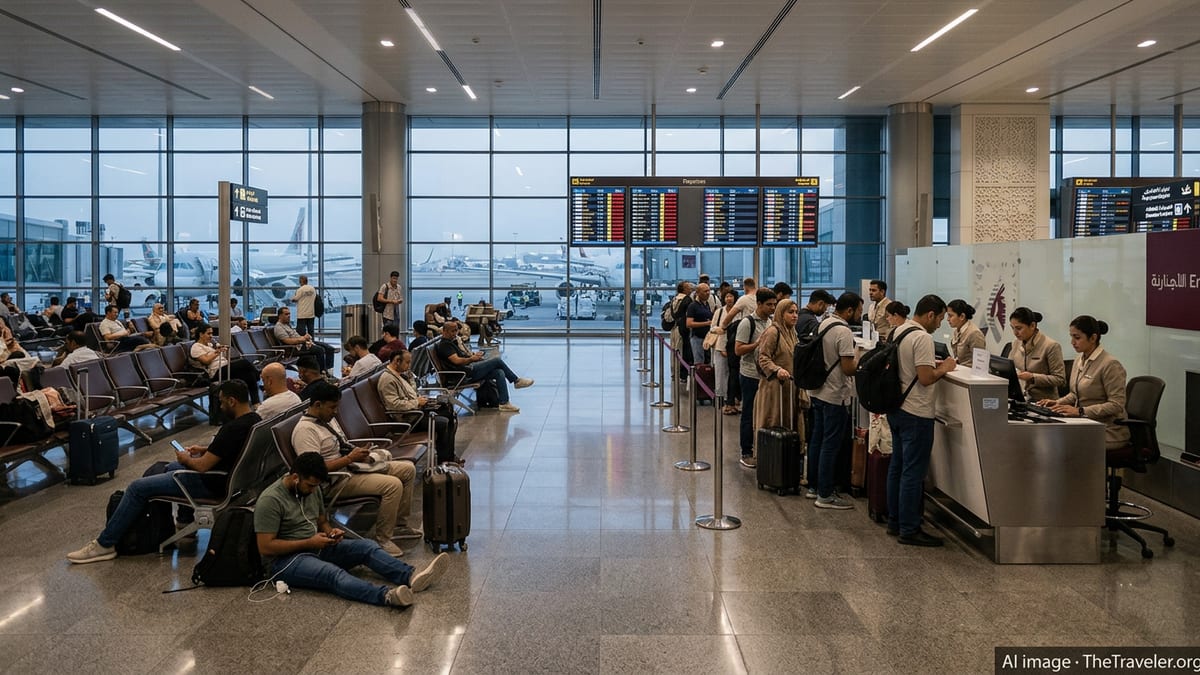
Scenes described in publicly shared photos and traveler accounts from today depict crowded terminal halls, long queues at airline service desks and passengers attempting to rebook via mobile apps as flights disappear from departure boards. With multiple countries enforcing overlapping restrictions, many travelers find that seemingly viable alternative routings also traverse closed or heavily congested airspace.
Rebooking challenges are especially acute for those with complex itineraries involving several carriers or separate tickets. When a key segment through Doha, Riyadh or another Gulf hub is canceled, entire trip chains can unravel, forcing passengers to negotiate with multiple airlines for new routings, refunds or travel credits. According to widely shared airline advisories, many carriers are temporarily waiving change fees and allowing date or routing changes within defined windows, but seats on remaining flights remain limited.
Accommodation and visa issues add another layer of complexity. With some travelers stranded in transit cities such as London or Dublin, questions arise over short‑stay entry requirements, hotel availability and travel insurance coverage. Public guidance from consular services and aviation regulators generally encourages affected passengers to remain in close contact with their airline and to retain all documentation related to disrupted journeys, including boarding passes and receipts for out-of-pocket expenses.
Social media posts and consumer forums indicate that while some travelers have managed to secure alternative flights within a day or two, others face significantly longer waits, especially if they are trying to reach destinations that currently rely on suspended Middle East corridors. The situation remains fluid as airlines adjust capacity and seek clearance for additional routings.
What Travelers Should Expect in the Coming Days
Based on current public information and expert commentary, flight operations across Saudi Arabia, Bahrain, Qatar, Kuwait, Jordan and neighboring airspace are expected to remain volatile in the short term. Even if additional safe corridors are approved or partial reopenings occur, airlines may move cautiously, restoring schedules in phases to avoid further disruption and to align with operational and insurance constraints.
Travelers with upcoming journeys touching the Middle East, or routed between Europe, Asia and Oceania, are being advised by publicly available guidance to check flight status frequently and to confirm transit rules for any country that might serve as an alternative connection point. Where possible, flexible tickets and route options that avoid the most affected airspace may reduce the risk of last‑minute cancellations.
Industry observers also point out that aircraft and crew rotations are heavily out of sync after weeks of disruption, meaning that some cancellations in cities such as London, Dublin or Miami are the downstream effect of earlier events in the Gulf. This imbalance can take days or even weeks to fully resolve, even after core airspace issues ease.
For now, today’s figure of 651 cancellations and 172 delays across Middle Eastern routes underscores the scale of the challenge facing airlines and passengers alike. With regional conditions still unsettled, travelers planning to pass through Doha, Riyadh and other affected hubs in the coming days should prepare for continued uncertainty and allow extra time and flexibility in their plans.