

More news on this day
Thousands of travelers were left stranded on March 20 as a new wave of flight cancellations and delays rippled across the Middle East, disrupting services operated by Gulf Air, Emirates, Qatar Airways, KLM and other major carriers and snarling connections at airports from Dubai and Riyadh to London, Munich and New York.
Get the latest news straight to your inbox!
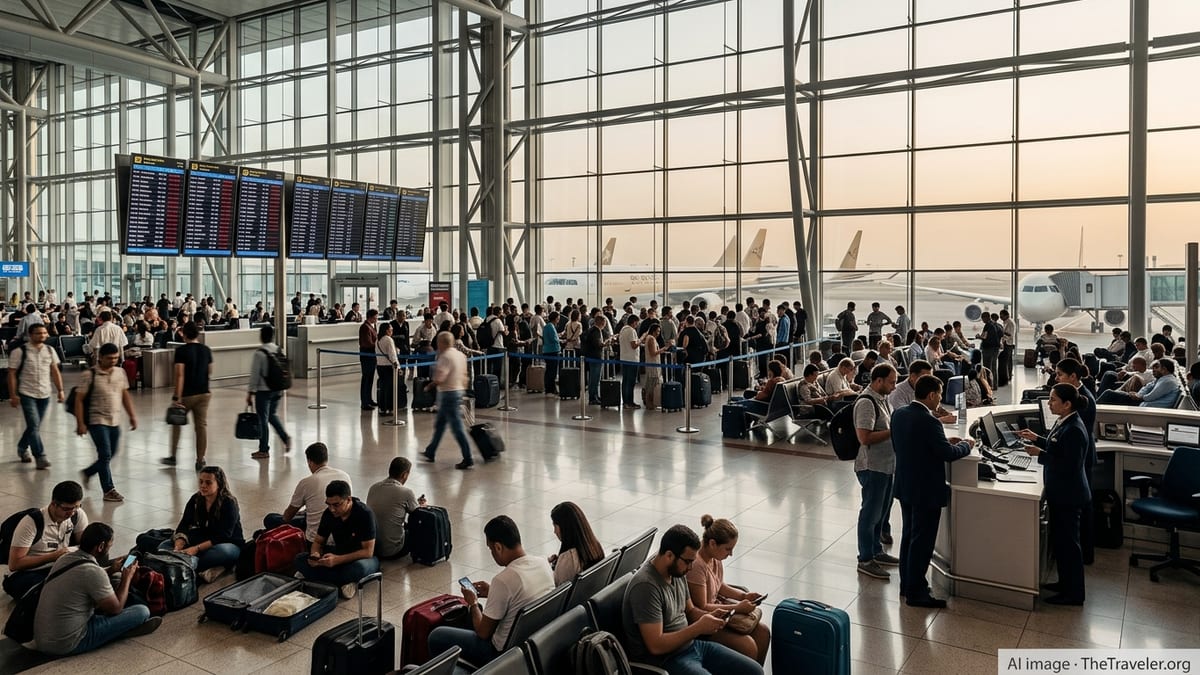
Regional Airspace Limits Trigger New Wave of Disruptions
Published updates on March 20 indicate that airspace restrictions and partial airport closures across several Gulf states, including Bahrain, Qatar, the United Arab Emirates, Kuwait and Oman, continue to constrain normal airline operations. While some corridors have reopened on a limited basis, multiple aviation notices and industry summaries describe a patchwork of closures and constrained routes that are still forcing airlines to trim schedules, consolidate services and divert aircraft away from traditional Gulf hubs.
Operational bulletins from logistics and aviation analysts this month describe Bahrain and Kuwait as effectively shut to regular commercial traffic for extended periods, with the UAE and Qatar operating under controlled or emergency conditions and Oman functioning as a key alternative gateway with reduced but ongoing capacity. These conditions have contributed to a rolling pattern of cancellations and delays, rather than a single, isolated shutdown, leaving passengers vulnerable to sudden last minute changes even when flights initially appear to be operating as scheduled.
Against this backdrop, regional and international media coverage points to at least 215 flights canceled and more than 100 delayed across the Gulf and beyond over the latest 24 hour cycle, as carriers adjust to changing airspace permissions and congestion at the few airports still handling near normal volumes. The numbers represent only a fraction of the thousands of flights disrupted across the wider Middle East since the start of the current crisis, but they underline that routine long haul connectivity through Gulf hubs remains fragile.
Major Carriers Scale Back as Hubs Struggle to Cope
Flag carriers from the region and Europe have been forced into repeated schedule rewrites in response to the constraints. Public schedules and airline updates show Gulf Air reducing or suspending services that rely on Bahrain as a transfer point, while Emirates and Qatar Airways have alternated between near total shutdowns and limited repatriation style operations, focusing on a smaller number of long haul destinations.
European and transatlantic operators have also been drawn into the disruption. KLM, along with other major European airlines, has rerouted or suspended flights that normally rely on overflying or connecting through the Gulf, consolidating passengers on fewer services and in some cases bypassing congested hubs entirely. These changes have had knock on effects at airports such as London Heathrow, Munich and New York, where arriving and departing flights linked to the Middle East remain subject to lengthy delays, rolling cancellations and reroutings.
At Dubai International Airport, one of the world’s busiest long haul hubs, publicly available flight boards in recent days have shown waves of departures and arrivals labeled as canceled, delayed or “rescheduled,” reflecting repeated attempt by airlines to rebuild skeleton schedules on short notice. Riyadh and other Saudi gateways, which have kept more capacity open, have absorbed diverted services and additional passenger loads, but this has shifted rather than eliminated congestion, creating new pressure points for travelers trying to leave or transit the region.
Stranded Travelers Turn to Secondary Gateways
With core Gulf hubs under pressure, passengers have increasingly been directed toward alternative routes through airports in Saudi Arabia and Oman. Industry updates this month highlight Muscat and Dammam as important relief valves, with some airlines arranging special services from these cities to key long haul destinations such as London, Mumbai and Bangkok to move stranded travelers who can no longer connect via Bahrain, Doha or Dubai.
For many affected passengers, however, reaching these secondary gateways has proved challenging. Reports from traveler forums describe individuals and families undertaking long overland journeys between Gulf states in order to access a functioning airport, often at short notice and with limited information about whether onward flights will ultimately depart. In some cases, travelers have needed to secure new visas or meet additional entry requirements simply to position themselves for a possible departure from a different country.
The reliance on secondary hubs has also shifted congestion rather than removed it. Muscat, which has maintained near normal operations compared with its neighbors, has faced surging demand for a limited number of seats, while Dammam and other Saudi airports have had to accommodate additional flights layered on top of existing schedules. This dynamic has contributed to a pattern where seats can become available suddenly as airlines add capacity, only to disappear quickly as stranded travelers compete for any route out of the region.
Global Ripple Effects Reach Europe and North America
The Gulf’s role as a crossroads between Europe, Asia, Africa and the Americas means that disruptions in Bahrain, Qatar, the UAE, Kuwait and Oman have quickly spilled over into airports far from the Middle East. Flight status pages for London, Munich and New York have reflected a mix of outright cancellations, heavily delayed arrivals and aircraft arriving out of sequence, complicating crew scheduling and stand allocation for airport operators.
Travel industry commentary notes that some long haul services linking Europe and North America to Asia have been rerouted via southern corridors over Saudi Arabia, Egypt and the eastern Mediterranean in an attempt to avoid the most congested or restricted segments of Gulf airspace. These detours add flight time and fuel burn, increasing the risk of missed connections even when flights depart broadly on schedule.
For passengers holding through tickets, airlines have in many cases offered waivers allowing rebooking or refunds, particularly where itineraries touch closed or partially closed airports. However, the combination of constrained capacity, longer routings and continuing day to day uncertainty over airspace permissions means that replacement options can be limited, especially for those needing to travel on specific dates.
Uncertain Outlook for Return to Normal Schedules
Despite some signs of gradual reopening, publicly available airline timetables and operational updates suggest that a full restoration of pre crisis schedules in the Gulf remains some distance away. Several major carriers have announced only phased resumptions on selected routes, with reduced frequencies and aircraft changes that prioritize high demand corridors over secondary destinations.
Analysts following the situation caution that even once formal airspace restrictions ease, airlines may take time to bring aircraft, crews and maintenance cycles fully back into alignment, prolonging the period of irregular operations. The cumulative effect of days of cancellations and rolling delays has left large backlogs of passengers waiting for seats, further complicating efforts to return to normal.
For now, travelers with itineraries touching Bahrain, Qatar, the UAE, Kuwait, Oman or neighboring states are being urged by travel agencies and industry commentators to monitor flight status closely, maintain flexible plans where possible and consider routings that avoid the most affected hubs. With hundreds of flights still being canceled or delayed on a daily basis, the Middle East’s role as a global aviation crossroads remains under unusual strain, and those passing through it should be prepared for continued disruption.